- 01Access and Mobility Management FunctionAMF
- 02Unified Data ManagementUDM
- 03Policy Control FunctionPCF
- 04Network Repository FunctionNRF
- 05Non-3GPP Interworking FunctionN3IWF
- 06Security Edge Protection ProxySEPP
- 07Network Slice Selection FunctionNSSF
- 08Service Communication ProxySCP
- 09Application FunctionAF
- 10Location Management FunctionLMF
- 11Cell Broadcast CentreCBCF
- 12Gateway Mobile Location CentreGMLC
- 13Session Management FunctionSMF
- 14User Plane FunctionUPF
- 15SMS FunctionSMSF
- 16Equipment Identity RegisterEIR
Applications know what they need from the network; the core knows how to deliver it. The AF 5G connects the two with one simple API.
A 5G core can guarantee a bit rate for a video session, steer a factory's traffic to a local edge site, charge a partner's traffic to the partner, or report when a sensor comes back online. In IMS, the P-CSCF already uses this to give every voice call its QoS. For other applications, the procedures are 3GPP interfaces they do not speak.
Exposing the policy function or the NEF directly to applications brings its own issues: identifying each application, limiting what it may ask for, cleaning up when it disappears. Without an intermediary, every integration becomes a project.

One API for applications
Applications call a simple REST API with OAuth2 credentials: QoS on demand for a flow of a subscriber, sponsored data, traffic steering to an edge site, event subscriptions, background data transfer. Each application has its rights, quotas and validity periods.
Translated into 3GPP procedures
Inside the operator network, the AF 5G is a trusted application function: it requests the policy directly from the PCF over N5, or from the PCRF over Rx for 4G sessions. For third-party exposure, it goes through the NEF over N33, which applies the operator's exposure policy.
Follow the session
The requested QoS or steering lives with the session: it is removed when the application ends it, when its validity expires or when the subscriber's session ends. Events of the core — bearer loss, QoS not granted, mobility — are sent back to the application.
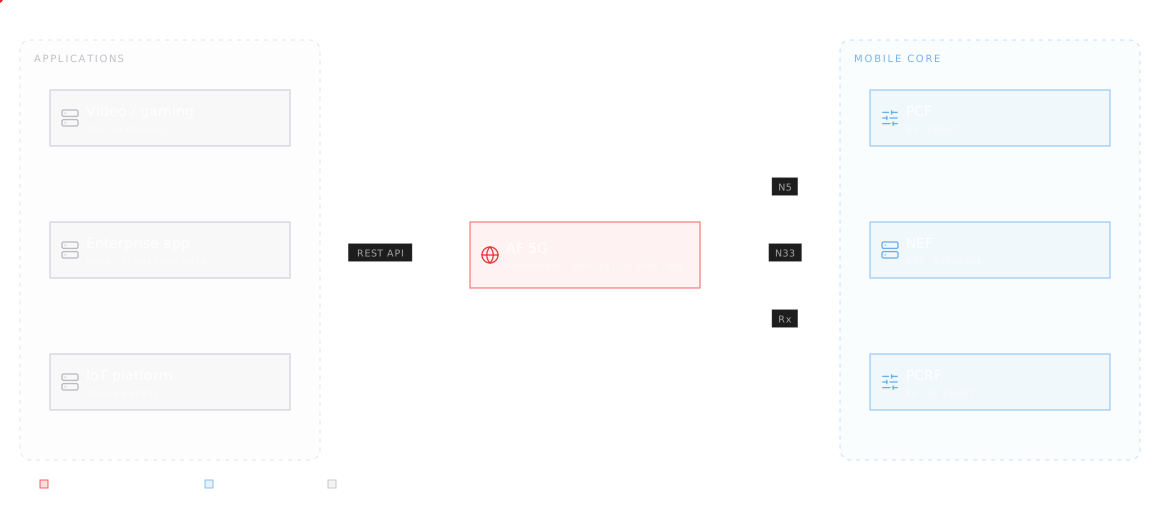
AF 5G — applications talking to the mobile core
QoS on demand, sponsored data, edge computing, IoT, enterprise services — one API.
QoS on demand
Video streaming, cloud gaming, telemedicine and live broadcast ask for a guaranteed or prioritised bit rate for the duration of a session.
Sponsored data
A partner's application traffic is charged to the partner instead of the subscriber, for zero-rating offers.
Edge computing
The traffic of an application is steered to a local UPF and data network, close to its edge servers.
IoT events
IoT platforms are notified when devices become reachable, change location or lose connectivity.
Enterprise services
On private or public 5G networks, enterprises request the network behaviour their applications need through one API.

We've selected Ouroboros because it was the best company capable of fulfilling our need for a scalable and virtualised full MVNO platform. Moreover, the Ouroboros team is pragmatic, flexible and responsive.
Pascal Prot
CEO-CTO · Legos
Simple northbound API
REST and JSON, with OAuth2 authentication. No 3GPP knowledge needed on the application side.
Rights and quotas per application
Each application is limited to the services, subscribers and volumes it is entitled to.
4G and 5G
Rx toward the PCRF and N5 toward the PCF, behind the same API.
Direct or through the NEF
Trusted AF toward the PCF for the operator's own services, NEF exposure for third parties.
Session-bound requests
QoS and steering are removed with the session, the application or the end of their validity.
Notifications to the application
Bearer loss, QoS not granted, mobility and reachability events are forwarded to the application.
Supervision
Counters per application and per service, SNMP traps and Prometheus metrics.
IPv4, IPv6 and dual-stack
Every interface runs over IPv4, IPv6 or both. The element fits an IPv6 core or a mixed network without a separate configuration.
The AF 5G comes from the same platform as the PCRF / PCF, SMF and UPF that apply its requests, tested together in the Ouroboros TechLab. The policy rules it asks for are the ones these functions already enforce, in 4G and 5G. It also works with third-party policy functions and NEFs over the standard interfaces.

Tell us the applications and partners you want to serve and the network behaviour they need. We'll propose an AF 5G configuration to match, on OPEX or CAPEX.
 Product datasheet
5G Standalone · 5G Standalone
Application Function (AF 5G)
Applications know what they need from the network; the core knows how to deliver it. The AF 5G connects the two with one simple API.
In production since 2004 · 148M+ subscribers · 99.999% availability
The network can do more than applications can ask for
A 5G core can guarantee a bit rate for a video session, steer a factory's traffic to a local edge site, charge a partner's traffic to the partner, or report when a sensor comes back online. In IMS, the P-CSCF already uses this to give every voice call its QoS. For other applications, the procedures are 3GPP interfaces they do not speak.
Exposing the policy function or the NEF directly to applications brings its own issues: identifying each application, limiting what it may ask for, cleaning up when it disappears. Without an intermediary, every integration becomes a project.
Ask in REST, served in 3GPP.
One API for applications
Applications call a simple REST API with OAuth2 credentials: QoS on demand for a flow of a subscriber, sponsored data, traffic steering to an edge site, event subscriptions, background data transfer. Each application has its rights, quotas and validity periods.
Translated into 3GPP procedures
Inside the operator network, the AF 5G is a trusted application function: it requests the policy directly from the PCF over N5, or from the PCRF over Rx for 4G sessions. For third-party exposure, it goes through the NEF over N33, which applies the operator's exposure policy.
Follow the session
The requested QoS or steering lives with the session: it is removed when the application ends it, when its validity expires or when the subscriber's session ends. Events of the core — bearer loss, QoS not granted, mobility — are sent back to the application.
AF 5G — applications talking to the mobile core
How operators use it.
QoS on demand, sponsored data, edge computing, IoT, enterprise services — one API.
QoS on demand
Video streaming, cloud gaming, telemedicine and live broadcast ask for a guaranteed or prioritised bit rate for the duration of a session.
Sponsored data
A partner's application traffic is charged to the partner instead of the subscriber, for zero-rating offers.
Edge computing
The traffic of an application is steered to a local UPF and data network, close to its edge servers.
IoT events
IoT platforms are notified when devices become reachable, change location or lose connectivity.
Enterprise services
On private or public 5G networks, enterprises request the network behaviour their applications need through one API.
Specifications.
Inside the platform.
Simple northbound API
REST and JSON, with OAuth2 authentication. No 3GPP knowledge needed on the application side.
Rights and quotas per application
Each application is limited to the services, subscribers and volumes it is entitled to.
4G and 5G
Rx toward the PCRF and N5 toward the PCF, behind the same API.
Direct or through the NEF
Trusted AF toward the PCF for the operator's own services, NEF exposure for third parties.
Session-bound requests
QoS and steering are removed with the session, the application or the end of their validity.
Notifications to the application
Bearer loss, QoS not granted, mobility and reachability events are forwarded to the application.
Supervision
Counters per application and per service, SNMP traps and Prometheus metrics.
IPv4, IPv6 and dual-stack
Every interface runs over IPv4, IPv6 or both. The element fits an IPv6 core or a mixed network without a separate configuration.
The AF 5G comes from the same platform as the PCRF / PCF, SMF and UPF that apply its requests, tested together in the Ouroboros TechLab. The policy rules it asks for are the ones these functions already enforce, in 4G and 5G. It also works with third-party policy functions and NEFs over the standard interfaces.
Policy Control Function (PCF)
The PCF turns the AF requests into policy rules for the SMF and UPF.
Policy and Charging Rules Function (PCRF)
The same requests on 4G sessions, over Rx.
IMS Core
The P-CSCF is the AF of voice calls.
Next step
Which applications need more from your network?
Tell us the applications and partners you want to serve and the network behaviour they need. We'll propose an AF 5G configuration to match, on OPEX or CAPEX.