- 01Access and Mobility Management FunctionAMF
- 02Unified Data ManagementUDM
- 03Policy Control FunctionPCF
- 04Network Repository FunctionNRF
- 05Non-3GPP Interworking FunctionN3IWF
- 06Security Edge Protection ProxySEPP
- 07Network Slice Selection FunctionNSSF
- 08Service Communication ProxySCP
- 09Application FunctionAF
- 10Location Management FunctionLMF
- 11Cell Broadcast CentreCBCF
- 12Gateway Mobile Location CentreGMLC
- 13Session Management FunctionSMF
- 14User Plane FunctionUPF
- 15SMS FunctionSMSF
- 16Equipment Identity RegisterEIR
Every PDU session on a 5G Standalone network is set up, modified, and torn down by the SMF. It allocates IP addresses, selects the UPF, applies policy from the PCF and opens charging with the CHF. In a 4G core, this work sat inside the PGW. In 5G SA, it splits into a control plane and a data plane joined over N4 — and the Ouroboros SMF still serves the 4G network as PGW-C, so sessions move between 4G and 5G without changing anchor.
In a 4G core, session management lives inside the PGW: one element handles both the control decisions and the data forwarding. 5G Standalone separates them. The control plane becomes the SMF. The data plane becomes the UPF. They are different network functions, connected over N4.
Operators moving from LTE to 5G SA face that split as a procurement question. A packet core that cannot decompose into SMF and UPF means a full replacement at 5G launch: a new vendor, a new integration, and another migration event at the point when engineering teams are already committed to the 5G rollout.

AMF passes the request — SMF creates the session
When a 5G device establishes a data session, the AMF passes the request to the SMF over N11. The SMF creates the PDU session, allocates the IP address, selects a UPF to carry the traffic, and programs that UPF over N4 using PFCP. It registers the session and retrieves the subscription from the UDM over N10, the policy rules from the PCF over N7, and opens a converged charging session with the CHF over N40. For the duration of the session, the SMF is the control point: it creates, modifies and removes QoS flows from the PCF rules, follows N2 handovers and Xn path switches, deactivates the user plane and pages idle devices, and releases the session at the request of the device, the AMF or the PCF, or when the credit granted by the CHF is exhausted.
Gateway continuity: PGW-C becomes the SMF
The Ouroboros SMF is the control-plane half of the gateway that already runs as GGSN for 2G/3G and PDN-GW for LTE. Operators moving to 5G SA extend that platform into the SMF/UPF split rather than procuring a separate 5G data core. The session logic, the charging integration, and the policy interfaces carry forward. The SMF is also the PGW-C (and SGW-C) of the Ouroboros MME: a combined SMF + PGW-C anchor keeps the session and its IP address when the device moves between 4G and 5G over N26, in idle mode and in handover, both ways.
Charging, slicing, and QoS in one control point
Usage reports of the UPF per rating group feed converged charging over N40. DNN configurations are selected per slice (S-NSSAI) from the UDM, so traffic for different network slices is mapped to the appropriate UPF and policy set. With the DPI option, the application rules of the PCF are applied by the UPF to block or charge each application.
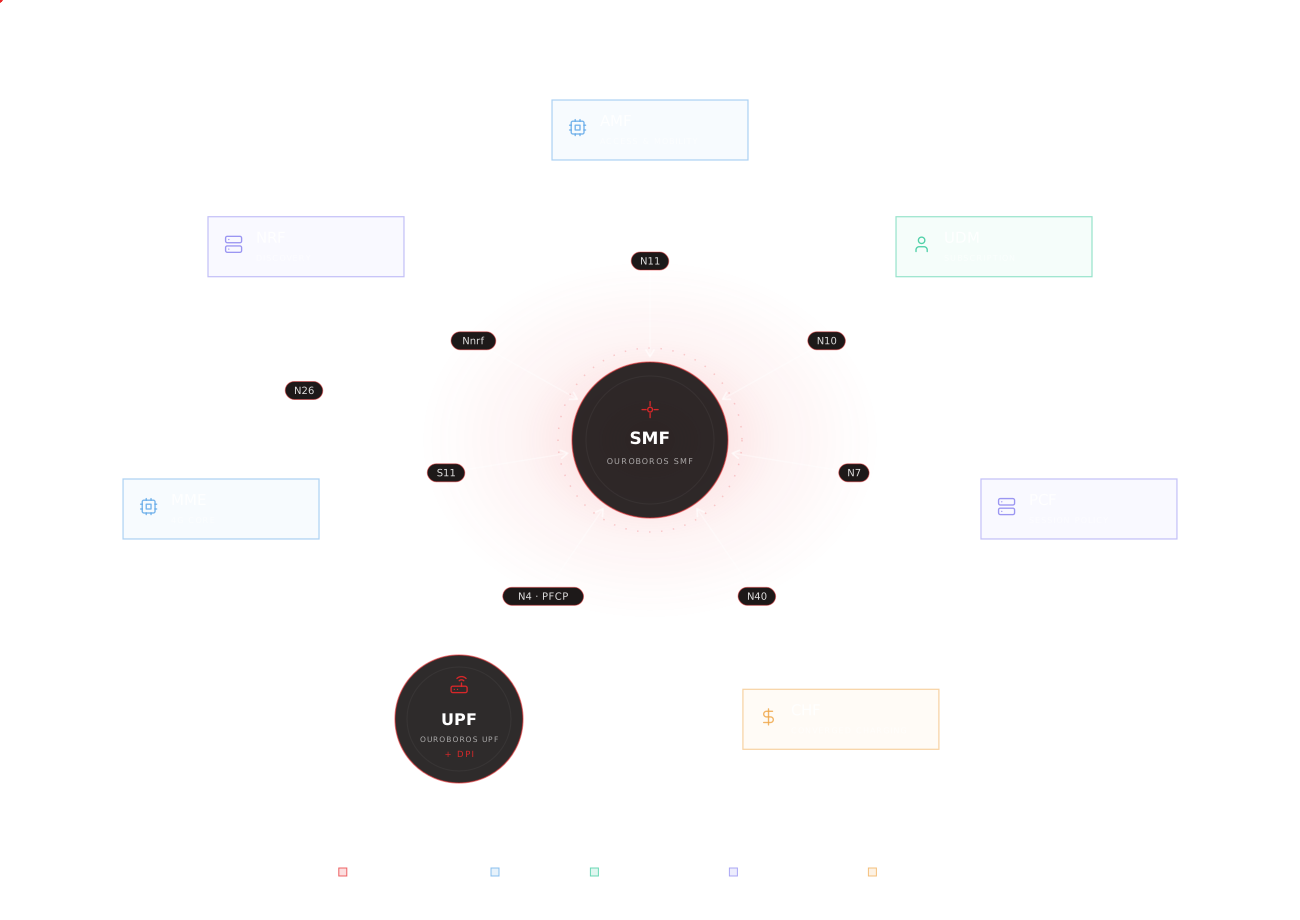
SMF — 5G session control and the combined 4G/5G anchor
5G SA migration, greenfield launch, network slicing, private networks — one session control plane.
LTE-to-5G SA migration on the existing gateway
An operator running the Ouroboros PDN-GW for LTE turns up the SMF/UPF split at 5G launch, with session control handled by the SMF and no separate 5G packet core to procure.
5G Standalone greenfield
An operator with new 5G spectrum deploys the SMF alongside the UPF and the 5G core to manage PDU sessions from first attach. Session management, IP allocation, and UPF control run from one platform.
Network slicing
The SMF maps PDU sessions to the correct UPF and policy profile per slice. An operator offering differentiated slices for enterprise, IoT, or consumer traffic controls session placement at the SMF.
4G/5G mobility without re-attach
Subscribers moving between 5G islands and LTE coverage keep their session and IP address: the SMF anchors both sides as SMF and PGW-C, with N26 interworking toward the Ouroboros MME.
Private 5G networks
A campus, industrial, or utility private 5G network runs the SMF on local infrastructure to manage on-site sessions, with UPF placement controlled for low-latency local breakout.

We've selected Ouroboros because it was the best company capable of fulfilling our need for a scalable and virtualised full MVNO platform. Moreover, the Ouroboros team is pragmatic, flexible and responsive.
Pascal Prot
CEO-CTO · Legos
Control-plane continuity from PGW to SMF
The same platform that runs GGSN and PDN-GW provides the SMF control plane in 5G SA. Operators extend the gateway into 5G rather than replacing it. The session logic carries forward.
N4 control of the UPF
The SMF programs forwarding, QoS, and charging rules on the UPF over PFCP. Control and data planes scale independently. Add UPF capacity at the edge without touching the control plane.
Per-slice session management
PDU sessions map to the correct UPF and policy profile for their network slice. Enterprise, IoT, and consumer slices run with isolated session handling on one SMF.
Policy integration over N7
The SMF applies PCF policy decisions per session at setup and on modification. The same policy platform serving LTE extends to 5G SA without a separate policy stack.
Dual-stack IP allocation
IPv4, IPv6, and dual-stack address assignment per PDU session. Operators running IPv6 or mixed addressing need no separate configuration path.
Converged charging over N40
Usage per rating group reports to the converged charging function, and the session is released when the granted credit is exhausted. 5G sessions bill through the same charging path as earlier generations.
Combined 4G/5G anchor
The SMF is also PGW-C and SGW-C for the Ouroboros MME. Sessions move over N26 between 4G and 5G without a change of anchor or IP address.
Application detection (DPI option)
Applications recognised by the UPF are blocked or charged on their own rating group, following the rules of the PCF.
The SMF is one half of a split that only matters if the operator is moving a real network to 5G SA. Ouroboros has carried that network through 2G, 3G, and 4G already. The gateway that runs as GGSN and PDN-GW becomes the SMF and UPF in 5G SA, so the move is an extension of a known platform, not a new vendor relationship at the riskiest point in the rollout.
The platform is carrier-grade and in production since 2004. The same deployment flexibility applies: bare metal, VMware, KVM, Docker, Kubernetes, or public cloud.
OPEX rental is available, so 5G control-plane capacity can be added as the network turns up rather than committed ahead of subscriber demand.

What PGW are you running, and when does 5G SA land on the roadmap? We'll confirm how the platform extends into the SMF/UPF split and what the migration sequence looks like.
 Product datasheet
5G Standalone · 5G Standalone
Session Management Function (SMF)
Every PDU session on a 5G Standalone network is set up, modified, and torn down by the SMF. It allocates IP addresses, selects the UPF, applies policy from the PCF and opens charging with the CHF. In a 4G core, this work sat inside the PGW. In 5G SA, it splits into a control plane and a data plane joined over N4 — and the Ouroboros SMF still serves the 4G network as PGW-C, so sessions move between 4G and 5G without changing anchor.
In production since 2004 · 148M+ subscribers · 99.999% availability
The control plane that splits off at 5G
In a 4G core, session management lives inside the PGW: one element handles both the control decisions and the data forwarding. 5G Standalone separates them. The control plane becomes the SMF. The data plane becomes the UPF. They are different network functions, connected over N4.
Operators moving from LTE to 5G SA face that split as a procurement question. A packet core that cannot decompose into SMF and UPF means a full replacement at 5G launch: a new vendor, a new integration, and another migration event at the point when engineering teams are already committed to the 5G rollout.
From AMF request to live 5G data session.
AMF passes the request — SMF creates the session
When a 5G device establishes a data session, the AMF passes the request to the SMF over N11. The SMF creates the PDU session, allocates the IP address, selects a UPF to carry the traffic, and programs that UPF over N4 using PFCP. It registers the session and retrieves the subscription from the UDM over N10, the policy rules from the PCF over N7, and opens a converged charging session with the CHF over N40. For the duration of the session, the SMF is the control point: it creates, modifies and removes QoS flows from the PCF rules, follows N2 handovers and Xn path switches, deactivates the user plane and pages idle devices, and releases the session at the request of the device, the AMF or the PCF, or when the credit granted by the CHF is exhausted.
Gateway continuity: PGW-C becomes the SMF
The Ouroboros SMF is the control-plane half of the gateway that already runs as GGSN for 2G/3G and PDN-GW for LTE. Operators moving to 5G SA extend that platform into the SMF/UPF split rather than procuring a separate 5G data core. The session logic, the charging integration, and the policy interfaces carry forward. The SMF is also the PGW-C (and SGW-C) of the Ouroboros MME: a combined SMF + PGW-C anchor keeps the session and its IP address when the device moves between 4G and 5G over N26, in idle mode and in handover, both ways.
Charging, slicing, and QoS in one control point
Usage reports of the UPF per rating group feed converged charging over N40. DNN configurations are selected per slice (S-NSSAI) from the UDM, so traffic for different network slices is mapped to the appropriate UPF and policy set. With the DPI option, the application rules of the PCF are applied by the UPF to block or charge each application.
SMF — 5G session control and the combined 4G/5G anchor
How operators use it.
5G SA migration, greenfield launch, network slicing, private networks — one session control plane.
LTE-to-5G SA migration on the existing gateway
An operator running the Ouroboros PDN-GW for LTE turns up the SMF/UPF split at 5G launch, with session control handled by the SMF and no separate 5G packet core to procure.
5G Standalone greenfield
An operator with new 5G spectrum deploys the SMF alongside the UPF and the 5G core to manage PDU sessions from first attach. Session management, IP allocation, and UPF control run from one platform.
Network slicing
The SMF maps PDU sessions to the correct UPF and policy profile per slice. An operator offering differentiated slices for enterprise, IoT, or consumer traffic controls session placement at the SMF.
4G/5G mobility without re-attach
Subscribers moving between 5G islands and LTE coverage keep their session and IP address: the SMF anchors both sides as SMF and PGW-C, with N26 interworking toward the Ouroboros MME.
Private 5G networks
A campus, industrial, or utility private 5G network runs the SMF on local infrastructure to manage on-site sessions, with UPF placement controlled for low-latency local breakout.
Specifications.
Inside the platform.
Control-plane continuity from PGW to SMF
The same platform that runs GGSN and PDN-GW provides the SMF control plane in 5G SA. Operators extend the gateway into 5G rather than replacing it. The session logic carries forward.
N4 control of the UPF
The SMF programs forwarding, QoS, and charging rules on the UPF over PFCP. Control and data planes scale independently. Add UPF capacity at the edge without touching the control plane.
Per-slice session management
PDU sessions map to the correct UPF and policy profile for their network slice. Enterprise, IoT, and consumer slices run with isolated session handling on one SMF.
Policy integration over N7
The SMF applies PCF policy decisions per session at setup and on modification. The same policy platform serving LTE extends to 5G SA without a separate policy stack.
Dual-stack IP allocation
IPv4, IPv6, and dual-stack address assignment per PDU session. Operators running IPv6 or mixed addressing need no separate configuration path.
Converged charging over N40
Usage per rating group reports to the converged charging function, and the session is released when the granted credit is exhausted. 5G sessions bill through the same charging path as earlier generations.
Combined 4G/5G anchor
The SMF is also PGW-C and SGW-C for the Ouroboros MME. Sessions move over N26 between 4G and 5G without a change of anchor or IP address.
Application detection (DPI option)
Applications recognised by the UPF are blocked or charged on their own rating group, following the rules of the PCF.
The SMF is one half of a split that only matters if the operator is moving a real network to 5G SA. Ouroboros has carried that network through 2G, 3G, and 4G already. The gateway that runs as GGSN and PDN-GW becomes the SMF and UPF in 5G SA, so the move is an extension of a known platform, not a new vendor relationship at the riskiest point in the rollout.
The platform is carrier-grade and in production since 2004. The same deployment flexibility applies: bare metal, VMware, KVM, Docker, Kubernetes, or public cloud.
OPEX rental is available, so 5G control-plane capacity can be added as the network turns up rather than committed ahead of subscriber demand.
User Plane Function (UPF)
The SMF controls the UPF over N4. The two form the 5G SA data core: SMF in the control plane, UPF in the data plane.
PDN-GW
The LTE PGW is the predecessor of the SMF/UPF split. Operators running the Ouroboros PDN-GW extend the same platform into 5G SA.
PCF
Issues the session policy to the SMF over N7, on the same element as the PCRF.
CHF
Converged charging of the PDU sessions over N40.
AMF
Relays the PDU session requests to the SMF over N11.
Next step
Planning 5G SA on top of an existing LTE packet core?
What PGW are you running, and when does 5G SA land on the roadmap? We'll confirm how the platform extends into the SMF/UPF split and what the migration sequence looks like.