- 01Access and Mobility Management FunctionAMF
- 02Unified Data ManagementUDM
- 03Policy Control FunctionPCF
- 04Network Repository FunctionNRF
- 05Non-3GPP Interworking FunctionN3IWF
- 06Security Edge Protection ProxySEPP
- 07Network Slice Selection FunctionNSSF
- 08Service Communication ProxySCP
- 09Application FunctionAF
- 10Location Management FunctionLMF
- 11Cell Broadcast CentreCBCF
- 12Gateway Mobile Location CentreGMLC
- 13Session Management FunctionSMF
- 14User Plane FunctionUPF
- 15SMS FunctionSMSF
- 16Equipment Identity RegisterEIR
Your 5G core needs subscriber data on day one. Your subscribers are already provisioned for 2G, 3G, 4G and IMS. The Ouroboros UDM serves 5G from that same record, with the AUSF built in.
Most 5G cores arrive with their own UDM and their own data repository. The operator already runs an HLR for 2G and 3G, an HSS for LTE and IMS, an EIR for devices. Add 5G SA and the subscriber now lives in yet another database, with yet another provisioning flow and another synchronisation job to keep it aligned.
The cost shows up on the subscriber's first 5G attach. If the 5G record is missing or out of date, the device falls back to 4G or fails to register. Every plan change, every new SIM, every barring has to reach one more system. The gap between the databases becomes an operational cost that grows with the subscriber base.

Subscriber data for the 5G core
The UDM is the subscriber data function of the 5G core. When a device registers, the AMF asks the AUSF to authenticate it, and the AUSF fetches the authentication vectors from the UDM. The UDM then registers the serving AMF, gives it the access and mobility data and the allowed network slices, and later serves the SMF with the session data per slice and DNN, and the SMSF with the SMS subscription.
The same UDR as the HLR, HSS and EIR
The Ouroboros UDM reads and writes the same Unified Data Repository (UDR) as the Ouroboros HLR, HSS and EIR. A subscriber provisioned once is visible to 2G and 3G over MAP, to 4G and IMS over Diameter, and to 5G SA over the Service Based Interface. The authentication sequence number is shared across generations, so a SIM can move between 3G, 4G and 5G without resynchronisation.
AUSF, IMS and event exposure
The AUSF runs in the same element. It runs 5G AKA with the AMF, deconceals the SUCI (null scheme, ECIES profiles A and B, home network keys per operator) and returns the anchor key and the SUPI. For a 5G IMS core, the UDM also serves the I-CSCF and S-CSCF with IMS authentication, registration and profile, from the same data the HSS uses on Cx. Data changes are notified to the subscribed network functions, and event exposure and UE reachability are available to the NEF.
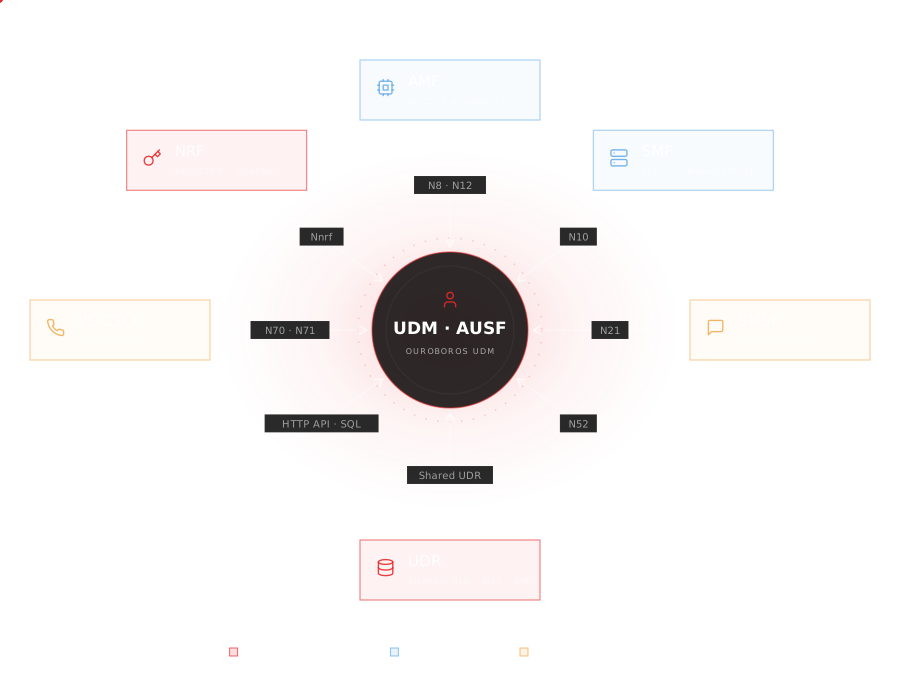
UDM · AUSF — 5G subscriber data on the shared UDR
5G on the existing base, MVNOs, session continuity, SMS and IMS voice — one subscriber record.
5G SA launch on an existing subscriber base
An operator already running the Ouroboros HLR and HSS turns on 5G SA without migrating a single subscriber. The UDM reads the existing records. Network slices and 5G DNN configurations are added per service profile.
MVNO or multi-licence operator
Several SUPI / GPSI ranges and MCC / MNC live on one instance. SUCI home network keys and OP keys are set per operator or MVNO, so each brand keeps its own security material on shared infrastructure.
Session continuity across generations
The UDM registers the serving AMF, SMF and SMSF. When a device moves between 4G and 5G, the session anchor stays known and the previous AMF is told to release its context.
SMS delivery in 5G
The SMSC asks the UDM where to deliver a message. The UDM answers with the SMSF registered for the subscriber, so SMS reaches 5G devices without a 2G or 4G fallback.
IMS voice on a 5G core
The I-CSCF and S-CSCF authenticate and register IMS users against the UDM. The IMS profile (initial filter criteria, charging information) is the one already provisioned for VoLTE.

We've selected Ouroboros because it was the best company capable of fulfilling our need for a scalable and virtualised full MVNO platform. Moreover, the Ouroboros team is pragmatic, flexible and responsive.
Pascal Prot
CEO-CTO · Legos
Shared UDR with HLR, HSS and EIR
One data repository serves 2G MAP, 4G Diameter and 5G SBI requests. Provision a subscriber once. Every generation sees the same record immediately, with no sync layer to build or debug.
AUSF built in
5G AKA, key derivation and SUCI deconcealment run in the same element as the UDM. One fewer network function to deploy, license and monitor.
Sequence numbers shared across generations
3G, 4G and 5G authentication use the same SIM sequence counter. Devices move between generations without authentication failures or resynchronisation storms.
Subscriptions stored in the UDR
Data change and event subscriptions are kept in the repository, not in memory. Several UDM instances share them, and they survive a restart.
Multi-tenant security keys
Home network keys and OP keys are configured per operator or MVNO. Brands share infrastructure without sharing secrets.
IMS services from the same record
The Nhss IMS services expose the IMS identities and profile already used by the HSS. VoNR and VoLTE subscribers are managed as one population.
Secured Service Based Interface
TLS with X.509 certificates issued by the operator CA, and optional OAuth2 tokens from the NRF. Only authorised network functions read subscriber data.
IPv4, IPv6 and dual-stack
Every interface runs over IPv4, IPv6 or both. The element fits an IPv6 core or a mixed network without a separate configuration.
The expensive part of a 5G core is not the UDM itself. It is one more subscriber database to keep in step with the HLR and HSS. The Ouroboros UDM removes that database: 5G is one more view of the subscriber record the operator already owns, provisioned through the same HTTP command API and SQL interface.
UDM and AUSF ship as one element, beside the HLR and HSS functions of the Registration center. Operators add 5G SA as a capability of what they already run, not as a parallel platform. The AMTP platform has been in production since 2004 and carries 148M+ subscribers.
OPEX rental is available. 5G data management grows with the 5G subscriber base, not ahead of it.

Tell us which HLR and HSS you run today and how many subscribers they hold. We'll show how the UDM serves 5G from the same records, and what the rollout looks like on your timeline.
 Product datasheet
5G Standalone · 5G Standalone
Unified Data Management (UDM)
Your 5G core needs subscriber data on day one. Your subscribers are already provisioned for 2G, 3G, 4G and IMS. The Ouroboros UDM serves 5G from that same record, with the AUSF built in.
In production since 2004 · 148M+ subscribers · 99.999% availability
A fourth subscriber database for a fifth generation
Most 5G cores arrive with their own UDM and their own data repository. The operator already runs an HLR for 2G and 3G, an HSS for LTE and IMS, an EIR for devices. Add 5G SA and the subscriber now lives in yet another database, with yet another provisioning flow and another synchronisation job to keep it aligned.
The cost shows up on the subscriber's first 5G attach. If the 5G record is missing or out of date, the device falls back to 4G or fails to register. Every plan change, every new SIM, every barring has to reach one more system. The gap between the databases becomes an operational cost that grows with the subscriber base.
One subscriber record, served to the 5G core.
Subscriber data for the 5G core
The UDM is the subscriber data function of the 5G core. When a device registers, the AMF asks the AUSF to authenticate it, and the AUSF fetches the authentication vectors from the UDM. The UDM then registers the serving AMF, gives it the access and mobility data and the allowed network slices, and later serves the SMF with the session data per slice and DNN, and the SMSF with the SMS subscription.
The same UDR as the HLR, HSS and EIR
The Ouroboros UDM reads and writes the same Unified Data Repository (UDR) as the Ouroboros HLR, HSS and EIR. A subscriber provisioned once is visible to 2G and 3G over MAP, to 4G and IMS over Diameter, and to 5G SA over the Service Based Interface. The authentication sequence number is shared across generations, so a SIM can move between 3G, 4G and 5G without resynchronisation.
AUSF, IMS and event exposure
The AUSF runs in the same element. It runs 5G AKA with the AMF, deconceals the SUCI (null scheme, ECIES profiles A and B, home network keys per operator) and returns the anchor key and the SUPI. For a 5G IMS core, the UDM also serves the I-CSCF and S-CSCF with IMS authentication, registration and profile, from the same data the HSS uses on Cx. Data changes are notified to the subscribed network functions, and event exposure and UE reachability are available to the NEF.
UDM · AUSF — 5G subscriber data on the shared UDR
How operators use it.
5G on the existing base, MVNOs, session continuity, SMS and IMS voice — one subscriber record.
5G SA launch on an existing subscriber base
An operator already running the Ouroboros HLR and HSS turns on 5G SA without migrating a single subscriber. The UDM reads the existing records. Network slices and 5G DNN configurations are added per service profile.
MVNO or multi-licence operator
Several SUPI / GPSI ranges and MCC / MNC live on one instance. SUCI home network keys and OP keys are set per operator or MVNO, so each brand keeps its own security material on shared infrastructure.
Session continuity across generations
The UDM registers the serving AMF, SMF and SMSF. When a device moves between 4G and 5G, the session anchor stays known and the previous AMF is told to release its context.
SMS delivery in 5G
The SMSC asks the UDM where to deliver a message. The UDM answers with the SMSF registered for the subscriber, so SMS reaches 5G devices without a 2G or 4G fallback.
IMS voice on a 5G core
The I-CSCF and S-CSCF authenticate and register IMS users against the UDM. The IMS profile (initial filter criteria, charging information) is the one already provisioned for VoLTE.
Specifications.
Inside the platform.
Shared UDR with HLR, HSS and EIR
One data repository serves 2G MAP, 4G Diameter and 5G SBI requests. Provision a subscriber once. Every generation sees the same record immediately, with no sync layer to build or debug.
AUSF built in
5G AKA, key derivation and SUCI deconcealment run in the same element as the UDM. One fewer network function to deploy, license and monitor.
Sequence numbers shared across generations
3G, 4G and 5G authentication use the same SIM sequence counter. Devices move between generations without authentication failures or resynchronisation storms.
Subscriptions stored in the UDR
Data change and event subscriptions are kept in the repository, not in memory. Several UDM instances share them, and they survive a restart.
Multi-tenant security keys
Home network keys and OP keys are configured per operator or MVNO. Brands share infrastructure without sharing secrets.
IMS services from the same record
The Nhss IMS services expose the IMS identities and profile already used by the HSS. VoNR and VoLTE subscribers are managed as one population.
Secured Service Based Interface
TLS with X.509 certificates issued by the operator CA, and optional OAuth2 tokens from the NRF. Only authorised network functions read subscriber data.
IPv4, IPv6 and dual-stack
Every interface runs over IPv4, IPv6 or both. The element fits an IPv6 core or a mixed network without a separate configuration.
The expensive part of a 5G core is not the UDM itself. It is one more subscriber database to keep in step with the HLR and HSS. The Ouroboros UDM removes that database: 5G is one more view of the subscriber record the operator already owns, provisioned through the same HTTP command API and SQL interface.
UDM and AUSF ship as one element, beside the HLR and HSS functions of the Registration center. Operators add 5G SA as a capability of what they already run, not as a parallel platform. The AMTP platform has been in production since 2004 and carries 148M+ subscribers.
OPEX rental is available. 5G data management grows with the 5G subscriber base, not ahead of it.
Home Subscriber Server (HSS)
The HSS serves 4G and IMS from the same UDR. Together with the UDM, one record covers LTE, IMS and 5G SA.
Home Location Register (HLR)
2G and 3G authentication and location on the shared repository, with the same sequence numbers.
Access and Mobility Management Function (AMF)
The AMF authenticates every 5G registration through the AUSF and reads the mobility data from the UDM.
Network Repository Function (NRF)
The UDM registers its services in the NRF, which issues the access tokens that protect them.
Next step
Planning 5G SA on top of your current subscriber base?
Tell us which HLR and HSS you run today and how many subscribers they hold. We'll show how the UDM serves 5G from the same records, and what the rollout looks like on your timeline.