- 01MSC / VLRMSC/VLR
- 02Gateway Mobile Switching CenterGMSC
- 03Gateway Mobile Location CentreGMLC
- 04Home Location RegisterHLR
- 05Messaging CenterSMSC
- 06Signaling Transfer PointSTP
- 07GGSN / SGSNGGSN
- 08S4-SGSNSGSN
- 09Equipment Identity RegisterEIR
- 10Service Control PointSCP
- 11USSD GatewayUSSD
- 12Cell Broadcast CentreCBC
Packet data for 2G and 3G today. Reconfigure as PDN-GW when the network moves to 4G. Same platform. No replacement procurement. No second integration project at upgrade.
Every mobile data session on a 2G or 3G network passes through the GGSN. Every LTE data session passes through the PDN Gateway. These are the same function at different generations — but most vendors sell them as separate products on separate contracts.
An operator running a 2G or 3G network today buys a GGSN. When that network upgrades to LTE, they buy a PDN-GW. Two procurement cycles, two integration projects, two support contracts, and a platform migration event that carries real operational risk — for a function the network has been running all along.

Every data session exits here
Every subscriber data session on a 2G or 3G network exits the packet core through the GGSN. It is the gateway to the internet, to enterprise VPNs, to any external IP network a subscriber reaches. When that operator adds LTE, the same function runs through the PDN Gateway. Operators who treat these as separate products absorb the cost of that separation twice.
GGSN today, PDN-GW at upgrade
The Ouroboros GGSN/PDN Gateway handles subscriber packet data for 2G and 3G networks and reconfigures as a PDN Gateway for 4G LTE when the network upgrades. No replacement. No second procurement. The same product also covers the S-GW, and the SMF and UPF of the 5G standalone core, with separated control and user planes (CUPS, PFCP). When the 2G/3G access moves to the Ouroboros S4-SGSN, 2G and 3G sessions run on the SGW and PGW of the EPC.
QoS per subscriber, APNs per device
IPv4, IPv6, and dual-stack are supported. QoS applies per individual subscriber — not per APN or service class — so data plan commitments are enforced at the subscriber level. Congestion control manages peak load without degrading the overall subscriber experience. Multiple simultaneous APNs run per device: internet, enterprise, and dedicated M2M connections on the same SIM concurrently.
Lean launch, charging later
The platform runs without PCRF, OCS, or OFCS for lean deployments. Charging and policy infrastructure can be added later as the network grows. Third-party OCS and PCRF connect via standard interfaces when ready. Billing and rating are modular and scale independently from the gateway function.
Virtualised, distributed, five nines
Fully virtualised and cloud-ready, with control and user planes on separate hosts. 99.999% availability via a distributed P-Gateway architecture. Each user plane server forwards up to 10 Gb/s, and additional nodes scale linearly.
Application-aware and interception-ready
With the Deep Packet Inspection option, the user plane recognises applications to block them or charge them on their own rating group, driven by the application rules of the PCRF. With the Lawful Interception option, session events and a copy of the traffic of the targets go to a certified mediation, for accredited operators only.
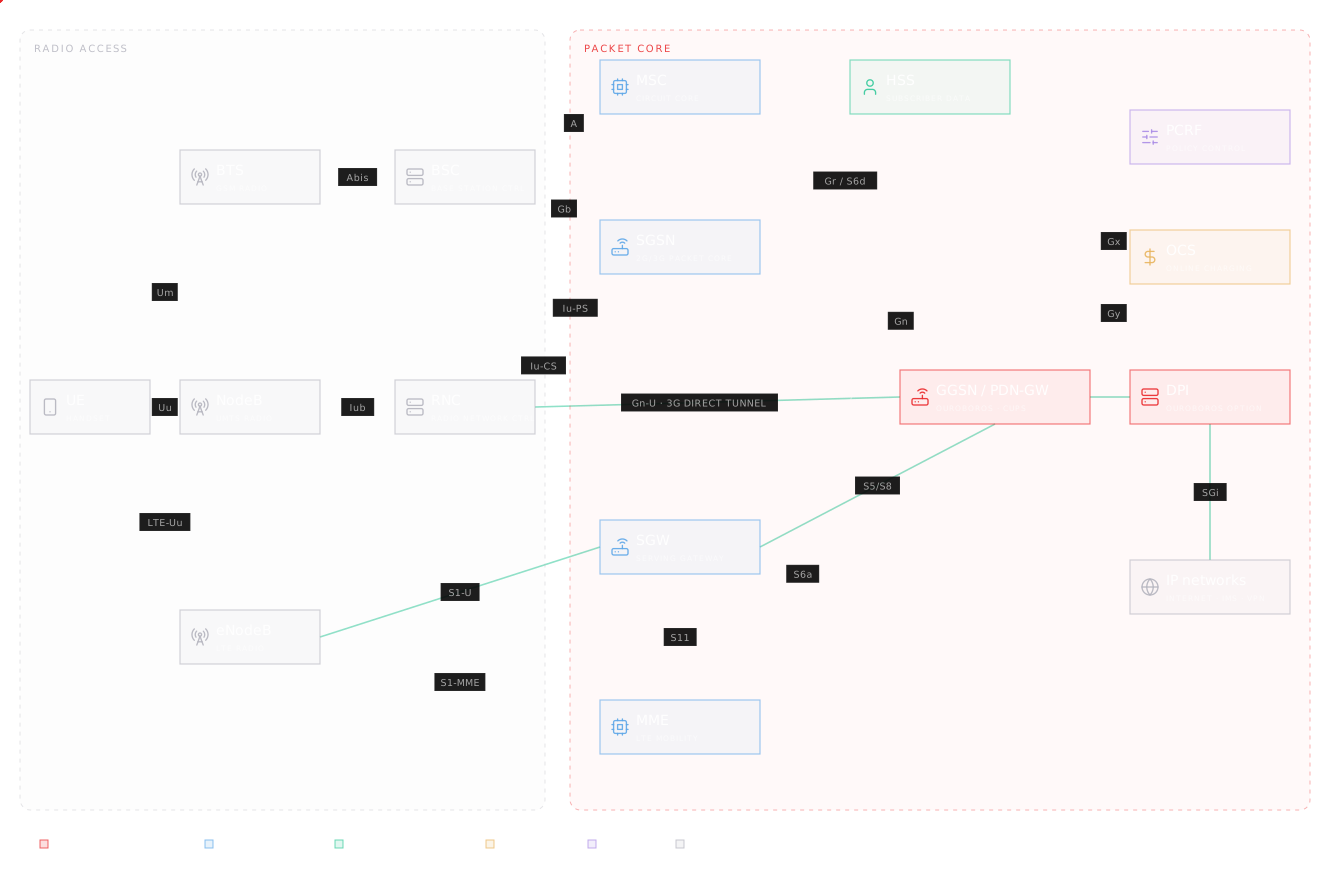
GGSN / PDN-GW — 2G, 3G and 4G user planes into one gateway, with DPI and policy
Mobile internet today, LTE tomorrow — the same gateway, the same team, the same contract.
Mobile internet for 2G and 3G subscribers
Subscribers access mobile internet, MMS, and enterprise data services through the GGSN. The platform handles concurrent APNs per device — internet, corporate VPN, and dedicated M2M on the same SIM simultaneously.
LTE upgrade without a replacement procurement
When the operator adds LTE, the existing Ouroboros GGSN reconfigures as a PDN Gateway. The platform, its configuration, its integrations, and the team that operates it all carry forward. No parallel running of two separate data gateway vendors.
QoS-managed data services
Per-subscriber QoS parameters let operators enforce actual throughput commitments at the individual level. Premium subscribers receive guaranteed bitrate. Congestion control protects the rest of the network when aggregate load rises.
Lean deployment without charging infrastructure
Operators launching data services without an OCS or PCRF deploy the GGSN in standalone mode. Charging and policy infrastructure can be added later. No dependency on either at launch.
Virtualised core environments
The fully virtualised architecture deploys alongside other virtualised core functions on existing cloud or on-premise infrastructure — no separate hardware procurement for the data gateway.

We've selected Ouroboros because it was the best company capable of fulfilling our need for a scalable and virtualised full MVNO platform. Moreover, the Ouroboros team is pragmatic, flexible and responsive.
Pascal Prot
CEO-CTO · Legos
Single platform for GGSN and PDN-GW
The same product serves as GGSN in 2G/3G and reconfigures as PDN Gateway in 4G LTE. LTE upgrade does not trigger a data gateway procurement. The existing platform carries forward unchanged.
QoS per subscriber
Quality of service parameters apply at the individual level, not per APN or service class. Differentiated data plans enforce actual throughput guarantees per subscriber without affecting other users.
Operates without PCRF/OCS/OFCS
The platform runs in standalone mode without charging or policy infrastructure. Operators launch data services on day one without waiting for full OCS or PCRF deployment.
Fully virtualised architecture
The entire platform runs on virtual infrastructure. Bare metal is not required. Deploys alongside other virtualised core functions on infrastructure already in place.
Distributed P-Gateway architecture
Availability comes from distributed gateway nodes, not from active/standby hardware pairs. 99.999% uptime without dependency on a single chassis.
Modular billing and rating
Billing and rating scale independently from the gateway function. Enhanced charging supports complex tariff structures. The charging layer grows with the service catalogue without a gateway reconfiguration.
Third-party OCS and PCRF integration
Standard interfaces connect to any compliant OCS or PCRF: Gx with application detection and control, Gy with one credit control per rating group. Operators with existing charging or policy infrastructure integrate without replacing those systems.
Deep Packet Inspection option
Applications are detected from TLS and QUIC server names, DNS answers, and traffic analysis. Operators block applications, zero-rate them, or apply a specific tariff per application.
IPv4, IPv6 and dual-stack
Subscribers get IPv4, IPv6 or both addresses per session, and the gateway runs over IPv4 or IPv6 networks. Operators moving to IPv6 need no separate configuration path.
Treating the GGSN and PDN-GW as the same function — which they are — eliminates a procurement, an integration project, and a support contract. The Ouroboros platform covers both generations in one deployment. The reconfiguration from GGSN to PDN-GW is a software change.
OPEX rental is available. For operators building out data services in markets where CAPEX commitment is a constraint, the rental model provides a path to deployment without the upfront investment.
The platform is carrier-grade. 99.999% availability. In production since 2021. The operators running it include STC, Orange, and Etisalat.

Tell us your current network generation and your LTE timeline. We'll propose a GGSN/PDN-GW configuration that covers both — OPEX or CAPEX, virtualised or bare metal.
 Product datasheet
2G / 3G · 2G/3G Core
GGSN / SGSN
Packet data for 2G and 3G today. Reconfigure as PDN-GW when the network moves to 4G. Same platform. No replacement procurement. No second integration project at upgrade.
In production since 2021 · 148M+ subscribers · 3GPP EPC compliant
Two procurements for one function
Every mobile data session on a 2G or 3G network passes through the GGSN. Every LTE data session passes through the PDN Gateway. These are the same function at different generations — but most vendors sell them as separate products on separate contracts.
An operator running a 2G or 3G network today buys a GGSN. When that network upgrades to LTE, they buy a PDN-GW. Two procurement cycles, two integration projects, two support contracts, and a platform migration event that carries real operational risk — for a function the network has been running all along.
One gateway. Both generations. No replacement.
Every data session exits here
Every subscriber data session on a 2G or 3G network exits the packet core through the GGSN. It is the gateway to the internet, to enterprise VPNs, to any external IP network a subscriber reaches. When that operator adds LTE, the same function runs through the PDN Gateway. Operators who treat these as separate products absorb the cost of that separation twice.
GGSN today, PDN-GW at upgrade
The Ouroboros GGSN/PDN Gateway handles subscriber packet data for 2G and 3G networks and reconfigures as a PDN Gateway for 4G LTE when the network upgrades. No replacement. No second procurement. The same product also covers the S-GW, and the SMF and UPF of the 5G standalone core, with separated control and user planes (CUPS, PFCP). When the 2G/3G access moves to the Ouroboros S4-SGSN, 2G and 3G sessions run on the SGW and PGW of the EPC.
QoS per subscriber, APNs per device
IPv4, IPv6, and dual-stack are supported. QoS applies per individual subscriber — not per APN or service class — so data plan commitments are enforced at the subscriber level. Congestion control manages peak load without degrading the overall subscriber experience. Multiple simultaneous APNs run per device: internet, enterprise, and dedicated M2M connections on the same SIM concurrently.
Lean launch, charging later
The platform runs without PCRF, OCS, or OFCS for lean deployments. Charging and policy infrastructure can be added later as the network grows. Third-party OCS and PCRF connect via standard interfaces when ready. Billing and rating are modular and scale independently from the gateway function.
Virtualised, distributed, five nines
Fully virtualised and cloud-ready, with control and user planes on separate hosts. 99.999% availability via a distributed P-Gateway architecture. Each user plane server forwards up to 10 Gb/s, and additional nodes scale linearly.
Application-aware and interception-ready
With the Deep Packet Inspection option, the user plane recognises applications to block them or charge them on their own rating group, driven by the application rules of the PCRF. With the Lawful Interception option, session events and a copy of the traffic of the targets go to a certified mediation, for accredited operators only.
GGSN / PDN-GW — 2G, 3G and 4G user planes into one gateway, with DPI and policy
How operators use it.
Mobile internet today, LTE tomorrow — the same gateway, the same team, the same contract.
Mobile internet for 2G and 3G subscribers
Subscribers access mobile internet, MMS, and enterprise data services through the GGSN. The platform handles concurrent APNs per device — internet, corporate VPN, and dedicated M2M on the same SIM simultaneously.
LTE upgrade without a replacement procurement
When the operator adds LTE, the existing Ouroboros GGSN reconfigures as a PDN Gateway. The platform, its configuration, its integrations, and the team that operates it all carry forward. No parallel running of two separate data gateway vendors.
QoS-managed data services
Per-subscriber QoS parameters let operators enforce actual throughput commitments at the individual level. Premium subscribers receive guaranteed bitrate. Congestion control protects the rest of the network when aggregate load rises.
Lean deployment without charging infrastructure
Operators launching data services without an OCS or PCRF deploy the GGSN in standalone mode. Charging and policy infrastructure can be added later. No dependency on either at launch.
Virtualised core environments
The fully virtualised architecture deploys alongside other virtualised core functions on existing cloud or on-premise infrastructure — no separate hardware procurement for the data gateway.
Specifications.
Inside the platform.
Single platform for GGSN and PDN-GW
The same product serves as GGSN in 2G/3G and reconfigures as PDN Gateway in 4G LTE. LTE upgrade does not trigger a data gateway procurement. The existing platform carries forward unchanged.
QoS per subscriber
Quality of service parameters apply at the individual level, not per APN or service class. Differentiated data plans enforce actual throughput guarantees per subscriber without affecting other users.
Operates without PCRF/OCS/OFCS
The platform runs in standalone mode without charging or policy infrastructure. Operators launch data services on day one without waiting for full OCS or PCRF deployment.
Fully virtualised architecture
The entire platform runs on virtual infrastructure. Bare metal is not required. Deploys alongside other virtualised core functions on infrastructure already in place.
Distributed P-Gateway architecture
Availability comes from distributed gateway nodes, not from active/standby hardware pairs. 99.999% uptime without dependency on a single chassis.
Modular billing and rating
Billing and rating scale independently from the gateway function. Enhanced charging supports complex tariff structures. The charging layer grows with the service catalogue without a gateway reconfiguration.
Third-party OCS and PCRF integration
Standard interfaces connect to any compliant OCS or PCRF: Gx with application detection and control, Gy with one credit control per rating group. Operators with existing charging or policy infrastructure integrate without replacing those systems.
Deep Packet Inspection option
Applications are detected from TLS and QUIC server names, DNS answers, and traffic analysis. Operators block applications, zero-rate them, or apply a specific tariff per application.
IPv4, IPv6 and dual-stack
Subscribers get IPv4, IPv6 or both addresses per session, and the gateway runs over IPv4 or IPv6 networks. Operators moving to IPv6 need no separate configuration path.
Treating the GGSN and PDN-GW as the same function — which they are — eliminates a procurement, an integration project, and a support contract. The Ouroboros platform covers both generations in one deployment. The reconfiguration from GGSN to PDN-GW is a software change.
OPEX rental is available. For operators building out data services in markets where CAPEX commitment is a constraint, the rental model provides a path to deployment without the upfront investment.
The platform is carrier-grade. 99.999% availability. In production since 2021. The operators running it include STC, Orange, and Etisalat.
PCRF
Policy and charging rules for data sessions apply through the GGSN/PDN-GW via the standard Gx interface.
vEPC (MME / SGW / PGW)
Full virtualised 4G core bundle including MME, SGW, and PGW. The GGSN/PDN-GW integrates as the PGW component in a full vEPC deployment.
Serving GPRS Support Node (S4-SGSN)
Puts 2G and 3G data on the EPC, so the same gateway serves every generation.
PDN-GW
The 4G role of the same gateway.
Next step
Running 2G or 3G data today with an LTE upgrade on the roadmap?
Tell us your current network generation and your LTE timeline. We'll propose a GGSN/PDN-GW configuration that covers both — OPEX or CAPEX, virtualised or bare metal.