- 01Access and Mobility Management FunctionAMF
- 02Unified Data ManagementUDM
- 03Policy Control FunctionPCF
- 04Network Repository FunctionNRF
- 05Non-3GPP Interworking FunctionN3IWF
- 06Security Edge Protection ProxySEPP
- 07Network Slice Selection FunctionNSSF
- 08Service Communication ProxySCP
- 09Application FunctionAF
- 10Location Management FunctionLMF
- 11Cell Broadcast CentreCBCF
- 12Gateway Mobile Location CentreGMLC
- 13Session Management FunctionSMF
- 14User Plane FunctionUPF
- 15SMS FunctionSMSF
- 16Equipment Identity RegisterEIR
A 5G Standalone subscriber has no circuit-switched channel and may not be on IMS. Without an SMSF, that subscriber cannot send or receive a text. The SMSF carries SMS over 5G signalling and hands it to the SMSC you already run.
SMS is not optional. Two-factor codes, banking alerts, account notifications, and service messages all depend on it. But a 5G Standalone subscriber has no 2G/3G circuit-switched fallback for messaging, and may attach before VoLTE/VoNR IMS messaging is in place. The path that delivered SMS on earlier generations is not there.
5G SA defines a dedicated path: SMS over NAS, carried by the SMSF. Without that function, a 5G SA subscriber drops off the messaging network the moment they attach. For an operator launching 5G SA, that affects every subscriber who relies on text for authentication or alerts, which is most of them.

Subscriber sends — AMF relays to SMSF over N20
In 5G Standalone, SMS travels inside NAS signalling rather than over a voice channel. When a 5G subscriber sends a message, the AMF relays it to the SMSF over N20. The SMSF retrieves the subscriber's SMS subscription from the UDM over N21, then routes the message onward to the SMSC for store-and-forward delivery. Mobile-terminated messages take the reverse path: the SMSF receives them from the SMSC and delivers them to the subscriber through the AMF.
UDM lookup validates the SMS subscription
The SMSF is a mode of the Ouroboros Next-Gen Messaging Center. It registers in the UDM as the serving SMSF and reads the SMS subscription of the subscriber over N21, registers with the NRF, and exchanges messages with the AMF through the Nsmsf SMService and Namf Communication services. For a mobile-terminated message, the Messaging Center selects the 5G domain from the subscriber's registration, as it does for VoLTE; the AMF pages the device if it is idle, and the delivery report returns along the same path. The Ouroboros SMSF bridges 5G SA subscribers into the existing messaging infrastructure. It hands the messages to the Ouroboros Next-Gen Messaging Center, which reaches IMS and 2G/3G over SIP and MAP and a third-party SMSC over standard interfaces, so an operator adding 5G SA does not deploy a parallel messaging stack. The same SMSC that serves 2G, 3G, and LTE serves 5G through the SMSF.
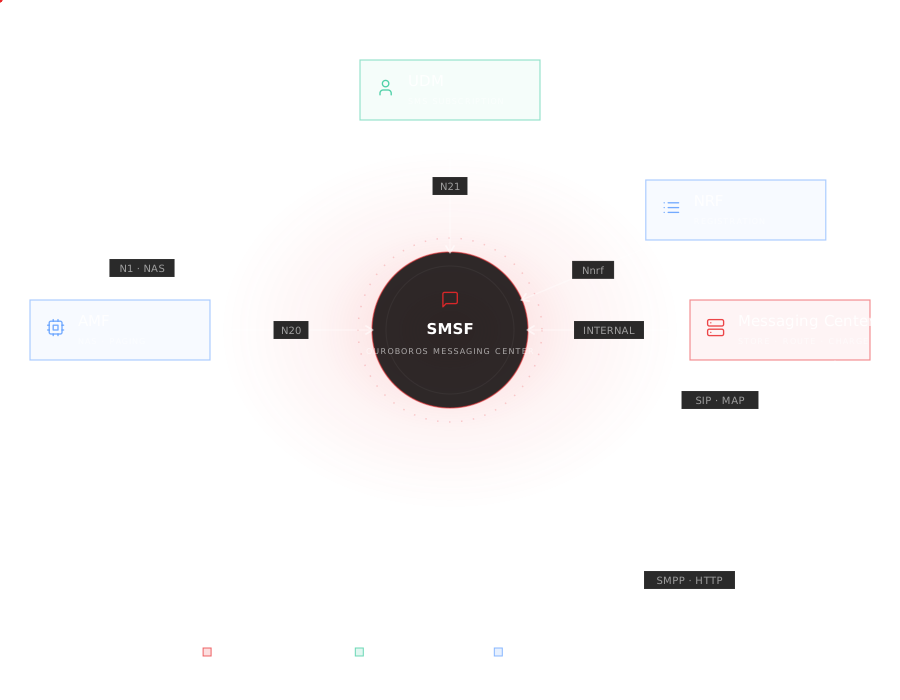
SMSF — SMS over NAS in the 5G core
5G SA launch, SMSC continuity, A2P delivery, private 5G — SMS from first attach.
SMS continuity at 5G SA launch
An operator launching 5G SA deploys the SMSF so subscribers keep sending and receiving SMS from first attach. Two-factor codes and alerts continue to work without a circuit-switched or IMS dependency.
Inbound roaming SMS to a 5G SA visitor
A subscriber roaming in on a visited 5G SA network receives home-network and A2P messages through the SMSF, which delivers them over NAS via the AMF while the home SMSC handles origination.
A2P delivery to 5G subscribers
Enterprise application-to-person messages, transaction alerts, and authentication codes reach 5G SA handsets via the SMSF and the SMSC, with no change to the originating A2P platform.
Private 5G messaging
A private 5G network uses the SMSF to deliver operational and alert messages to devices that attach over 5G SA without a separate messaging deployment.

We've selected Ouroboros because it was the best company capable of fulfilling our need for a scalable and virtualised full MVNO platform. Moreover, the Ouroboros team is pragmatic, flexible and responsive.
Pascal Prot
CEO-CTO · Legos
SMS over NAS for 5G SA
The SMSF carries SMS inside 5G NAS signalling between the subscriber and the network. 5G SA subscribers send and receive text without a circuit-switched or IMS messaging dependency.
Bridges to the existing SMSC
The SMSF routes 5G messages to the Ouroboros Next-Gen Messaging Center, which relays them to a third-party SMSC when needed. Operators add 5G messaging without deploying a parallel SMS platform.
UDM subscription lookup over N21
The SMSF retrieves SMS subscription data from the UDM before routing. Messaging respects each subscriber's SMS subscription and service profile.
Mobile-originated and mobile-terminated delivery
The SMSF handles both directions through the AMF over N20. Sending and receiving both work for 5G SA subscribers from first attach.
A2P reach to 5G subscribers
Application-to-person traffic from the SMSC reaches 5G handsets through the SMSF. Two-factor codes and enterprise alerts deliver to 5G SA subscribers with no change to A2P platforms.
Standard SBI and SMSC interfaces
Service-based interfaces to the 5G core, over HTTP/2 with TLS and mutual authentication, with NRF registration. The SMSF connects to any 5G core without custom integration; the links to the other domains stay in the Messaging Center.
Registration-based domain selection
Mobile-terminated messages follow the subscriber's current registration: 5G, IMS or 2G/3G. When the device deregisters from 5G, its SMS are routed to the other domains.
IPv4, IPv6 and dual-stack
Every interface runs over IPv4, IPv6 or both. The element fits an IPv6 core or a mixed network without a separate configuration.
The SMSF is the function that keeps SMS working when a network turns up 5G Standalone. Its value is in what it connects to: the Ouroboros SMSF bridges 5G subscribers into the same SMSC that already serves 2G, 3G, and LTE, rather than standing up a separate 5G messaging silo. Operators running the Ouroboros Next-Gen SMSC add 5G coverage by adding the SMSF. Operators on a third-party SMSC connect through the Messaging Center over standard interfaces; the SMSF itself only speaks the 5G protocols.
Carrier-grade, in production since 2004, deployable on COTS, virtualised, or cloud. OPEX rental is available.

Give us your 5G core vendor, current SMSC, and launch date, and we'll confirm how the SMSF bridges 5G subscribers into your existing messaging infrastructure.
 Product datasheet
5G Standalone · 5G Standalone
SMS Function (SMSF)
A 5G Standalone subscriber has no circuit-switched channel and may not be on IMS. Without an SMSF, that subscriber cannot send or receive a text. The SMSF carries SMS over 5G signalling and hands it to the SMSC you already run.
In production since 2004 · 148M+ subscribers · 99.999% availability
The 5G subscriber who cannot receive a text
SMS is not optional. Two-factor codes, banking alerts, account notifications, and service messages all depend on it. But a 5G Standalone subscriber has no 2G/3G circuit-switched fallback for messaging, and may attach before VoLTE/VoNR IMS messaging is in place. The path that delivered SMS on earlier generations is not there.
5G SA defines a dedicated path: SMS over NAS, carried by the SMSF. Without that function, a 5G SA subscriber drops off the messaging network the moment they attach. For an operator launching 5G SA, that affects every subscriber who relies on text for authentication or alerts, which is most of them.
SMS over NAS. No CS channel. No IMS dependency.
Subscriber sends — AMF relays to SMSF over N20
In 5G Standalone, SMS travels inside NAS signalling rather than over a voice channel. When a 5G subscriber sends a message, the AMF relays it to the SMSF over N20. The SMSF retrieves the subscriber's SMS subscription from the UDM over N21, then routes the message onward to the SMSC for store-and-forward delivery. Mobile-terminated messages take the reverse path: the SMSF receives them from the SMSC and delivers them to the subscriber through the AMF.
UDM lookup validates the SMS subscription
The SMSF is a mode of the Ouroboros Next-Gen Messaging Center. It registers in the UDM as the serving SMSF and reads the SMS subscription of the subscriber over N21, registers with the NRF, and exchanges messages with the AMF through the Nsmsf SMService and Namf Communication services. For a mobile-terminated message, the Messaging Center selects the 5G domain from the subscriber's registration, as it does for VoLTE; the AMF pages the device if it is idle, and the delivery report returns along the same path. The Ouroboros SMSF bridges 5G SA subscribers into the existing messaging infrastructure. It hands the messages to the Ouroboros Next-Gen Messaging Center, which reaches IMS and 2G/3G over SIP and MAP and a third-party SMSC over standard interfaces, so an operator adding 5G SA does not deploy a parallel messaging stack. The same SMSC that serves 2G, 3G, and LTE serves 5G through the SMSF.
SMSF — SMS over NAS in the 5G core
How operators use it.
5G SA launch, SMSC continuity, A2P delivery, private 5G — SMS from first attach.
SMS continuity at 5G SA launch
An operator launching 5G SA deploys the SMSF so subscribers keep sending and receiving SMS from first attach. Two-factor codes and alerts continue to work without a circuit-switched or IMS dependency.
Inbound roaming SMS to a 5G SA visitor
A subscriber roaming in on a visited 5G SA network receives home-network and A2P messages through the SMSF, which delivers them over NAS via the AMF while the home SMSC handles origination.
A2P delivery to 5G subscribers
Enterprise application-to-person messages, transaction alerts, and authentication codes reach 5G SA handsets via the SMSF and the SMSC, with no change to the originating A2P platform.
Private 5G messaging
A private 5G network uses the SMSF to deliver operational and alert messages to devices that attach over 5G SA without a separate messaging deployment.
Specifications.
Inside the platform.
SMS over NAS for 5G SA
The SMSF carries SMS inside 5G NAS signalling between the subscriber and the network. 5G SA subscribers send and receive text without a circuit-switched or IMS messaging dependency.
Bridges to the existing SMSC
The SMSF routes 5G messages to the Ouroboros Next-Gen Messaging Center, which relays them to a third-party SMSC when needed. Operators add 5G messaging without deploying a parallel SMS platform.
UDM subscription lookup over N21
The SMSF retrieves SMS subscription data from the UDM before routing. Messaging respects each subscriber's SMS subscription and service profile.
Mobile-originated and mobile-terminated delivery
The SMSF handles both directions through the AMF over N20. Sending and receiving both work for 5G SA subscribers from first attach.
A2P reach to 5G subscribers
Application-to-person traffic from the SMSC reaches 5G handsets through the SMSF. Two-factor codes and enterprise alerts deliver to 5G SA subscribers with no change to A2P platforms.
Standard SBI and SMSC interfaces
Service-based interfaces to the 5G core, over HTTP/2 with TLS and mutual authentication, with NRF registration. The SMSF connects to any 5G core without custom integration; the links to the other domains stay in the Messaging Center.
Registration-based domain selection
Mobile-terminated messages follow the subscriber's current registration: 5G, IMS or 2G/3G. When the device deregisters from 5G, its SMS are routed to the other domains.
IPv4, IPv6 and dual-stack
Every interface runs over IPv4, IPv6 or both. The element fits an IPv6 core or a mixed network without a separate configuration.
The SMSF is the function that keeps SMS working when a network turns up 5G Standalone. Its value is in what it connects to: the Ouroboros SMSF bridges 5G subscribers into the same SMSC that already serves 2G, 3G, and LTE, rather than standing up a separate 5G messaging silo. Operators running the Ouroboros Next-Gen SMSC add 5G coverage by adding the SMSF. Operators on a third-party SMSC connect through the Messaging Center over standard interfaces; the SMSF itself only speaks the 5G protocols.
Carrier-grade, in production since 2004, deployable on COTS, virtualised, or cloud. OPEX rental is available.
Next-Gen SMSC & AI Anti-Spam
The SMSF routes 5G SA messages to the Next-Gen SMSC, which handles store-and-forward, routing, and spam filtering across all generations.
Session Management Function (SMF)
Part of the same 5G SA core. The SMF manages data sessions; the SMSF manages SMS over NAS.
IP-SMS Gateway
For VoLTE/VoNR subscribers on IMS, the IP-SM-GW bridges IMS messaging to the SMSC. The SMSF covers the SMS-over-NAS path for 5G SA.
AMF
Carries SMS over NAS between the device and the SMSF on N20, and pages idle devices.
UDM
Holds the SMS subscription and the serving SMSF of each subscriber, read and updated over N21.
Next step
Launching 5G SA and need SMS working from first attach?
Give us your 5G core vendor, current SMSC, and launch date, and we'll confirm how the SMSF bridges 5G subscribers into your existing messaging infrastructure.