- 01Virtualised Evolved Packet CorevEPC
- 02Home Subscriber ServerHSS
- 03Packet Data Network GatewayPDN-GW
- 04Diameter Routing AgentDRA
- 05Equipment Identity RegisterEIR
- 06Policy and Charging Rules FunctionPCRF
- 07Messaging CenterSMSC
- 08IP-SMS GatewayIP-SM-GW
- 09Gateway Mobile Location CentreGMLC
- 10IMS Core with TAS and MRFIMS
- 11Access Network Discovery and Selection FunctionANDSF
- 12Cell Broadcast CentreCBC
An LTE network needs three core functions working together before a single subscriber can attach: authentication and mobility management from the MME, data routing from the SGW, and internet access from the PGW. Source them from three vendors and you have three integration projects before the network is live.
Deploying LTE means standing up three distinct core elements: an MME for authentication and mobility, an SGW for data routing, and a PGW for external IP connectivity. Each has its own interfaces, its own failure domains, and its own configuration. Sourcing them separately means three vendor relationships, three integration projects, and three support contracts before a single subscriber attaches.
For operators on a tight timeline or without a large integration team, the coordination overhead is the primary barrier to getting LTE live.

Three functions, one packet core
Before a subscriber can use LTE, the MME must authenticate them against the HSS, manage their location across cells, and coordinate handovers. The SGW must maintain the data tunnel during cell transitions. The PGW must connect the subscriber to the internet, enforce QoS rules from the PCRF, and generate charging events. These three functions are interdependent. They are not three separate products. They are one packet core.
Pre-integrated, tested, versioned
The Ouroboros vEPC packages all three as a single deployable unit. MME, SGW, and PGW are pre-integrated, tested together, and versioned together. Operators connect to their RAN and HSS, and the core is functional. No inter-element integration project. One support contract covering the complete EPC. The vEPC uses Control and User Plane Separation (CUPS) to avoid bottlenecks, scale smoothly, and keep latency low. For home subscribers, a colocated SGW/PGW user plane — like the 5G UPF — avoids repeating packets between SGW and PGW and reduces backbone bandwidth. Capacity grows by adding user plane nodes, or a pool of MME/SGW/PGW in a Kubernetes deployment.
Any infrastructure, any scale
The same package runs on bare metal COTS hardware, VMware, KVM, Docker, Kubernetes, or public cloud on AWS, Azure, or OpenStack. Private LTE networks use the same vEPC as national MNO deployments: campuses, ports, utilities, mines. The platform scales from a single-site private network to a national subscriber base. One product across the full size range.
One core for every access
The same core serves 2G/3G through the Ouroboros S4-SGSN (idle mobility and PS handover over S3), Wi-Fi through the ePDG (S2b), and interworks with the Ouroboros 5G SA core over N26 for idle mode and handover. VoLTE calls leaving LTE coverage are handed over to 2G/3G with SRVCC (Sv), and CS fallback runs over SGs.
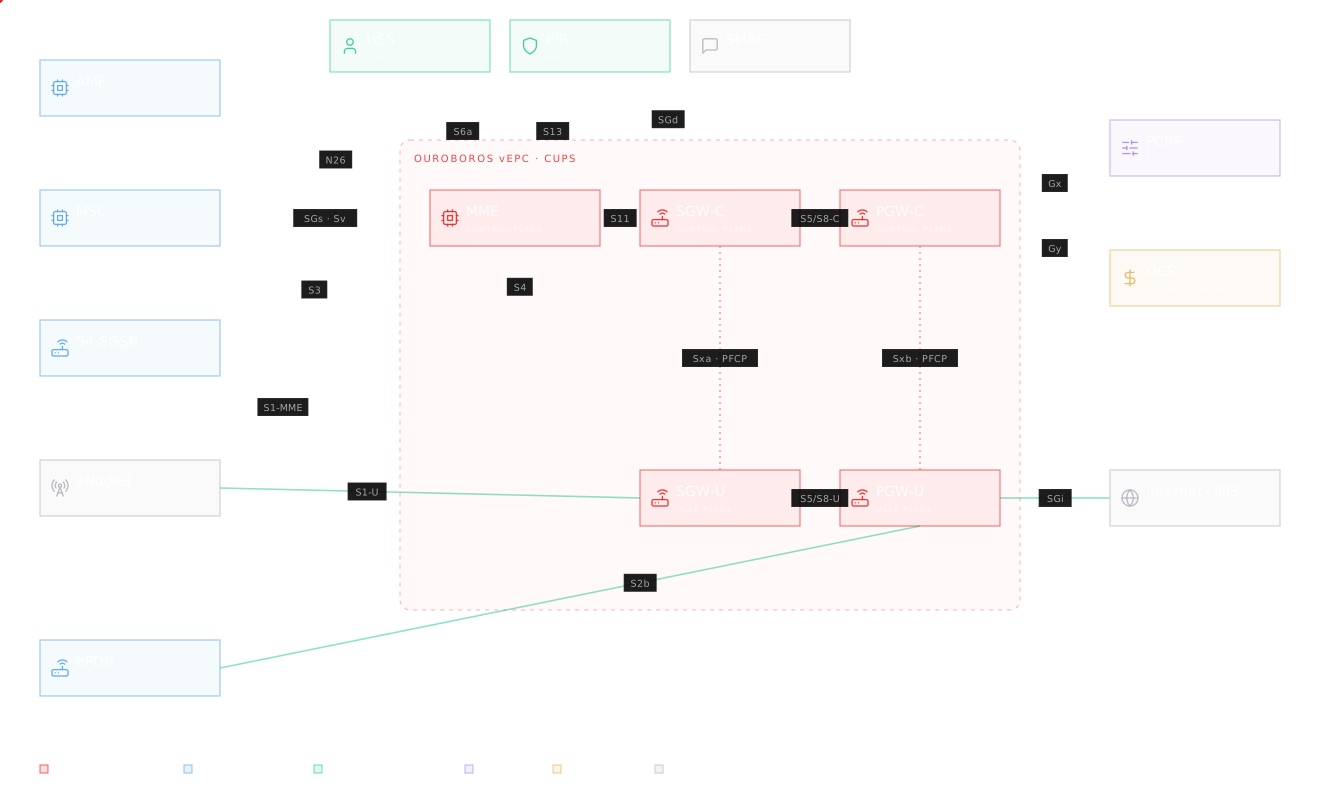
vEPC — MME, SGW-C / SGW-U and PGW-C / PGW-U in CUPS
Greenfield LTE, private networks, full-core MVNOs, 3G migration, MEC — one EPC across the size range.
Greenfield MNO LTE launch
An operator with a new LTE licence deploys the vEPC to connect their RAN to the packet core from day one. Authentication against the HSS, mobility management, and data routing to the internet are ready in weeks. No separate MME, SGW, or PGW procurement.
Private LTE for industrial or campus networks
A port authority, campus, or mining operation deploying private LTE runs the vEPC on standard COTS hardware within a local data centre. Carrier-grade hardware assumptions do not apply to a private network footprint.
MVNO with full core ownership
MVNOs who want subscriber authentication and data routing under their own control deploy the vEPC to own the complete EPC stack independently of the host MNO.
3G-to-LTE migration
Operators transitioning subscribers from a legacy 3G packet core connect their 2G/3G radio through the Ouroboros S4-SGSN: one packet core serves 2G, 3G, and 4G, with idle mobility and PS handover between the technologies.
Multi-access edge compute (MEC)
Distributing SGW and PGW functions to edge nodes reduces latency for latency-sensitive applications. The virtualised architecture supports distributed deployment without separate hardware per function.

We've selected Ouroboros because it was the best company capable of fulfilling our need for a scalable and virtualised full MVNO platform. Moreover, the Ouroboros team is pragmatic, flexible and responsive.
Pascal Prot
CEO-CTO · Legos
Pre-integrated MME, SGW, and PGW
All three EPC functions ship as a single tested package with shared configuration and versioning. Operators avoid the integration project that comes with sourcing each element separately.
Cloud-native and bare metal deployment
The same vEPC software runs on COTS hardware, VMware, KVM, Docker, Kubernetes, AWS, Azure, or OpenStack. Deployment target is a procurement decision, not a software limitation.
MME: full mobility management
Handles LTE attach, authentication, tracking area management, paging, and bearer setup. Subscribers attach, move between cells, and re-attach after coverage gaps without session loss.
SGW: mobility anchor during handover
Maintains the GTP tunnel during inter-eNodeB and inter-frequency handovers. Active data sessions survive cell handovers without interruption to the application layer.
PGW: QoS and charging at the data plane
Enforces PCRF-issued QoS rules and reports charging events to the OCS or OFCS. Policy and billing accuracy are maintained per session, not per subscriber aggregate.
Private LTE support
Scales to single-site deployments for campus, industrial, or utility private networks. A private LTE operator uses the same platform as a national MNO. No separate product line.
Active-active geographic redundancy
MME and SGW state replicates across sites. A site failure does not drop active sessions. Network-level events do not become subscriber-visible outages.
Voice and SMS continuity
VoLTE, RCS, and IMS emergency sessions on LTE; SRVCC to 2G/3G over Sv; CS fallback over SGs; SMS over SGs or SGd. Voice services keep working at the edge of LTE coverage.
Inter-RAT and 5G interworking
Idle mobility and PS handover with the S4-SGSN over S3, and idle mode and handover with the 5G AMF over N26. Sessions keep their SGW and PGW anchor across 2G, 3G, 4G, and 5G SA.
Security and device control
EPS AKA with the HSS, NAS integrity and ciphering with Snow 3G, AES, and ZUC, and IMEI checks against the EIR over S13.
Application-aware data plane (DPI option)
Applications are recognised in the user plane to block them, zero-rate them, or charge them on their own rating group.
IPv4, IPv6 and dual-stack
Subscribers get IPv4, IPv6 or both addresses per session, and the gateway runs over IPv4 or IPv6 networks. Operators moving to IPv6 need no separate configuration path.
One configuration management interface covers the whole core. For operators deploying LTE without a large integration team or a long procurement programme, that scope difference is significant. The work that usually sits between three vendors is already done.
The vEPC runs on whatever infrastructure the operator already has: bare metal, cloud, or virtualised. OPEX rental is available for operators who are not ready to commit to a capital programme before the first subscriber attaches.
The platform is in production since 2004. It also runs private LTE deployments for enterprise and industrial operators. Same codebase across the full size range.

Where will you deploy, and what subscriber capacity are you targeting? We'll size the vEPC and confirm the timeline: OPEX or CAPEX, cloud or bare metal.
 Product datasheet
4G / LTE · 4G/LTE
Virtualised Evolved Packet Core (vEPC)
An LTE network needs three core functions working together before a single subscriber can attach: authentication and mobility management from the MME, data routing from the SGW, and internet access from the PGW. Source them from three vendors and you have three integration projects before the network is live.
In production since 2020 · 148M+ subscribers
Three elements. Three vendors. Three projects.
Deploying LTE means standing up three distinct core elements: an MME for authentication and mobility, an SGW for data routing, and a PGW for external IP connectivity. Each has its own interfaces, its own failure domains, and its own configuration. Sourcing them separately means three vendor relationships, three integration projects, and three support contracts before a single subscriber attaches.
For operators on a tight timeline or without a large integration team, the coordination overhead is the primary barrier to getting LTE live.
MME, SGW, PGW. One package. One contract.
Three functions, one packet core
Before a subscriber can use LTE, the MME must authenticate them against the HSS, manage their location across cells, and coordinate handovers. The SGW must maintain the data tunnel during cell transitions. The PGW must connect the subscriber to the internet, enforce QoS rules from the PCRF, and generate charging events. These three functions are interdependent. They are not three separate products. They are one packet core.
Pre-integrated, tested, versioned
The Ouroboros vEPC packages all three as a single deployable unit. MME, SGW, and PGW are pre-integrated, tested together, and versioned together. Operators connect to their RAN and HSS, and the core is functional. No inter-element integration project. One support contract covering the complete EPC. The vEPC uses Control and User Plane Separation (CUPS) to avoid bottlenecks, scale smoothly, and keep latency low. For home subscribers, a colocated SGW/PGW user plane — like the 5G UPF — avoids repeating packets between SGW and PGW and reduces backbone bandwidth. Capacity grows by adding user plane nodes, or a pool of MME/SGW/PGW in a Kubernetes deployment.
Any infrastructure, any scale
The same package runs on bare metal COTS hardware, VMware, KVM, Docker, Kubernetes, or public cloud on AWS, Azure, or OpenStack. Private LTE networks use the same vEPC as national MNO deployments: campuses, ports, utilities, mines. The platform scales from a single-site private network to a national subscriber base. One product across the full size range.
One core for every access
The same core serves 2G/3G through the Ouroboros S4-SGSN (idle mobility and PS handover over S3), Wi-Fi through the ePDG (S2b), and interworks with the Ouroboros 5G SA core over N26 for idle mode and handover. VoLTE calls leaving LTE coverage are handed over to 2G/3G with SRVCC (Sv), and CS fallback runs over SGs.
vEPC — MME, SGW-C / SGW-U and PGW-C / PGW-U in CUPS
How operators use it.
Greenfield LTE, private networks, full-core MVNOs, 3G migration, MEC — one EPC across the size range.
Greenfield MNO LTE launch
An operator with a new LTE licence deploys the vEPC to connect their RAN to the packet core from day one. Authentication against the HSS, mobility management, and data routing to the internet are ready in weeks. No separate MME, SGW, or PGW procurement.
Private LTE for industrial or campus networks
A port authority, campus, or mining operation deploying private LTE runs the vEPC on standard COTS hardware within a local data centre. Carrier-grade hardware assumptions do not apply to a private network footprint.
MVNO with full core ownership
MVNOs who want subscriber authentication and data routing under their own control deploy the vEPC to own the complete EPC stack independently of the host MNO.
3G-to-LTE migration
Operators transitioning subscribers from a legacy 3G packet core connect their 2G/3G radio through the Ouroboros S4-SGSN: one packet core serves 2G, 3G, and 4G, with idle mobility and PS handover between the technologies.
Multi-access edge compute (MEC)
Distributing SGW and PGW functions to edge nodes reduces latency for latency-sensitive applications. The virtualised architecture supports distributed deployment without separate hardware per function.
Specifications.
Inside the platform.
Pre-integrated MME, SGW, and PGW
All three EPC functions ship as a single tested package with shared configuration and versioning. Operators avoid the integration project that comes with sourcing each element separately.
Cloud-native and bare metal deployment
The same vEPC software runs on COTS hardware, VMware, KVM, Docker, Kubernetes, AWS, Azure, or OpenStack. Deployment target is a procurement decision, not a software limitation.
MME: full mobility management
Handles LTE attach, authentication, tracking area management, paging, and bearer setup. Subscribers attach, move between cells, and re-attach after coverage gaps without session loss.
SGW: mobility anchor during handover
Maintains the GTP tunnel during inter-eNodeB and inter-frequency handovers. Active data sessions survive cell handovers without interruption to the application layer.
PGW: QoS and charging at the data plane
Enforces PCRF-issued QoS rules and reports charging events to the OCS or OFCS. Policy and billing accuracy are maintained per session, not per subscriber aggregate.
Private LTE support
Scales to single-site deployments for campus, industrial, or utility private networks. A private LTE operator uses the same platform as a national MNO. No separate product line.
Active-active geographic redundancy
MME and SGW state replicates across sites. A site failure does not drop active sessions. Network-level events do not become subscriber-visible outages.
Voice and SMS continuity
VoLTE, RCS, and IMS emergency sessions on LTE; SRVCC to 2G/3G over Sv; CS fallback over SGs; SMS over SGs or SGd. Voice services keep working at the edge of LTE coverage.
Inter-RAT and 5G interworking
Idle mobility and PS handover with the S4-SGSN over S3, and idle mode and handover with the 5G AMF over N26. Sessions keep their SGW and PGW anchor across 2G, 3G, 4G, and 5G SA.
Security and device control
EPS AKA with the HSS, NAS integrity and ciphering with Snow 3G, AES, and ZUC, and IMEI checks against the EIR over S13.
Application-aware data plane (DPI option)
Applications are recognised in the user plane to block them, zero-rate them, or charge them on their own rating group.
IPv4, IPv6 and dual-stack
Subscribers get IPv4, IPv6 or both addresses per session, and the gateway runs over IPv4 or IPv6 networks. Operators moving to IPv6 need no separate configuration path.
One configuration management interface covers the whole core. For operators deploying LTE without a large integration team or a long procurement programme, that scope difference is significant. The work that usually sits between three vendors is already done.
The vEPC runs on whatever infrastructure the operator already has: bare metal, cloud, or virtualised. OPEX rental is available for operators who are not ready to commit to a capital programme before the first subscriber attaches.
The platform is in production since 2004. It also runs private LTE deployments for enterprise and industrial operators. Same codebase across the full size range.
HSS
The MME authenticates every LTE subscriber attach against the HSS over S6a. The two are designed to deploy together.
PCRF
The PGW enforces policy rules received from the PCRF over the Gx interface. QoS and charging accuracy depend on the PCRF connection.
DRA
Diameter traffic between the MME, HSS, PCRF, and OCS routes through the DRA. Centralised Diameter routing reduces direct peer connections across the EPC.
Serving GPRS Support Node (S4-SGSN)
Brings 2G and 3G data onto the vEPC, with mobility over S3.
ePDG & AAA
Wi-Fi access and VoWiFi on the vEPC over S2b.
Access and Mobility Management Function (AMF)
4G / 5G SA interworking over N26.
Next step
What is your RAN vendor and your target date for first attached subscriber?
Where will you deploy, and what subscriber capacity are you targeting? We'll size the vEPC and confirm the timeline: OPEX or CAPEX, cloud or bare metal.