- 01Virtualised Evolved Packet CorevEPC
- 02Home Subscriber ServerHSS
- 03Packet Data Network GatewayPDN-GW
- 04Diameter Routing AgentDRA
- 05Equipment Identity RegisterEIR
- 06Policy and Charging Rules FunctionPCRF
- 07Messaging CenterSMSC
- 08IP-SMS GatewayIP-SM-GW
- 09Gateway Mobile Location CentreGMLC
- 10IMS Core with TAS and MRFIMS
- 11Access Network Discovery and Selection FunctionANDSF
- 12Cell Broadcast CentreCBC
LTE and 5G carry voice as IP. Without an IMS, your subscribers fall back to 2G or 3G for every call, and you keep a circuit-switched core alive just for voice. The Ouroboros IMS brings voice, video and SMS onto the packet core, with the application server and the media resources included.
Data moved to LTE years ago. Voice often did not. Operators without an IMS rely on CS fallback: every call drops the handset back to 2G or 3G, call setup takes longer, data sessions slow down or stop during the call, and the 2G/3G network has to stay sized for voice traffic it should be shedding.
The usual answer is a large IMS from a major vendor: CSCFs, an application server, a media server, an interconnect border, each from a different product line with its own integration project. For an MVNO, a regional operator or a private network, the cost and the complexity of that stack are out of proportion with the voice traffic it carries.

Three CSCFs handle the signalling
The Ouroboros IMS is a compact voice core dedicated to VoLTE, VoWiFi and 5G voice. Calls, video calls and SMS are seen by the packet core as ordinary IP flows on the "ims" APN or DNN. The P-CSCF is the first contact point of the handset: it receives the registration, protects the signalling and requests the right bearer for each call from the PCRF or PCF over Rx. The I-CSCF queries the HSS over Cx (or the UDM in 5G) to find the S-CSCF of the subscriber, including for roaming users. The S-CSCF authenticates the subscriber with IMS AKA, downloads the service profile at registration and invokes the application servers named in that profile.
The TAS controls the call
The Telephony Application Server is the call control of the subscriber. It locates the called party through the HLR or the HSS, applies number portability, checks credit and subscription rights, and routes the call: to another IMS subscriber, to the 2G/3G network, or to a partner network over SIP, SIP-I or ISUP. Prepaid calls are charged in real time over Diameter Ro toward the OCS, or through CAMEL toward an existing SCP. Call forwarding cascades and routing per calendar, congestion or registration state are applied before the call is presented.
The MRF plays the network's voice
The Media Resource Function plays the announcements, tones and voice menus of the network: "your credit is low", "the number you dialled is not reachable", short codes and IVR services. The TAS drives it over MSML and VoiceXML, so new prompts and menus are configuration, not development. Optional elements complete the core: the IP-SMS Gateway for SMS over IMS, the USSI Gateway for USSD menus over VoLTE, and the IM-SSF for CAMEL charging of IMS calls.
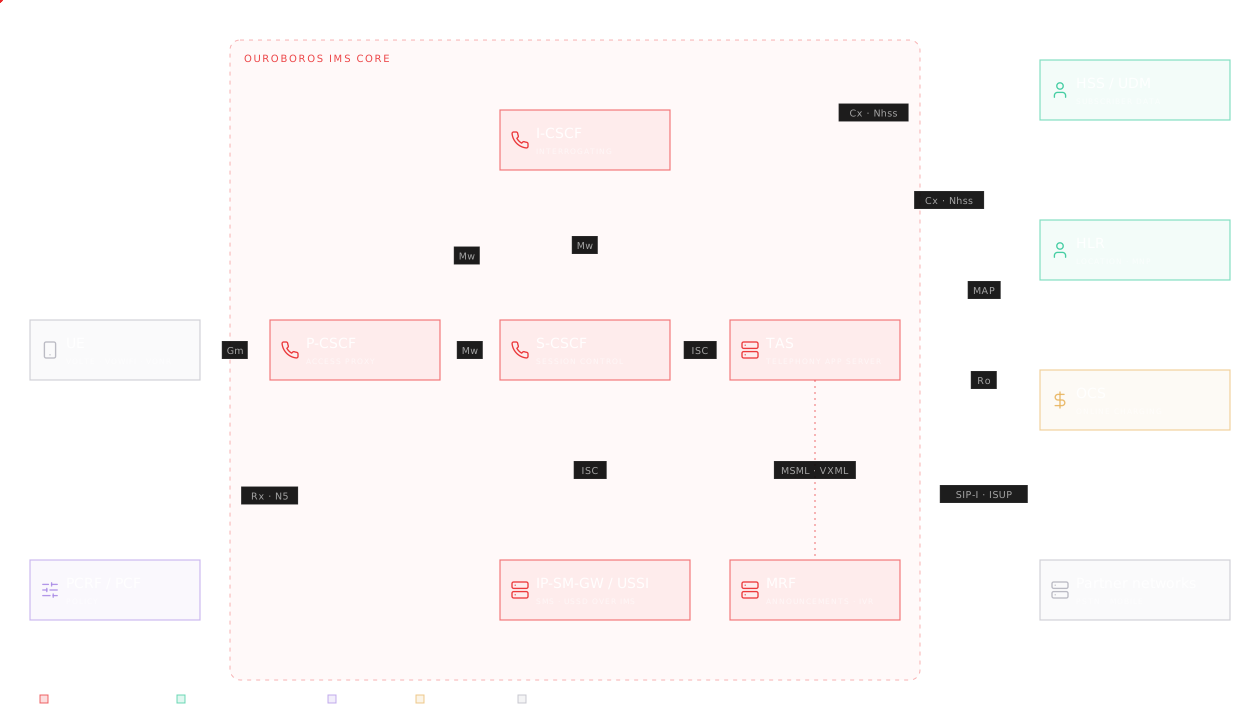
IMS — CSCF, TAS and MRF in one voice core
VoLTE, VoWiFi, 5G voice, MVNO voice, prepaid — one IMS core.
VoLTE launch without CS fallback
Subscribers call over LTE with HD voice and keep their data session during the call. The 2G/3G network stops carrying voice traffic that LTE can handle.
VoWiFi for indoor coverage
Through the Ouroboros ePDG, the same IMS serves calls over Wi-Fi at home or in the office, with handover to VoLTE when the subscriber leaves the building.
5G voice
5G SA subscribers register on the same IMS, authenticated by the UDM, with sessions and QoS from the SMF and the PCF.
MVNO with its own voice core
An MVNO controls call routing, charging and announcements instead of renting them from its host MNO, and keeps the interconnect margin.
Prepaid voice with real-time charging
Every call is authorised and debited during the call against the OCS, with announcements played by the MRF when the credit runs low or is exhausted.

We've selected Ouroboros because it was the best company capable of fulfilling our need for a scalable and virtualised full MVNO platform. Moreover, the Ouroboros team is pragmatic, flexible and responsive.
Pascal Prot
CEO-CTO · Legos
Complete voice core in one product
CSCFs, application server and media resources are delivered and tested together. No separate integration project for each IMS element before the first VoLTE call.
TAS built on the Ouroboros switching core
The application server reuses the call control of the Ouroboros MSS: locating, number portability, routing and charging. Voice services behave the same way on IMS and on the 2G/3G network.
Integrated MRF
Announcements, tones and voice menus are played by the IMS itself. No external media server to buy and connect for basic network announcements.
Real-time charging over Ro or CAMEL
Prepaid calls are charged by the Ouroboros OCS or by an existing SCP. IMS voice fits into the charging the operator already runs.
Shared subscriber data
The CSCFs authenticate against the HSS or the UDM that also serve 2G, 3G, 4G and 5G. A subscriber provisioned once is ready for VoLTE, VoWiFi and 5G voice.
Open to third-party application servers
The S-CSCF invokes any SIP application server named in the subscriber profile. Operators add their own services without changing the core.
IPv4, IPv6 and dual-stack
Every interface runs over IPv4, IPv6 or both. The element fits an IPv6 core or a mixed network without a separate configuration.
The Ouroboros IMS is sized for operators who need voice over LTE and Wi-Fi without the cost of a tier-one IMS. It comes with the pieces that are usually sold separately: the application server, the media resources and the interconnect toward the 2G/3G and partner networks.
It works best with the rest of the Ouroboros core (HSS, PCRF, OCS, ePDG), all on one platform and one support contract, and stays open to third-party HSS, PCRF, OCS and application servers through standard interfaces.
OPEX rental is available, so voice over LTE can start before the business case is fully proven.

Tell us your subscriber base, your LTE and Wi-Fi coverage and your current voice core. We'll propose an IMS configuration with TAS and MRF, on OPEX or CAPEX.
 Product datasheet
4G / LTE · 4G/LTE
IMS Core with TAS and MRF
LTE and 5G carry voice as IP. Without an IMS, your subscribers fall back to 2G or 3G for every call, and you keep a circuit-switched core alive just for voice. The Ouroboros IMS brings voice, video and SMS onto the packet core, with the application server and the media resources included.
In production since 2004 · 148M+ subscribers · 99.999% availability
Voice is the last service still tied to the old core
Data moved to LTE years ago. Voice often did not. Operators without an IMS rely on CS fallback: every call drops the handset back to 2G or 3G, call setup takes longer, data sessions slow down or stop during the call, and the 2G/3G network has to stay sized for voice traffic it should be shedding.
The usual answer is a large IMS from a major vendor: CSCFs, an application server, a media server, an interconnect border, each from a different product line with its own integration project. For an MVNO, a regional operator or a private network, the cost and the complexity of that stack are out of proportion with the voice traffic it carries.
From registration to announcement, one voice core.
Three CSCFs handle the signalling
The Ouroboros IMS is a compact voice core dedicated to VoLTE, VoWiFi and 5G voice. Calls, video calls and SMS are seen by the packet core as ordinary IP flows on the "ims" APN or DNN. The P-CSCF is the first contact point of the handset: it receives the registration, protects the signalling and requests the right bearer for each call from the PCRF or PCF over Rx. The I-CSCF queries the HSS over Cx (or the UDM in 5G) to find the S-CSCF of the subscriber, including for roaming users. The S-CSCF authenticates the subscriber with IMS AKA, downloads the service profile at registration and invokes the application servers named in that profile.
The TAS controls the call
The Telephony Application Server is the call control of the subscriber. It locates the called party through the HLR or the HSS, applies number portability, checks credit and subscription rights, and routes the call: to another IMS subscriber, to the 2G/3G network, or to a partner network over SIP, SIP-I or ISUP. Prepaid calls are charged in real time over Diameter Ro toward the OCS, or through CAMEL toward an existing SCP. Call forwarding cascades and routing per calendar, congestion or registration state are applied before the call is presented.
The MRF plays the network's voice
The Media Resource Function plays the announcements, tones and voice menus of the network: "your credit is low", "the number you dialled is not reachable", short codes and IVR services. The TAS drives it over MSML and VoiceXML, so new prompts and menus are configuration, not development. Optional elements complete the core: the IP-SMS Gateway for SMS over IMS, the USSI Gateway for USSD menus over VoLTE, and the IM-SSF for CAMEL charging of IMS calls.
IMS — CSCF, TAS and MRF in one voice core
How operators use it.
VoLTE, VoWiFi, 5G voice, MVNO voice, prepaid — one IMS core.
VoLTE launch without CS fallback
Subscribers call over LTE with HD voice and keep their data session during the call. The 2G/3G network stops carrying voice traffic that LTE can handle.
VoWiFi for indoor coverage
Through the Ouroboros ePDG, the same IMS serves calls over Wi-Fi at home or in the office, with handover to VoLTE when the subscriber leaves the building.
5G voice
5G SA subscribers register on the same IMS, authenticated by the UDM, with sessions and QoS from the SMF and the PCF.
MVNO with its own voice core
An MVNO controls call routing, charging and announcements instead of renting them from its host MNO, and keeps the interconnect margin.
Prepaid voice with real-time charging
Every call is authorised and debited during the call against the OCS, with announcements played by the MRF when the credit runs low or is exhausted.
Specifications.
Inside the platform.
Complete voice core in one product
CSCFs, application server and media resources are delivered and tested together. No separate integration project for each IMS element before the first VoLTE call.
TAS built on the Ouroboros switching core
The application server reuses the call control of the Ouroboros MSS: locating, number portability, routing and charging. Voice services behave the same way on IMS and on the 2G/3G network.
Integrated MRF
Announcements, tones and voice menus are played by the IMS itself. No external media server to buy and connect for basic network announcements.
Real-time charging over Ro or CAMEL
Prepaid calls are charged by the Ouroboros OCS or by an existing SCP. IMS voice fits into the charging the operator already runs.
Shared subscriber data
The CSCFs authenticate against the HSS or the UDM that also serve 2G, 3G, 4G and 5G. A subscriber provisioned once is ready for VoLTE, VoWiFi and 5G voice.
Open to third-party application servers
The S-CSCF invokes any SIP application server named in the subscriber profile. Operators add their own services without changing the core.
IPv4, IPv6 and dual-stack
Every interface runs over IPv4, IPv6 or both. The element fits an IPv6 core or a mixed network without a separate configuration.
The Ouroboros IMS is sized for operators who need voice over LTE and Wi-Fi without the cost of a tier-one IMS. It comes with the pieces that are usually sold separately: the application server, the media resources and the interconnect toward the 2G/3G and partner networks.
It works best with the rest of the Ouroboros core (HSS, PCRF, OCS, ePDG), all on one platform and one support contract, and stays open to third-party HSS, PCRF, OCS and application servers through standard interfaces.
OPEX rental is available, so voice over LTE can start before the business case is fully proven.
Home Subscriber Server (HSS)
The I-CSCF and the S-CSCF query the HSS over Cx for the serving S-CSCF, the IMS AKA vectors and the service profile.
PCRF
The P-CSCF requests the voice bearer from the PCRF over Rx.
IM-SSF
CAMEL charging of IMS calls toward an existing SCP.
ePDG & AAA
VoWiFi access to the same IMS.
IP-SMS Gateway
SMS over IMS for VoLTE subscribers.
Online Charging System (OCS)
Real-time charging of IMS calls over Ro.
Next step
Still falling back to 2G or 3G for every call?
Tell us your subscriber base, your LTE and Wi-Fi coverage and your current voice core. We'll propose an IMS configuration with TAS and MRF, on OPEX or CAPEX.