- 01MSC / VLRMSC/VLR
- 02Gateway Mobile Switching CenterGMSC
- 03Gateway Mobile Location CentreGMLC
- 04Home Location RegisterHLR
- 05Messaging CenterSMSC
- 06Signaling Transfer PointSTP
- 07GGSN / SGSNGGSN
- 08S4-SGSNSGSN
- 09Equipment Identity RegisterEIR
- 10Service Control PointSCP
- 11USSD GatewayUSSD
- 12Cell Broadcast CentreCBC
2G and 3G data does not need its own packet core any more. The Ouroboros S4-SGSN connects GPRS, EDGE and UMTS access straight to your EPC, so one SGW, one PGW and one PCRF serve 2G, 3G and 4G.
An operator running LTE alongside 2G and 3G usually runs two packet cores: an EPC for 4G and a legacy SGSN/GGSN pair for GPRS, EDGE and UMTS. Two sets of gateways, two policy integrations, two charging integrations and two capacity plans, for subscribers who move between the three technologies every day.
The legacy SGSN is also often a bottleneck. In a classic 3G architecture, every user packet crosses it, so throughput is tied to its sizing and every hop adds latency. Many legacy SGSNs also depend on CAMEL for prepaid data control, one more integration to keep alive.

Sessions set up on the SGW
The Serving GPRS Support Node handles mobility, authentication and session management for 2.5G (GPRS/EDGE) and 3G (UMTS) data subscribers. The Ouroboros SGSN is an S4-SGSN: instead of handing sessions to a GGSN, it sets them up toward an SGW of the EPC over GTPv2-C (S4). The operator runs one packet core (SGW, PGW and PCRF) for 2G, 3G and 4G, with no GGSN to operate.
3G direct tunnel
In 3G, the SGSN only handles signalling. The GTP-U tunnel goes directly from the RNC to the SGW (S12 direct tunnel): no user traffic crosses the SGSN. Latency drops by one hop and throughput scales with the SGW, not with the SGSN. In 2.5G, GPRS/EDGE user data reaches the SGSN over Gb and is relayed to the SGW over S4-U.
HLR or HSS, no CAMEL
Subscriber data comes from a legacy HLR over MAP (Gr) or from an HSS over Diameter (S6d), selectable per PLMN. There is no CAMEL dependency: data policy and charging are handled by the EPC, through the PCRF and the OCS. For operators who keep third-party SGSNs, the GGSN function is provided by the Ouroboros GGSN / PDN-GW, which serves 2G/3G and LTE sessions on the same gateway.
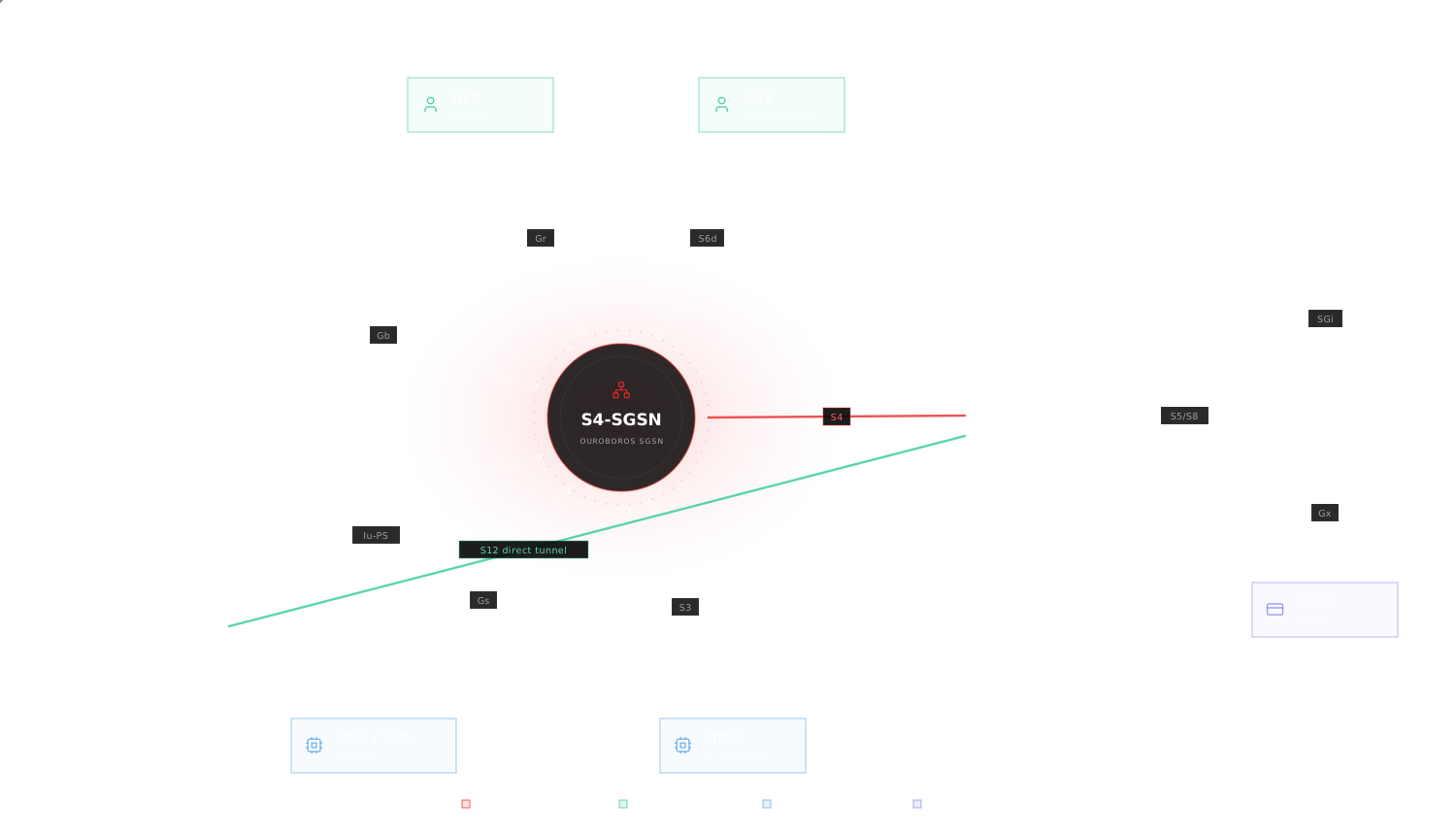
S4-SGSN — 2G and 3G access on the EPC, with 3G direct tunnel
LTE operators, legacy replacement, M2M, inter-RAT mobility, network sharing — one packet core.
LTE operator extending 2G/3G data coverage
2G and 3G data rides on the existing EPC. No separate GGSN, no second policy or charging integration. Subscribers moving between LTE and 2G/3G stay on the same gateway.
Replacing an end-of-life SGSN/GGSN
The legacy pair is retired. The S4-SGSN connects the existing BSCs over Gb and RNCs over Iu-PS, and the PDN-GW takes over the gateway role.
M2M and IoT on 2G/3G
Millions of devices still connect over GPRS and EDGE. The SGSN serves them on the same core, policy and charging as LTE devices, with several MCC/MNC per node.
Seamless mobility between 4G and 2G/3G
Idle mobility and PS handover with the MME over S3 keep SGW sessions in place when a device changes radio technology.
Network sharing
Iu-flex and network sharing let several operators or several SGSN nodes serve the same radio network.

We've selected Ouroboros because it was the best company capable of fulfilling our need for a scalable and virtualised full MVNO platform. Moreover, the Ouroboros team is pragmatic, flexible and responsive.
Pascal Prot
CEO-CTO · Legos
S4-SGSN: no GGSN to operate
2G and 3G sessions are set up on the SGW of the EPC. One packet core, one policy chain and one charging chain for 2G, 3G and 4G.
3G direct tunnel
User traffic goes from the RNC straight to the SGW. Lower latency, and data throughput that scales with the SGW instead of the SGSN.
No CAMEL dependency
Data policy and prepaid control are delegated to the EPC core. No IN integration to maintain for 2G/3G data.
HLR or HSS per PLMN
Subscriber data is read over MAP from an HLR, with TCAP application context negotiation, or over Diameter from an HSS. The SGSN fits both a legacy subscriber database and a modern HSS, during and after migration.
Mobility with the MME
Idle mobility and PS handover with the MME keep sessions in place. Data sessions survive a change between 4G, 3G and 2G.
Combined attach over Gs
GPRS and IMSI attach are combined, and CS paging reaches data-attached devices. Fewer signalling procedures for devices and the network.
IPv4 and IPv6
IPv4, IPv6 and dual-stack PDP contexts, over IPv4 or IPv6 transport. Operators running IPv6 or mixed addressing need no separate configuration path.
Multi-tenant and shared networks
Several MCC/MNC, per-VPLMN roaming profiles and Iu-flex network sharing. MVNOs, M2M operators and network-sharing partners run on the same node.
The S4-SGSN removes the second packet core. 2G and 3G data rides on the same SGW, PGW and PCRF as LTE, so policy, charging and capacity planning are done once. With the direct tunnel, the SGSN is out of the 3G data path entirely.
It runs on the AMTP platform, the same framework as the Ouroboros vEPC, HLR and HSS, in production since 2004. Low-latency signalling runs on COTS hardware or virtual machines, with geographic and local redundancy.
OPEX rental is available, so the legacy packet core can be retired without a capital programme.

Tell us your radio access, your 2G/3G data volumes and your EPC. We'll show how the S4-SGSN moves 2G/3G data onto your 4G core, on OPEX or CAPEX.
 Product datasheet
2G / 3G · 2G/3G Core
Serving GPRS Support Node (S4-SGSN)
2G and 3G data does not need its own packet core any more. The Ouroboros S4-SGSN connects GPRS, EDGE and UMTS access straight to your EPC, so one SGW, one PGW and one PCRF serve 2G, 3G and 4G.
In production since 2004 · 148M+ subscribers · 99.999% availability
Two packet cores for the same subscribers
An operator running LTE alongside 2G and 3G usually runs two packet cores: an EPC for 4G and a legacy SGSN/GGSN pair for GPRS, EDGE and UMTS. Two sets of gateways, two policy integrations, two charging integrations and two capacity plans, for subscribers who move between the three technologies every day.
The legacy SGSN is also often a bottleneck. In a classic 3G architecture, every user packet crosses it, so throughput is tied to its sizing and every hop adds latency. Many legacy SGSNs also depend on CAMEL for prepaid data control, one more integration to keep alive.
2G and 3G data on the 4G core.
Sessions set up on the SGW
The Serving GPRS Support Node handles mobility, authentication and session management for 2.5G (GPRS/EDGE) and 3G (UMTS) data subscribers. The Ouroboros SGSN is an S4-SGSN: instead of handing sessions to a GGSN, it sets them up toward an SGW of the EPC over GTPv2-C (S4). The operator runs one packet core (SGW, PGW and PCRF) for 2G, 3G and 4G, with no GGSN to operate.
3G direct tunnel
In 3G, the SGSN only handles signalling. The GTP-U tunnel goes directly from the RNC to the SGW (S12 direct tunnel): no user traffic crosses the SGSN. Latency drops by one hop and throughput scales with the SGW, not with the SGSN. In 2.5G, GPRS/EDGE user data reaches the SGSN over Gb and is relayed to the SGW over S4-U.
HLR or HSS, no CAMEL
Subscriber data comes from a legacy HLR over MAP (Gr) or from an HSS over Diameter (S6d), selectable per PLMN. There is no CAMEL dependency: data policy and charging are handled by the EPC, through the PCRF and the OCS. For operators who keep third-party SGSNs, the GGSN function is provided by the Ouroboros GGSN / PDN-GW, which serves 2G/3G and LTE sessions on the same gateway.
S4-SGSN — 2G and 3G access on the EPC, with 3G direct tunnel
How operators use it.
LTE operators, legacy replacement, M2M, inter-RAT mobility, network sharing — one packet core.
LTE operator extending 2G/3G data coverage
2G and 3G data rides on the existing EPC. No separate GGSN, no second policy or charging integration. Subscribers moving between LTE and 2G/3G stay on the same gateway.
Replacing an end-of-life SGSN/GGSN
The legacy pair is retired. The S4-SGSN connects the existing BSCs over Gb and RNCs over Iu-PS, and the PDN-GW takes over the gateway role.
M2M and IoT on 2G/3G
Millions of devices still connect over GPRS and EDGE. The SGSN serves them on the same core, policy and charging as LTE devices, with several MCC/MNC per node.
Seamless mobility between 4G and 2G/3G
Idle mobility and PS handover with the MME over S3 keep SGW sessions in place when a device changes radio technology.
Network sharing
Iu-flex and network sharing let several operators or several SGSN nodes serve the same radio network.
Specifications.
Inside the platform.
S4-SGSN: no GGSN to operate
2G and 3G sessions are set up on the SGW of the EPC. One packet core, one policy chain and one charging chain for 2G, 3G and 4G.
3G direct tunnel
User traffic goes from the RNC straight to the SGW. Lower latency, and data throughput that scales with the SGW instead of the SGSN.
No CAMEL dependency
Data policy and prepaid control are delegated to the EPC core. No IN integration to maintain for 2G/3G data.
HLR or HSS per PLMN
Subscriber data is read over MAP from an HLR, with TCAP application context negotiation, or over Diameter from an HSS. The SGSN fits both a legacy subscriber database and a modern HSS, during and after migration.
Mobility with the MME
Idle mobility and PS handover with the MME keep sessions in place. Data sessions survive a change between 4G, 3G and 2G.
Combined attach over Gs
GPRS and IMSI attach are combined, and CS paging reaches data-attached devices. Fewer signalling procedures for devices and the network.
IPv4 and IPv6
IPv4, IPv6 and dual-stack PDP contexts, over IPv4 or IPv6 transport. Operators running IPv6 or mixed addressing need no separate configuration path.
Multi-tenant and shared networks
Several MCC/MNC, per-VPLMN roaming profiles and Iu-flex network sharing. MVNOs, M2M operators and network-sharing partners run on the same node.
The S4-SGSN removes the second packet core. 2G and 3G data rides on the same SGW, PGW and PCRF as LTE, so policy, charging and capacity planning are done once. With the direct tunnel, the SGSN is out of the 3G data path entirely.
It runs on the AMTP platform, the same framework as the Ouroboros vEPC, HLR and HSS, in production since 2004. Low-latency signalling runs on COTS hardware or virtual machines, with geographic and local redundancy.
OPEX rental is available, so the legacy packet core can be retired without a capital programme.
GGSN / SGSN
The GGSN / PDN-GW platform provides the gateway function for third-party SGSNs and for every 2G, 3G and 4G session.
PDN-GW
The PGW of the EPC on which the S4-SGSN sets up 2G/3G sessions through the SGW.
vEPC (MME / SGW / PGW)
The SGSN sets 2G/3G sessions up on the SGW of the vEPC and interworks with the MME for mobility.
MSC / VLR
Combined attach and CS paging run over Gs.
Home Location Register
Subscriber data over MAP Gr, sharing the same repository as the HSS.
Next step
Still running a separate packet core for 2G and 3G?
Tell us your radio access, your 2G/3G data volumes and your EPC. We'll show how the S4-SGSN moves 2G/3G data onto your 4G core, on OPEX or CAPEX.