- 01MSC / VLRMSC/VLR
- 02Gateway Mobile Switching CenterGMSC
- 03Gateway Mobile Location CentreGMLC
- 04Home Location RegisterHLR
- 05Messaging CenterSMSC
- 06Signaling Transfer PointSTP
- 07GGSN / SGSNGGSN
- 08S4-SGSNSGSN
- 09Equipment Identity RegisterEIR
- 10Service Control PointSCP
- 11USSD GatewayUSSD
- 12Cell Broadcast CentreCBC
Ouroboros Messaging Center is a low latency and high throughput, fully-featured and extended SMS-C, able to handle SMS-MO and SMS-MT in all generations. Depending on its configuration, it will act as a pure SMS-C, as an SMS router to dispatch selected traffic to other SMS-C instances, or as an SMS hub. Manage VoLTE, VoNR, SMS over MME (SGd) and SMS over NAS for 5G SA in one platform.

Every message passes through
Every person-to-person message, every Value Added Service message, every marketing campaign SMS pass through operator SMSC. It stores, charges, routes, and delivers. It also sits at the point where fraud enters the network — which is why the firewall belongs in the same system, not alongside it.
The full SMS lifecycle
The Ouroboros SMSC handles the full SMS lifecycle: Mobile Originated (SMS-MO) and Mobile Terminated (SMS-MT) and networks intermediation from 2G to 5G-SA. Charge SMS through various interfaces (normal, free, premium) incoming or outgoing messages. Moreover, our Messaging Center supports complex routing rules definition through independent feeder/behaviour for each of the incoming/outgoing queues.
Firewall built in, not bolted on
Anti-spoofing, AI driven content scanning, flood prevention, and blacklist-based anti-spam are integrated modules. None require a separate integration project.
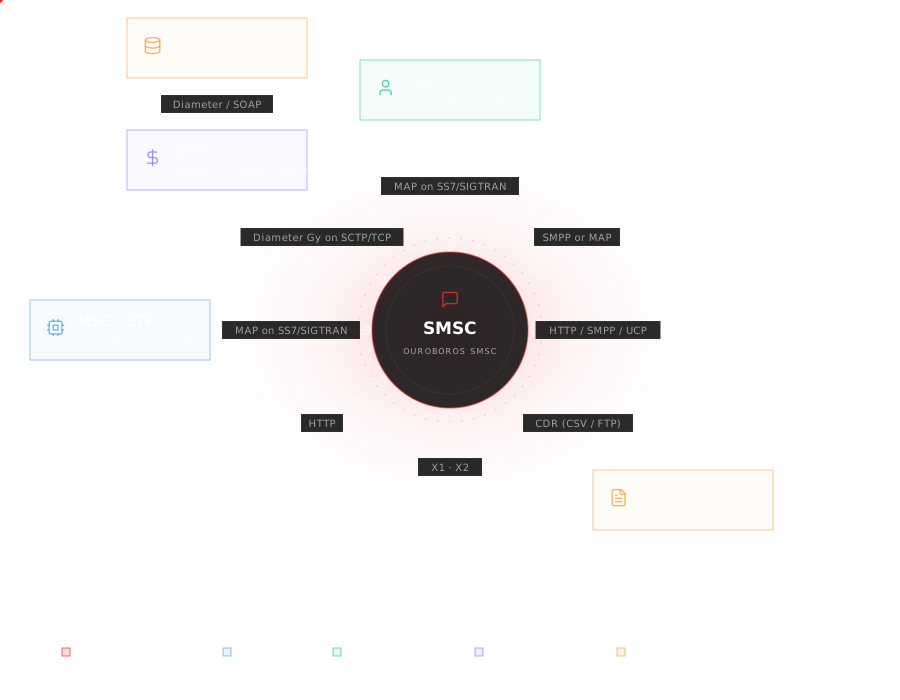
SMSC interface map — MAP · SMPP · Diameter · HTTP, with lawful interception
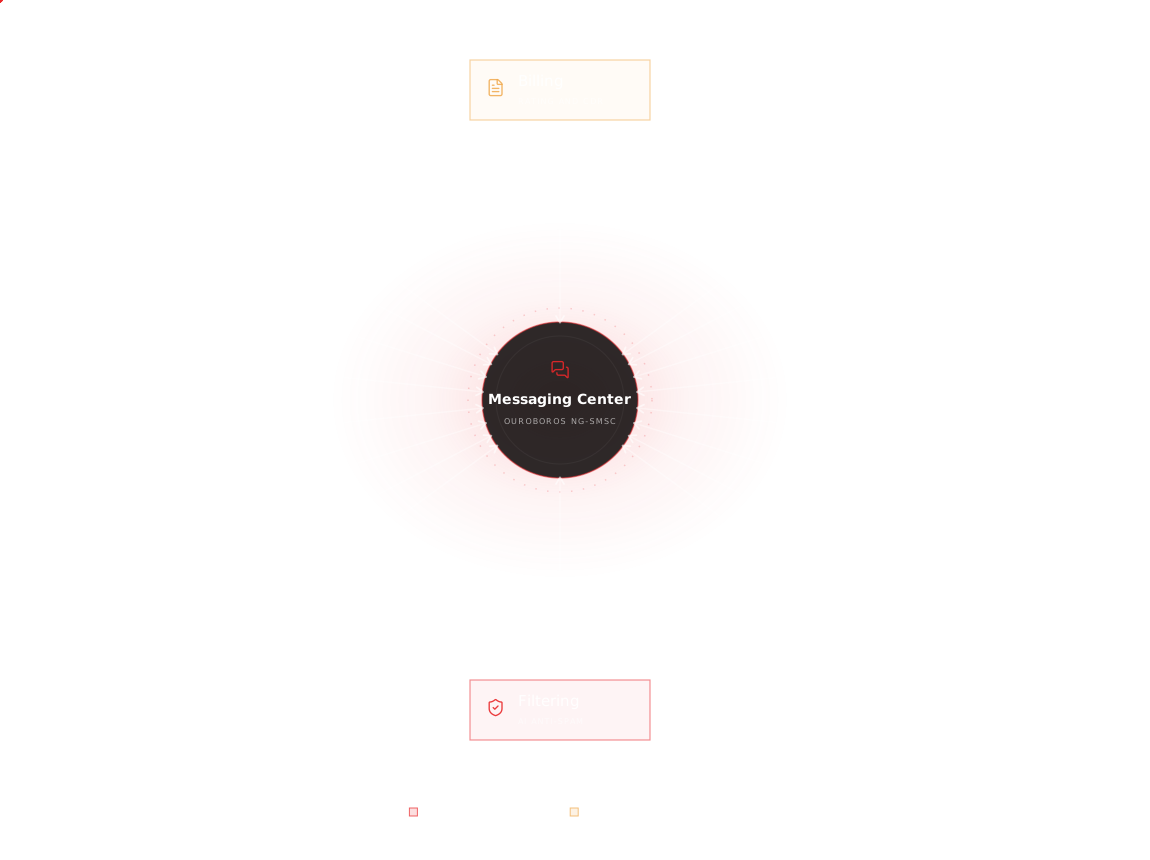
Messaging Center — any channel in, any channel out
One incident, one response, one resolution — from firewall consolidation to interactive SMS services.
legacy 2G/3G SMSC
Replace your original SMSC and interconnexions with partners.
IP-SM-GW
2 modes: - classical IP-SM-GW: translate IMS SMS to 2G SMS, and register CSCF subscriptions to HLR/HSS. - integrated IP-SM-GW: manage IMS messages and forward to the right network generation without hop and without need of HSS support.
SMS Router
The platform also runs as an SMS router, dispatching selected traffic streams to other SMSC instances or hubs. Per-stream routing rules configure P2P and VAS traffic independently. It enables operator to be a SMPP broker or hub with selectable route/storing per hour.
4G/5G over NAS SMSC
Reduces the overhead of IMS: SMS are exchanged directly with the MME over Diameter SGd, or with the AMF over NAS through the integrated SMSF (N20), with MT routing to the domain where the subscriber is registered.
SMS Home Routing
Incoming SMS is routed through the home network before reaching the subscriber, keeping the serving network's identity hidden from the originating operator. Subscriber location data is not exposed to external networks during delivery.
VAS and marketing traffic management
Per-stream routing handles marketing campaign traffic on Direct Delivery Attempt while P2P runs Store-and-Forward. Each queue is independently configured. Campaigns do not interfere with person-to-person delivery behaviour.
Bulk SMS for enterprise and VAS providers
HTTP and SMPP connectivity allows enterprise customers and VAS providers to send high-volume campaigns through the operator's SMSC.
IoT SMS gateway
SMS or USSD payloads are mapped directly to and from IoT protocols such as MQTT and CoAP, so existing SMS-centric industrial applications talk to new IoT devices without being rewritten. An alert is raised when a device misses its regular message, which reveals broken devices.

We've selected Ouroboros because it was the best company capable of fulfilling our need for a scalable and virtualised full MVNO platform. Moreover, the Ouroboros team is pragmatic, flexible and responsive.
Pascal Prot
CEO-CTO · Legos
Any-to-any message conversion
SMS, USSD, SIP, HTTP, SMPP, mail and IoT protocols are converted into each other. One platform runs as SMS-C, SMS router, SMS hub, USSD gateway, IP-SM-GW, SMSF, SMPP hub or HTTP/SMPP translator.
Integrated SMS firewall
Filtering rules on calling and called party, MSC of origin, DCS, UDH, number of parts and hourly statistics, plus white and black lists of up to 150 000 numbers each, with wildcards and longest match. Fake, spoofed and spam SMS are discarded and logged in a CDR.
Store-and-forward policy per queue
First delivery attempt, then retries configured per queue: number of retries, cyclic delays per error cause, time to live, synchronous or asynchronous delivery. Retries start immediately on an HLR/HSS alert.
Billing per number range
CAMEL, Diameter Ro/Gy, SQL or HTTP charging, selected per subscriber number range. Prepaid and postpaid traffic run on the same platform.
Mobile number portability and multi SC identity
Ported numbers are routed directly to the right network without an external MNP-SRF. A different service centre address can be presented per HLR and route for multi-carrier or roaming agreements.
Supervision and reporting
CSV CDRs for every flow, web reporting with statistics per country, queue, service and PLMN, SNMP counters and threshold alarms.
Carrier-grade redundancy
Active/standby cluster with a switch-over under 1 ms, message storage duplicated synchronously on two servers, and geographic redundancy through database replication to a remote site.
IPv4, IPv6 and dual-stack
Every interface runs over IPv4, IPv6 or both. The element fits an IPv6 core or a mixed network without a separate configuration.
Ouroboros built the all mobile messaging generations and all VAS into one SMSC platform. Same code base, same team, same support contract, no intermediation or integration needed. Low deployment time, ease of operational management.
A 2G SMSC, an IMS messaging gateway, a USSD gateway, and a spam filter: four products, four vendors, four incident systems. The Ouroboros Next-Gen Messaging Center consolidates all four. Protocol translation, store-and-forward, USSD sessions, and AI spam filtering run from one platform, under one support contract.
In deployment since 2005, on networks including Vala, MTN, Orange and Salt.
OPEX rental is also available. A new messaging platform need not be a capital project before the first message is billed.

Which SMSC are you on, and what protocol mix and volumes does your network carry? We'll confirm what the Next-Gen SMSC covers and what consolidation looks like.
 Product datasheet
2G / 3G · 2G/3G Core
Messaging Center (SMSC)
Ouroboros Messaging Center is a low latency and high throughput, fully-featured and extended SMS-C, able to handle SMS-MO and SMS-MT in all generations. Depending on its configuration, it will act as a pure SMS-C, as an SMS router to dispatch selected traffic to other SMS-C instances, or as an SMS hub. Manage VoLTE, VoNR, SMS over MME (SGd) and SMS over NAS for 5G SA in one platform.
In production since 2005 · 99.999% availability (geo-redundant clustering)
Traffic and threat. One platform. One team to call.
Every message passes through
Every person-to-person message, every Value Added Service message, every marketing campaign SMS pass through operator SMSC. It stores, charges, routes, and delivers. It also sits at the point where fraud enters the network — which is why the firewall belongs in the same system, not alongside it.
The full SMS lifecycle
The Ouroboros SMSC handles the full SMS lifecycle: Mobile Originated (SMS-MO) and Mobile Terminated (SMS-MT) and networks intermediation from 2G to 5G-SA. Charge SMS through various interfaces (normal, free, premium) incoming or outgoing messages. Moreover, our Messaging Center supports complex routing rules definition through independent feeder/behaviour for each of the incoming/outgoing queues.
Firewall built in, not bolted on
Anti-spoofing, AI driven content scanning, flood prevention, and blacklist-based anti-spam are integrated modules. None require a separate integration project.
SMSC interface map — MAP · SMPP · Diameter · HTTP, with lawful interception · 1/2
Messaging Center — any channel in, any channel out · 2/2
How operators use it.
One incident, one response, one resolution — from firewall consolidation to interactive SMS services.
legacy 2G/3G SMSC
Replace your original SMSC and interconnexions with partners.
IP-SM-GW
2 modes: - classical IP-SM-GW: translate IMS SMS to 2G SMS, and register CSCF subscriptions to HLR/HSS. - integrated IP-SM-GW: manage IMS messages and forward to the right network generation without hop and without need of HSS support.
SMS Router
The platform also runs as an SMS router, dispatching selected traffic streams to other SMSC instances or hubs. Per-stream routing rules configure P2P and VAS traffic independently. It enables operator to be a SMPP broker or hub with selectable route/storing per hour.
4G/5G over NAS SMSC
Reduces the overhead of IMS: SMS are exchanged directly with the MME over Diameter SGd, or with the AMF over NAS through the integrated SMSF (N20), with MT routing to the domain where the subscriber is registered.
SMS Home Routing
Incoming SMS is routed through the home network before reaching the subscriber, keeping the serving network's identity hidden from the originating operator. Subscriber location data is not exposed to external networks during delivery.
VAS and marketing traffic management
Per-stream routing handles marketing campaign traffic on Direct Delivery Attempt while P2P runs Store-and-Forward. Each queue is independently configured. Campaigns do not interfere with person-to-person delivery behaviour.
Bulk SMS for enterprise and VAS providers
HTTP and SMPP connectivity allows enterprise customers and VAS providers to send high-volume campaigns through the operator's SMSC.
IoT SMS gateway
SMS or USSD payloads are mapped directly to and from IoT protocols such as MQTT and CoAP, so existing SMS-centric industrial applications talk to new IoT devices without being rewritten. An alert is raised when a device misses its regular message, which reveals broken devices.
Specifications.
Inside the platform.
Any-to-any message conversion
SMS, USSD, SIP, HTTP, SMPP, mail and IoT protocols are converted into each other. One platform runs as SMS-C, SMS router, SMS hub, USSD gateway, IP-SM-GW, SMSF, SMPP hub or HTTP/SMPP translator.
Integrated SMS firewall
Filtering rules on calling and called party, MSC of origin, DCS, UDH, number of parts and hourly statistics, plus white and black lists of up to 150 000 numbers each, with wildcards and longest match. Fake, spoofed and spam SMS are discarded and logged in a CDR.
Store-and-forward policy per queue
First delivery attempt, then retries configured per queue: number of retries, cyclic delays per error cause, time to live, synchronous or asynchronous delivery. Retries start immediately on an HLR/HSS alert.
Billing per number range
CAMEL, Diameter Ro/Gy, SQL or HTTP charging, selected per subscriber number range. Prepaid and postpaid traffic run on the same platform.
Mobile number portability and multi SC identity
Ported numbers are routed directly to the right network without an external MNP-SRF. A different service centre address can be presented per HLR and route for multi-carrier or roaming agreements.
Supervision and reporting
CSV CDRs for every flow, web reporting with statistics per country, queue, service and PLMN, SNMP counters and threshold alarms.
Carrier-grade redundancy
Active/standby cluster with a switch-over under 1 ms, message storage duplicated synchronously on two servers, and geographic redundancy through database replication to a remote site.
IPv4, IPv6 and dual-stack
Every interface runs over IPv4, IPv6 or both. The element fits an IPv6 core or a mixed network without a separate configuration.
Ouroboros built the all mobile messaging generations and all VAS into one SMSC platform. Same code base, same team, same support contract, no intermediation or integration needed. Low deployment time, ease of operational management.
A 2G SMSC, an IMS messaging gateway, a USSD gateway, and a spam filter: four products, four vendors, four incident systems. The Ouroboros Next-Gen Messaging Center consolidates all four. Protocol translation, store-and-forward, USSD sessions, and AI spam filtering run from one platform, under one support contract.
In deployment since 2005, on networks including Vala, MTN, Orange and Salt.
OPEX rental is also available. A new messaging platform need not be a capital project before the first message is billed.
HLR
The SMSC performs HLR lookups on every SMS delivery. A direct dependency in any 2G/3G messaging stack.
USSD Gateway
Interactive messaging over USSD, running alongside SMS on the same network.
SCP
2G Billing and service logic for SMS-based services, triggered from the SMSC via CAMEL.
OCS
4G billing and service logic for SMS-based services, triggered from the SMSC via Diameter.
SMSF
The 5G SA mode of the Messaging Center: SMS over NAS through the AMF.
IP-SMS Gateway
The VoLTE, VoWiFi and VoNR mode of the Messaging Center.
AI Anti-Smishing SMS Firewall
AI scoring of every message, inline in front of the SMSC.
Next step
How many separate vendors are in your messaging stack today?
Which SMSC are you on, and what protocol mix and volumes does your network carry? We'll confirm what the Next-Gen SMSC covers and what consolidation looks like.