- 01MSC / VLRMSC/VLR
- 02Gateway Mobile Switching CenterGMSC
- 03Gateway Mobile Location CentreGMLC
- 04Home Location RegisterHLR
- 05Messaging CenterSMSC
- 06Signaling Transfer PointSTP
- 07GGSN / SGSNGGSN
- 08S4-SGSNSGSN
- 09Equipment Identity RegisterEIR
- 10Service Control PointSCP
- 11USSD GatewayUSSD
- 12Cell Broadcast CentreCBC
Real-time SS7 signalling routing for 2G/3G networks and the SS7 interworking of the 4G and 5G cores: legacy PCM SS7 links and SIGTRAN on one Signalling Router. The same node acts as STP, number portability server and SS7 firewall.
Every network element generates signalling. The MSC, HLR, SMSC, SCP and the rest all need to exchange messages to set up calls, deliver SMS, and look up subscribers. Without a routing hub, each element has to address every other element directly, and every interconnect with another operator adds another set of direct links to maintain.
Operators also run two kinds of SS7 transport at once. Legacy network elements speak PCM SS7 over E1 or STM-1; newer elements speak SIGTRAN, SS7 over IP. A network that cannot route both on one platform ends up maintaining separate signalling layers, each with its own configuration, its own licences and its own failure points.

A star instead of a mesh
The STP is the signalling routing hub of the network. Every message from an MSC, HLR, SMSC, SCP or external operator arrives at the STP, which routes it to its destination by Point Code, Global Title, SSN, translation type, MAP or CAP operation, or routing key. Elements no longer need to address each other directly. They address the STP. The star topology reduces the number of links and the declarations needed in every other element, especially for number portability.
PCM and SIGTRAN on one router
The Ouroboros Signalling Router handles legacy PCM SS7 links (Low Speed Links and High Speed Links) and SIGTRAN M3UA links. PCM and SIGTRAN can be mixed for the same signalling end point, so components migrate from TDM to IP without a cut-over. SCCP UDT, XUDT and LUDT are supported, with load sharing and failover driven by congestion and link state.
Mated pair, stateless processing
STPs are installed as a mated pair with instantaneous route failover, in less than one millisecond. Packets are processed stateless, so the failure of one STP has no impact on the network and no loss of capacity.
Number portability, handled centrally
The STP chooses the right HLR or operator per MGT, MSISDN or IMSI range or full number (MNP-SRF). The MNP tables are open and support any portability scheme, centralised or decentralised, across one country or several.
Security, translation and value-added services
As an Edge STP, the router screens and blocks unwanted SS7 traffic at the network border and hides the internal topology. PCM links are translated to SIGTRAN for elements that only speak IP. An external VAS callback over HTTP can choose the route, rewrite the GT number or block a message after inspection.
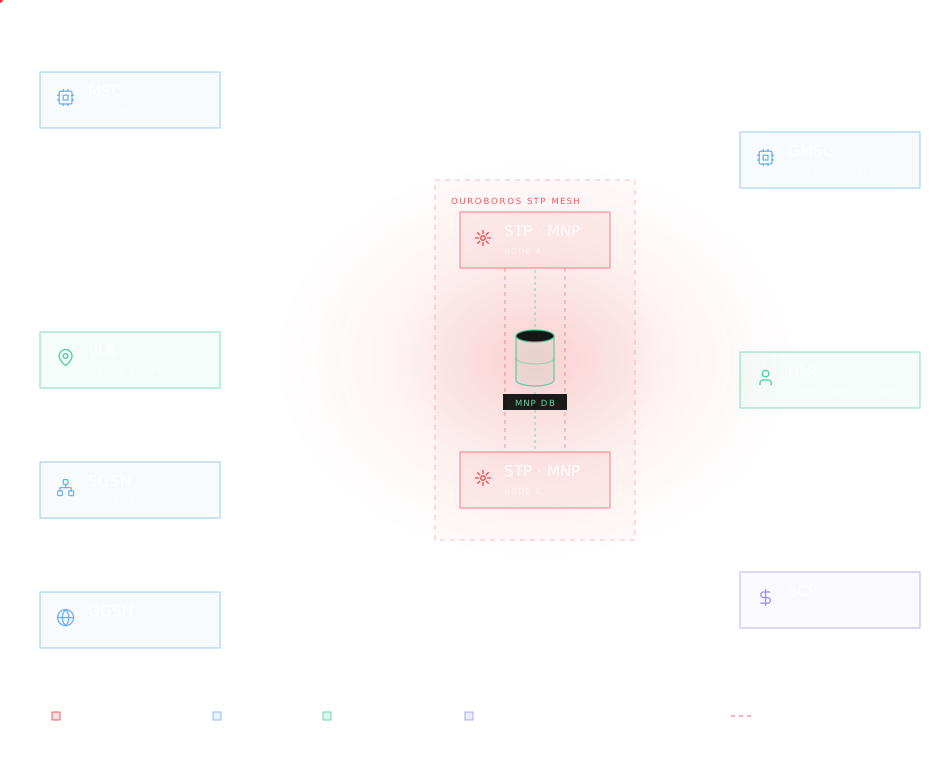
STP — redundant signalling pair
Hub-and-spoke signalling, SS7-to-IP migration, number portability, signalling security — one platform.
Consolidating PCM and IP signalling
An operator running PCM SS7 and SIGTRAN routes both through one Signalling Router, and migrates its elements from TDM to IP one by one. The signalling layers share a single routing configuration instead of separate platforms.
Inter-operator interconnect and SS7 firewall
Signalling to and from external operators is routed, screened and filtered at the Edge STP. Rules choose the link per destination or commercial contract, and topology hiding keeps the internal network invisible.
Mobile Number Portability
The STP routes calls, SMS and lookups of ported numbers to the right HLR or operator, with open tables that follow the national portability scheme.
Value-added services
Plugins of the STP use the signalling it routes to trigger SMS Welcome, Goodbye and Bon Voyage campaigns for inbound and outbound roamers.

We've selected Ouroboros because it was the best company capable of fulfilling our need for a scalable and virtualised full MVNO platform. Moreover, the Ouroboros team is pragmatic, flexible and responsive.
Pascal Prot
CEO-CTO · Legos
PCM SS7 and SIGTRAN on one platform
Legacy PCM links (LSL and HSL) and SS7 over IP route through the same platform. No second platform for the IP signalling layer.
Rich routing criteria
Point Code, Global Title, SSN, translation type, MAP and CAP operation codes and routing key. Calling and called numbers can be rewritten, including the numbering plan of a country.
Multiple identities in one node
Several Point Codes and Global Titles of different natures run on the same node, so several network functions are integrated in one STP.
Open number portability
MNP-SRF with open tables supporting any country portability system, even several countries.
SS7 firewall
The Edge STP mode screens messages per peer, block attacks at the border and hide the topology.
No licence per link or per TPS
STP capacity is unlimited from the start. Capacity grows by adding links and nodes, not licence keys.
Operations
Wireshark dumping, probing of signalling end points, SNMP and HTTP management with traps, Prometheus metrics, and a licence manager checking instances in NFV infrastructure.
IPv4, IPv6 and dual-stack
Every interface runs over IPv4, IPv6 or both. The element fits an IPv6 core or a mixed network without a separate configuration.
The Ouroboros Signalling Router covers SS7 signalling on one platform: PCM SS7 and SIGTRAN, with number portability, firewall and translation built in. Ouroboros develops its own SS7 stack, so non-standard adaptations and national variants are possible on request.
There is no licence per link or per TPS. It runs on COTS hardware, virtual machines or containers, as part of a platform in production since 2004 across 30+ countries.

Tell us your current signalling topology: PCM SS7, SIGTRAN, and the elements you need to route between. We'll confirm the right Signalling Router configuration for your network.
 Product datasheet
2G / 3G · 2G/3G Core
Signaling Transfer Point (STP)
Real-time SS7 signalling routing for 2G/3G networks and the SS7 interworking of the 4G and 5G cores: legacy PCM SS7 links and SIGTRAN on one Signalling Router. The same node acts as STP, number portability server and SS7 firewall.
In production since 2010 · 148M+ subscribers · 30+ countries · 99.999% availability
When every element has to talk to every other element
Every network element generates signalling. The MSC, HLR, SMSC, SCP and the rest all need to exchange messages to set up calls, deliver SMS, and look up subscribers. Without a routing hub, each element has to address every other element directly, and every interconnect with another operator adds another set of direct links to maintain.
Operators also run two kinds of SS7 transport at once. Legacy network elements speak PCM SS7 over E1 or STM-1; newer elements speak SIGTRAN, SS7 over IP. A network that cannot route both on one platform ends up maintaining separate signalling layers, each with its own configuration, its own licences and its own failure points.
One connection. Every destination.
A star instead of a mesh
The STP is the signalling routing hub of the network. Every message from an MSC, HLR, SMSC, SCP or external operator arrives at the STP, which routes it to its destination by Point Code, Global Title, SSN, translation type, MAP or CAP operation, or routing key. Elements no longer need to address each other directly. They address the STP. The star topology reduces the number of links and the declarations needed in every other element, especially for number portability.
PCM and SIGTRAN on one router
The Ouroboros Signalling Router handles legacy PCM SS7 links (Low Speed Links and High Speed Links) and SIGTRAN M3UA links. PCM and SIGTRAN can be mixed for the same signalling end point, so components migrate from TDM to IP without a cut-over. SCCP UDT, XUDT and LUDT are supported, with load sharing and failover driven by congestion and link state.
Mated pair, stateless processing
STPs are installed as a mated pair with instantaneous route failover, in less than one millisecond. Packets are processed stateless, so the failure of one STP has no impact on the network and no loss of capacity.
Number portability, handled centrally
The STP chooses the right HLR or operator per MGT, MSISDN or IMSI range or full number (MNP-SRF). The MNP tables are open and support any portability scheme, centralised or decentralised, across one country or several.
Security, translation and value-added services
As an Edge STP, the router screens and blocks unwanted SS7 traffic at the network border and hides the internal topology. PCM links are translated to SIGTRAN for elements that only speak IP. An external VAS callback over HTTP can choose the route, rewrite the GT number or block a message after inspection.
STP — redundant signalling pair
How operators use it.
Hub-and-spoke signalling, SS7-to-IP migration, number portability, signalling security — one platform.
Consolidating PCM and IP signalling
An operator running PCM SS7 and SIGTRAN routes both through one Signalling Router, and migrates its elements from TDM to IP one by one. The signalling layers share a single routing configuration instead of separate platforms.
Inter-operator interconnect and SS7 firewall
Signalling to and from external operators is routed, screened and filtered at the Edge STP. Rules choose the link per destination or commercial contract, and topology hiding keeps the internal network invisible.
Mobile Number Portability
The STP routes calls, SMS and lookups of ported numbers to the right HLR or operator, with open tables that follow the national portability scheme.
Value-added services
Plugins of the STP use the signalling it routes to trigger SMS Welcome, Goodbye and Bon Voyage campaigns for inbound and outbound roamers.
Specifications.
Inside the platform.
PCM SS7 and SIGTRAN on one platform
Legacy PCM links (LSL and HSL) and SS7 over IP route through the same platform. No second platform for the IP signalling layer.
Rich routing criteria
Point Code, Global Title, SSN, translation type, MAP and CAP operation codes and routing key. Calling and called numbers can be rewritten, including the numbering plan of a country.
Multiple identities in one node
Several Point Codes and Global Titles of different natures run on the same node, so several network functions are integrated in one STP.
Open number portability
MNP-SRF with open tables supporting any country portability system, even several countries.
SS7 firewall
The Edge STP mode screens messages per peer, block attacks at the border and hide the topology.
No licence per link or per TPS
STP capacity is unlimited from the start. Capacity grows by adding links and nodes, not licence keys.
Operations
Wireshark dumping, probing of signalling end points, SNMP and HTTP management with traps, Prometheus metrics, and a licence manager checking instances in NFV infrastructure.
IPv4, IPv6 and dual-stack
Every interface runs over IPv4, IPv6 or both. The element fits an IPv6 core or a mixed network without a separate configuration.
The Ouroboros Signalling Router covers SS7 signalling on one platform: PCM SS7 and SIGTRAN, with number portability, firewall and translation built in. Ouroboros develops its own SS7 stack, so non-standard adaptations and national variants are possible on request.
There is no licence per link or per TPS. It runs on COTS hardware, virtual machines or containers, as part of a platform in production since 2004 across 30+ countries.
HLR
Signalling between the MSC and HLR is routed through the STP on every subscriber lookup, with MNP choosing the right HLR.
GMSC
Voice call signalling between the GMSC and the rest of the network passes through the STP.
DRA
The Diameter routing of the 4G and 5G core, beside the STP.
Next step
Routing PCM and IP signalling on separate platforms?
Tell us your current signalling topology: PCM SS7, SIGTRAN, and the elements you need to route between. We'll confirm the right Signalling Router configuration for your network.