- 01Access and Mobility Management FunctionAMF
- 02Unified Data ManagementUDM
- 03Policy Control FunctionPCF
- 04Network Repository FunctionNRF
- 05Non-3GPP Interworking FunctionN3IWF
- 06Security Edge Protection ProxySEPP
- 07Network Slice Selection FunctionNSSF
- 08Service Communication ProxySCP
- 09Application FunctionAF
- 10Location Management FunctionLMF
- 11Cell Broadcast CentreCBCF
- 12Gateway Mobile Location CentreGMLC
- 13Session Management FunctionSMF
- 14User Plane FunctionUPF
- 15SMS FunctionSMSF
- 16Equipment Identity RegisterEIR
Emergency services, lawful interception and location services all ask the same question: where is the device? In the 5G core, the LMF computes the answer.
In 2G, 3G and 4G, location requests went to the MSC or the MME, which often only knew the serving cell. A cell can cover a few hundred metres in a city and tens of kilometres in the countryside: too coarse to send an ambulance to the right house.
The 5G core separates the roles. The GMLC receives the requests and checks the privacy of the subscriber, the AMF knows the device, and a dedicated function, the LMF, runs the positioning with the device and the radio network. Without an LMF, a 5G network can only answer with the cell.

From the client to the LMF
A location client asks the GMLC, which checks the privacy settings in the UDM and asks the serving AMF. The AMF hands the request to the LMF over NL1, with the requested accuracy and response time.
Talk to the device and the radio
The LMF exchanges LPP with the device and NRPPa with the gNodeB, both carried by the AMF inside the NAS and the NGAP. It learns the capabilities of the device, sends assistance data — for example the GNSS data of a reference network — and collects the measurements of the device and of the gNodeB.
Compute the position
From the capabilities and the requested quality, the LMF selects the method: cell identity, enhanced cell identity, assisted GNSS, or the NR methods based on time of arrival, round trip time and angles. It returns the position, its accuracy and the method used to the AMF, then to the GMLC and the client.
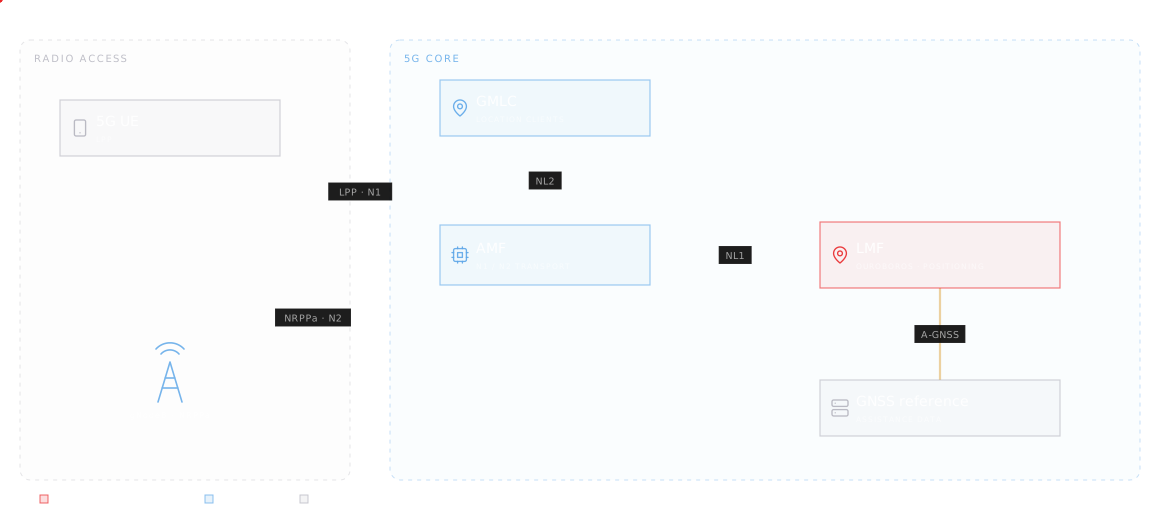
LMF — location of the devices in the 5G core
Emergency calls, lawful interception, location services, IoT, industry — one positioning function.
Emergency calls
The position of the caller is computed and sent to the public safety answering point, with the best method the device and the network allow.
Lawful interception
The location of the targets is provided to the authorities, in line with the interception of their sessions.
Location-based services
Fleet management, asset tracking and people-finder services obtain positions through the GMLC or the NEF, within the privacy rules of each subscriber.
Periodic and triggered location
Positions are reported at regular intervals, when a device enters or leaves an area, or when it moves.
Industry and IoT
On a campus or a factory with suitable NR coverage, devices are located with the NR time and angle methods.

We've selected Ouroboros because it was the best company capable of fulfilling our need for a scalable and virtualised full MVNO platform. Moreover, the Ouroboros team is pragmatic, flexible and responsive.
Pascal Prot
CEO-CTO · Legos
Core network function
The LMF sits in the 5G core and talks to the AMF only. It works with any gNodeB that supports NRPPa.
Method selection
The method follows the requested accuracy and response time, and the capabilities of the device and of the radio network.
Cell ID and E-CID
Available with every NR and LTE radio network connected to the 5G core.
Assisted GNSS
GNSS assistance data from a reference network shorten the time to fix and improve accuracy.
NR positioning methods
Downlink and uplink time difference of arrival, multi-cell round trip time, angles of departure and arrival.
Immediate, periodic and triggered
Single requests, periodic reporting, area and motion events.
Supervision
Counters per method and per client, SNMP traps and Prometheus metrics.
IPv4, IPv6 and dual-stack
Every interface runs over IPv4, IPv6 or both. The element fits an IPv6 core or a mixed network without a separate configuration.
The LMF comes from the same platform as the AMF and the GMLC it works with, tested together in the Ouroboros TechLab. The location chain — client, GMLC, UDM, AMF, LMF — is delivered by one vendor. It also works with third-party AMFs and gNodeBs over the standard interfaces.

Tell us your location use cases, your radio network and the accuracy you need. We'll propose an LMF and GMLC configuration to match, on OPEX or CAPEX.
 Product datasheet
5G Standalone · 5G Standalone
Location Management Function (LMF)
Emergency services, lawful interception and location services all ask the same question: where is the device? In the 5G core, the LMF computes the answer.
In production since 2004 · 148M+ subscribers · 99.999% availability
Locating a device takes more than knowing its cell
In 2G, 3G and 4G, location requests went to the MSC or the MME, which often only knew the serving cell. A cell can cover a few hundred metres in a city and tens of kilometres in the countryside: too coarse to send an ambulance to the right house.
The 5G core separates the roles. The GMLC receives the requests and checks the privacy of the subscriber, the AMF knows the device, and a dedicated function, the LMF, runs the positioning with the device and the radio network. Without an LMF, a 5G network can only answer with the cell.
Ask the AMF, the LMF does the maths.
From the client to the LMF
A location client asks the GMLC, which checks the privacy settings in the UDM and asks the serving AMF. The AMF hands the request to the LMF over NL1, with the requested accuracy and response time.
Talk to the device and the radio
The LMF exchanges LPP with the device and NRPPa with the gNodeB, both carried by the AMF inside the NAS and the NGAP. It learns the capabilities of the device, sends assistance data — for example the GNSS data of a reference network — and collects the measurements of the device and of the gNodeB.
Compute the position
From the capabilities and the requested quality, the LMF selects the method: cell identity, enhanced cell identity, assisted GNSS, or the NR methods based on time of arrival, round trip time and angles. It returns the position, its accuracy and the method used to the AMF, then to the GMLC and the client.
LMF — location of the devices in the 5G core
How operators use it.
Emergency calls, lawful interception, location services, IoT, industry — one positioning function.
Emergency calls
The position of the caller is computed and sent to the public safety answering point, with the best method the device and the network allow.
Lawful interception
The location of the targets is provided to the authorities, in line with the interception of their sessions.
Location-based services
Fleet management, asset tracking and people-finder services obtain positions through the GMLC or the NEF, within the privacy rules of each subscriber.
Periodic and triggered location
Positions are reported at regular intervals, when a device enters or leaves an area, or when it moves.
Industry and IoT
On a campus or a factory with suitable NR coverage, devices are located with the NR time and angle methods.
Specifications.
Inside the platform.
Core network function
The LMF sits in the 5G core and talks to the AMF only. It works with any gNodeB that supports NRPPa.
Method selection
The method follows the requested accuracy and response time, and the capabilities of the device and of the radio network.
Cell ID and E-CID
Available with every NR and LTE radio network connected to the 5G core.
Assisted GNSS
GNSS assistance data from a reference network shorten the time to fix and improve accuracy.
NR positioning methods
Downlink and uplink time difference of arrival, multi-cell round trip time, angles of departure and arrival.
Immediate, periodic and triggered
Single requests, periodic reporting, area and motion events.
Supervision
Counters per method and per client, SNMP traps and Prometheus metrics.
IPv4, IPv6 and dual-stack
Every interface runs over IPv4, IPv6 or both. The element fits an IPv6 core or a mixed network without a separate configuration.
The LMF comes from the same platform as the AMF and the GMLC it works with, tested together in the Ouroboros TechLab. The location chain — client, GMLC, UDM, AMF, LMF — is delivered by one vendor. It also works with third-party AMFs and gNodeBs over the standard interfaces.
Gateway Mobile Location Centre (GMLC)
The GMLC receives the location requests and reaches the LMF through the AMF.
Access and Mobility Management Function (AMF)
The AMF selects the LMF and carries its messages to the device and the gNodeB.
Unified Data Management (UDM)
The UDM holds the location privacy settings of each subscriber, checked by the GMLC.
Next step
How precisely can your 5G network locate a device?
Tell us your location use cases, your radio network and the accuracy you need. We'll propose an LMF and GMLC configuration to match, on OPEX or CAPEX.