- 01Access and Mobility Management FunctionAMF
- 02Unified Data ManagementUDM
- 03Policy Control FunctionPCF
- 04Network Repository FunctionNRF
- 05Non-3GPP Interworking FunctionN3IWF
- 06Security Edge Protection ProxySEPP
- 07Network Slice Selection FunctionNSSF
- 08Service Communication ProxySCP
- 09Application FunctionAF
- 10Location Management FunctionLMF
- 11Cell Broadcast CentreCBCF
- 12Gateway Mobile Location CentreGMLC
- 13Session Management FunctionSMF
- 14User Plane FunctionUPF
- 15SMS FunctionSMSF
- 16Equipment Identity RegisterEIR
Network slicing turns one 5G network into many. The NSSF decides which slices each device may use, where, and which network functions serve them.
A slice is a logical network with its own functions and resources: broadband for smartphones, low latency for a factory, massive IoT for meters, a private network for a company. A device asks for slices when it registers; its subscription says which ones it may have. But not every slice is available everywhere, and not every AMF serves every slice.
Without a central decision point, each AMF has to carry the slice rules of the whole network: which slices exist in which area, which AMF set and which NRF serve them. Every new slice or new site becomes a configuration change in every AMF.

Slice selection at registration
When a device registers, the AMF sends the NSSF the slices requested by the device, the slices of its subscription and the tracking area. The NSSF answers the Allowed NSSAI — the slices the device may use now — the Configured NSSAI to store in the device, and the slices it rejects, with the cause: not available in the network, or not available in this area.
The right AMF and the right NRF
If the AMF that received the registration does not serve the allowed slices, the NSSF returns the AMF set that does, and the registration is re-allocated to it. For each slice, the NSSF also gives the NRF to use, so that the SMF and the other functions of the slice are discovered inside it.
Availability per area and roaming
The AMFs report which slices they support in each tracking area and are notified when the operator changes the slice configuration. For a roaming device, the NSSF maps the slices of the visited network to the slices of the home network, asking the home NSSF over N31 through the SEPP.
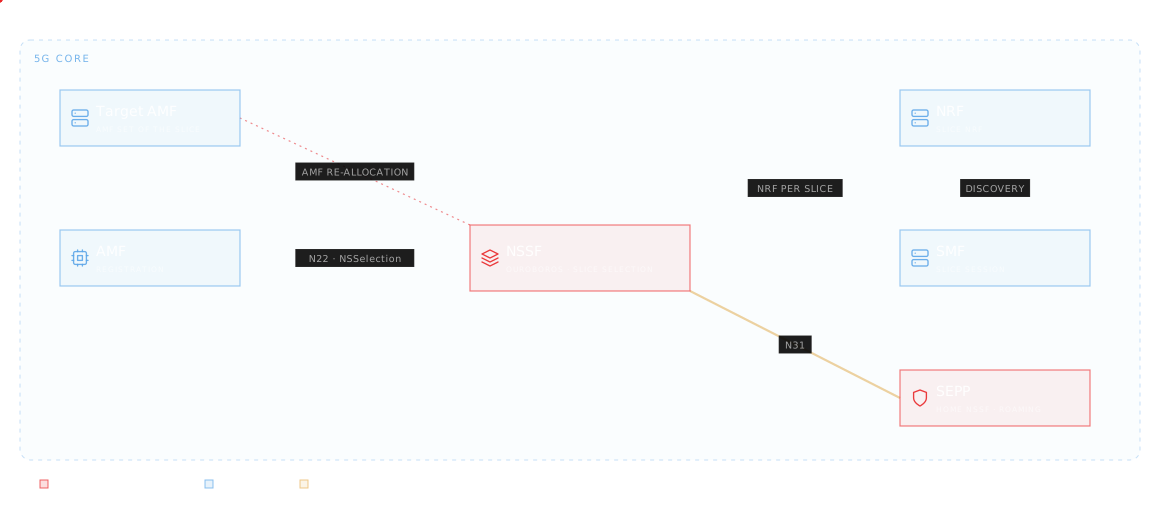
NSSF — network slice selection in the 5G core
Service slices, enterprise slices, local slices, dedicated AMFs, roaming — one slice policy.
Slices per service
Broadband, low-latency and massive IoT slices run side by side, each with its own SMF and UPF, and each device gets the slices of its subscription.
Enterprise slices
A company gets a private slice on the public network, with its own DNN and user plane, without a separate core.
Local slices
A slice can be offered only in some tracking areas — a factory, a port, a stadium — and is rejected elsewhere with the right cause.
Dedicated AMF sets
Critical slices are served by their own AMFs. The NSSF sends the devices of those slices to them by AMF re-allocation.
Roaming
Visitors' slices are mapped to the slices of their home network, so roaming devices keep their services.

We've selected Ouroboros because it was the best company capable of fulfilling our need for a scalable and virtualised full MVNO platform. Moreover, the Ouroboros team is pragmatic, flexible and responsive.
Pascal Prot
CEO-CTO · Legos
Central slice policy
Slices, tracking areas, AMF sets and NRFs are defined once, in the NSSF, for all the AMFs.
Allowed and Configured NSSAI
Selection follows the request of the device, its subscription and the tracking area, with rejection causes the device understands.
AMF re-allocation
The NSSF returns the AMF set of the slices when the serving AMF cannot handle them.
NRF per slice
Each slice can have its own NRF, so its functions are discovered inside the slice.
Availability per tracking area
AMFs report their supported slices per tracking area and are notified of changes.
Slice mapping for roamers
Visited and home slices are mapped, with the home NSSF reached over N31.
Provisioning and supervision
Slices and areas are provisioned by HTTP and CSV. Counters per slice and per tracking area, SNMP traps and Prometheus metrics show how slices are used.
IPv4, IPv6 and dual-stack
Every interface runs over IPv4, IPv6 or both. The element fits an IPv6 core or a mixed network without a separate configuration.
The NSSF comes from the same platform as the AMF, UDM and NRF it works with, tested together in the Ouroboros TechLab: the slices of the subscription in the UDM, the selection in the NSSF and the discovery in the NRF follow the same model. It also works with third-party AMFs over the standard SBI.
It runs on the same infrastructure options as the rest of the core: bare metal, VMware, KVM, Docker, Kubernetes or public cloud, with active-active and geographical redundancy.

Tell us the slices you plan, where they should be available and which functions serve them. We'll propose an NSSF configuration to match, on OPEX or CAPEX.
 Product datasheet
5G Standalone · 5G Standalone
Network Slice Selection Function (NSSF)
Network slicing turns one 5G network into many. The NSSF decides which slices each device may use, where, and which network functions serve them.
In production since 2004 · 148M+ subscribers · 99.999% availability
Slices are only useful if each device lands in the right one
A slice is a logical network with its own functions and resources: broadband for smartphones, low latency for a factory, massive IoT for meters, a private network for a company. A device asks for slices when it registers; its subscription says which ones it may have. But not every slice is available everywhere, and not every AMF serves every slice.
Without a central decision point, each AMF has to carry the slice rules of the whole network: which slices exist in which area, which AMF set and which NRF serve them. Every new slice or new site becomes a configuration change in every AMF.
Requested, subscribed, allowed.
Slice selection at registration
When a device registers, the AMF sends the NSSF the slices requested by the device, the slices of its subscription and the tracking area. The NSSF answers the Allowed NSSAI — the slices the device may use now — the Configured NSSAI to store in the device, and the slices it rejects, with the cause: not available in the network, or not available in this area.
The right AMF and the right NRF
If the AMF that received the registration does not serve the allowed slices, the NSSF returns the AMF set that does, and the registration is re-allocated to it. For each slice, the NSSF also gives the NRF to use, so that the SMF and the other functions of the slice are discovered inside it.
Availability per area and roaming
The AMFs report which slices they support in each tracking area and are notified when the operator changes the slice configuration. For a roaming device, the NSSF maps the slices of the visited network to the slices of the home network, asking the home NSSF over N31 through the SEPP.
NSSF — network slice selection in the 5G core
How operators use it.
Service slices, enterprise slices, local slices, dedicated AMFs, roaming — one slice policy.
Slices per service
Broadband, low-latency and massive IoT slices run side by side, each with its own SMF and UPF, and each device gets the slices of its subscription.
Enterprise slices
A company gets a private slice on the public network, with its own DNN and user plane, without a separate core.
Local slices
A slice can be offered only in some tracking areas — a factory, a port, a stadium — and is rejected elsewhere with the right cause.
Dedicated AMF sets
Critical slices are served by their own AMFs. The NSSF sends the devices of those slices to them by AMF re-allocation.
Roaming
Visitors' slices are mapped to the slices of their home network, so roaming devices keep their services.
Specifications.
Inside the platform.
Central slice policy
Slices, tracking areas, AMF sets and NRFs are defined once, in the NSSF, for all the AMFs.
Allowed and Configured NSSAI
Selection follows the request of the device, its subscription and the tracking area, with rejection causes the device understands.
AMF re-allocation
The NSSF returns the AMF set of the slices when the serving AMF cannot handle them.
NRF per slice
Each slice can have its own NRF, so its functions are discovered inside the slice.
Availability per tracking area
AMFs report their supported slices per tracking area and are notified of changes.
Slice mapping for roamers
Visited and home slices are mapped, with the home NSSF reached over N31.
Provisioning and supervision
Slices and areas are provisioned by HTTP and CSV. Counters per slice and per tracking area, SNMP traps and Prometheus metrics show how slices are used.
IPv4, IPv6 and dual-stack
Every interface runs over IPv4, IPv6 or both. The element fits an IPv6 core or a mixed network without a separate configuration.
The NSSF comes from the same platform as the AMF, UDM and NRF it works with, tested together in the Ouroboros TechLab: the slices of the subscription in the UDM, the selection in the NSSF and the discovery in the NRF follow the same model. It also works with third-party AMFs over the standard SBI.
It runs on the same infrastructure options as the rest of the core: bare metal, VMware, KVM, Docker, Kubernetes or public cloud, with active-active and geographical redundancy.
Access and Mobility Management Function (AMF)
The AMF asks the NSSF for the slices of each registering device.
Unified Data Management (UDM)
The UDM holds the slices of each subscription.
Network Repository Function (NRF)
Each slice can have its own NRF, given by the NSSF.
Next step
Launching network slices?
Tell us the slices you plan, where they should be available and which functions serve them. We'll propose an NSSF configuration to match, on OPEX or CAPEX.