- 01Virtualised Evolved Packet CorevEPC
- 02Home Subscriber ServerHSS
- 03Packet Data Network GatewayPDN-GW
- 04Diameter Routing AgentDRA
- 05Equipment Identity RegisterEIR
- 06Policy and Charging Rules FunctionPCRF
- 07Messaging CenterSMSC
- 08IP-SMS GatewayIP-SM-GW
- 09Gateway Mobile Location CentreGMLC
- 10IMS Core with TAS and MRFIMS
- 11Access Network Discovery and Selection FunctionANDSF
- 12Cell Broadcast CentreCBC
The IP-SM-GW is a sub mode of Next-Gen Messaging Center — the function that lets an IMS subscriber on SIP exchange messages with a 2G/3G handset on MAP. Turn it on, and VoLTE messaging works from day one.
When you launch VoLTE, VoWiFi or VoNR, IMS-registered subscribers send messages over SIP. Legacy 2G/3G subscribers and external systems use MAP. The two protocols do not understand each other.
An IMS subscriber sending an SMS to a legacy handset fails silently if nothing translates between SIP and MAP. At launch this affects most of the network — every message to a contact not yet on LTE.

Two protocols, one boundary
The IP-SM-GW is a sub function of the Ouroboros Next-Gen Messaging Center in a standalone product.
Translate, deliver, route back
When a VoWiFi or VoLTE subscriber sends a message, the platform receives it over SIP, converts it to the SMS CS format, and delivers it over MAP to the legacy SMSC in real time. Messages from those subscribers route back to the IMS subscriber's SIP client. The translation is invisible to both ends — neither subscriber knows the other is on a different generation. Delivery and read receipts pass in both directions.
Classical or integrated mode
In classical mode, the IP-SM-GW registers the IMS subscribers in the HLR/HSS and relays SMS to the operator's existing SMSC. In integrated mode, the Messaging Center also performs the SMS-GMSC and SMS-IWMSC functions: 4G SMS become 3G SMS and back in one element, without an extra hop, with fewer messages and less load on the HLR/HSS. On the IMS side, only SIP MO-SMS trigger billing; on the 2G/3G side, the Messaging Center charges as it handles the retries.
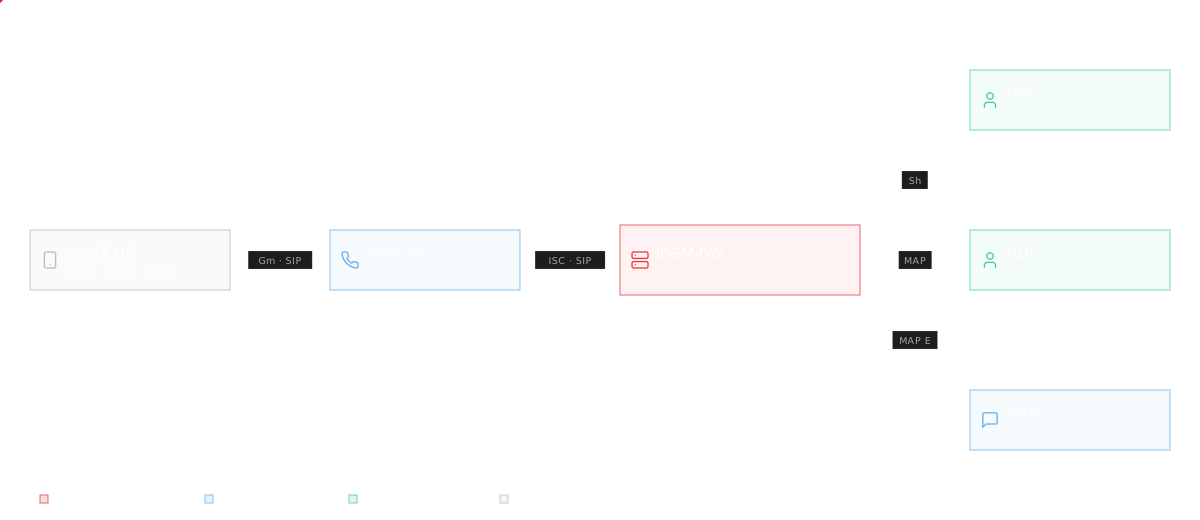
IP-SM-GW — between the IMS, the HLR/HSS and the SMSC
VoLTE/VoWiFi/VoNR day one, roaming interworking, A2P to IMS, MVNO bridges — the translation layer.
VoLTE/VoWiFi/VoNR launch — interoperability from day one
Enabling the IP-SM-GW mode on the Next-Gen Messaging Center lets IMS subscribers message legacy subscribers immediately, with no change to the experience on either side.
Roaming SMS — IMS to legacy
Subscribers on a foreign IMS network message home-network legacy subscribers. The platform handles MAP interworking at the home network, with no change required from the roaming partner.
MVNO with its own IMS core
An MVNO running its own IMS but routing SMS via the host MNO bridges IMS messaging to the host's MAP infrastructure, with no changes to the host's systems.
Retiring the legacy SMSC
In integrated mode, the same Messaging Center serves IMS and 2G/3G subscribers, so the operator replaces the IP-SM-GW and the legacy SMSC with one element.

We've selected Ouroboros because it was the best company capable of fulfilling our need for a scalable and virtualised full MVNO platform. Moreover, the Ouroboros team is pragmatic, flexible and responsive.
Pascal Prot
CEO-CTO · Legos
SIP to MAP/SS7 translation
IMS SIP MESSAGE requests translate to MAP SM-RP PDUs for delivery via the SMSC function. VoLTE subscribers message any handset on the network with no separate client or app.
Bidirectional delivery receipts
Read and delivery notifications pass both ways across the generation boundary. Subscribers on both sides see consistent message status.
Diameter subscriber lookup
Registration status is checked via Diameter Sh before routing. Messages reach the correct endpoint — IMS SIP client or legacy SMS — based on current registration.
Integrated SMS-GMSC and SMS-IWMSC
The IP-SM-GW function merges with the SMS-GMSC and SMS-IWMSC in one element. Messages between 4G and 2G/3G users take one hop instead of two, and the HLR/HSS sees fewer queries.
Charging where it belongs
SIP MO-SMS are charged on the IMS side over CAMEL or Diameter; MT retries are charged by the Messaging Center. No double charging across the generation boundary.
IPv4, IPv6 and dual-stack
Every interface runs over IPv4, IPv6 or both. The element fits an IPv6 core or a mixed network without a separate configuration.
VoLTE messaging interoperability is not optional at launch — the first IMS subscriber who sends a message needs the SIP-to-MAP bridge. Delivering it as a mode of the Next-Gen Messaging Center means operators enable a function rather than deploy and integrate another product.
The mode is available on OPEX rental, so interoperability does not have to be capitalised before VoLTE revenue arrives.

Give us your IMS vendor, current SMSC, and VoLTE launch date, and we'll confirm how the IP-SM-GW mode of the Next-Gen Messaging Center fits your network.
 Product datasheet
4G / LTE · 4G/LTE
IP-SMS Gateway (IP-SM-GW)
The IP-SM-GW is a sub mode of Next-Gen Messaging Center — the function that lets an IMS subscriber on SIP exchange messages with a 2G/3G handset on MAP. Turn it on, and VoLTE messaging works from day one.
A mode of the Next-Gen Messaging Center · In production since 2014
What breaks on VoLTE, VoWiFi and VoNR launch day
When you launch VoLTE, VoWiFi or VoNR, IMS-registered subscribers send messages over SIP. Legacy 2G/3G subscribers and external systems use MAP. The two protocols do not understand each other.
An IMS subscriber sending an SMS to a legacy handset fails silently if nothing translates between SIP and MAP. At launch this affects most of the network — every message to a contact not yet on LTE.
SIP on one side. MAP on the other.
Two protocols, one boundary
The IP-SM-GW is a sub function of the Ouroboros Next-Gen Messaging Center in a standalone product.
Translate, deliver, route back
When a VoWiFi or VoLTE subscriber sends a message, the platform receives it over SIP, converts it to the SMS CS format, and delivers it over MAP to the legacy SMSC in real time. Messages from those subscribers route back to the IMS subscriber's SIP client. The translation is invisible to both ends — neither subscriber knows the other is on a different generation. Delivery and read receipts pass in both directions.
Classical or integrated mode
In classical mode, the IP-SM-GW registers the IMS subscribers in the HLR/HSS and relays SMS to the operator's existing SMSC. In integrated mode, the Messaging Center also performs the SMS-GMSC and SMS-IWMSC functions: 4G SMS become 3G SMS and back in one element, without an extra hop, with fewer messages and less load on the HLR/HSS. On the IMS side, only SIP MO-SMS trigger billing; on the 2G/3G side, the Messaging Center charges as it handles the retries.
IP-SM-GW — between the IMS, the HLR/HSS and the SMSC
How operators use it.
VoLTE/VoWiFi/VoNR day one, roaming interworking, A2P to IMS, MVNO bridges — the translation layer.
VoLTE/VoWiFi/VoNR launch — interoperability from day one
Enabling the IP-SM-GW mode on the Next-Gen Messaging Center lets IMS subscribers message legacy subscribers immediately, with no change to the experience on either side.
Roaming SMS — IMS to legacy
Subscribers on a foreign IMS network message home-network legacy subscribers. The platform handles MAP interworking at the home network, with no change required from the roaming partner.
MVNO with its own IMS core
An MVNO running its own IMS but routing SMS via the host MNO bridges IMS messaging to the host's MAP infrastructure, with no changes to the host's systems.
Retiring the legacy SMSC
In integrated mode, the same Messaging Center serves IMS and 2G/3G subscribers, so the operator replaces the IP-SM-GW and the legacy SMSC with one element.
Specifications.
Inside the platform.
SIP to MAP/SS7 translation
IMS SIP MESSAGE requests translate to MAP SM-RP PDUs for delivery via the SMSC function. VoLTE subscribers message any handset on the network with no separate client or app.
Bidirectional delivery receipts
Read and delivery notifications pass both ways across the generation boundary. Subscribers on both sides see consistent message status.
Diameter subscriber lookup
Registration status is checked via Diameter Sh before routing. Messages reach the correct endpoint — IMS SIP client or legacy SMS — based on current registration.
Integrated SMS-GMSC and SMS-IWMSC
The IP-SM-GW function merges with the SMS-GMSC and SMS-IWMSC in one element. Messages between 4G and 2G/3G users take one hop instead of two, and the HLR/HSS sees fewer queries.
Charging where it belongs
SIP MO-SMS are charged on the IMS side over CAMEL or Diameter; MT retries are charged by the Messaging Center. No double charging across the generation boundary.
IPv4, IPv6 and dual-stack
Every interface runs over IPv4, IPv6 or both. The element fits an IPv6 core or a mixed network without a separate configuration.
VoLTE messaging interoperability is not optional at launch — the first IMS subscriber who sends a message needs the SIP-to-MAP bridge. Delivering it as a mode of the Next-Gen Messaging Center means operators enable a function rather than deploy and integrate another product.
The mode is available on OPEX rental, so interoperability does not have to be capitalised before VoLTE revenue arrives.
Next-Gen SMSC
The messaging platform the IP-SM-GW runs on. Handles SMS-MO/MT, USSD, and SMPP across 2G to 5G.
HSS
The IP-SM-GW checks IMS registration status against the HSS over Sh.
HLR
The IP-SM-GW registers IMS subscribers and gets SMS routing information from the HLR over MAP.
IMS Core
The S-CSCF hands SIP messages to the IP-SM-GW.
Next step
Launching VoLTE, VoWiFi or VoNR and need SMS interoperability from day one?
Give us your IMS vendor, current SMSC, and VoLTE launch date, and we'll confirm how the IP-SM-GW mode of the Next-Gen Messaging Center fits your network.