- 01Virtualised Evolved Packet CorevEPC
- 02Home Subscriber ServerHSS
- 03Packet Data Network GatewayPDN-GW
- 04Diameter Routing AgentDRA
- 05Equipment Identity RegisterEIR
- 06Policy and Charging Rules FunctionPCRF
- 07Messaging CenterSMSC
- 08IP-SMS GatewayIP-SM-GW
- 09Gateway Mobile Location CentreGMLC
- 10IMS Core with TAS and MRFIMS
- 11Access Network Discovery and Selection FunctionANDSF
- 12Cell Broadcast CentreCBC
Without policy enforcement, every subscriber on the network gets the same bearer treatment. You cannot honour tiered data plans, protect emergency traffic, or enforce parental controls. The PCRF is where those decisions are made, at the packet level, in real time.
An LTE network without policy enforcement treats all data traffic identically. Video streaming, emergency services calls, messaging, and background app updates compete for the same bearer resources. Congestion hits indiscriminately. Premium subscribers experience the same degradation as basic-tier users.
Operators in this position cannot monetise higher-tier plans with confidence, cannot protect emergency traffic during peak load, and cannot comply with content filtering regulations at the session level. Every data plan commitment made commercially becomes difficult to honour technically.

Every session needs a decision
Every data session on an LTE network needs a decision: which bearer class does this subscriber get, how much bandwidth, what happens if the network is congested? In a network without a PCRF, those decisions are static — configured once per APN, applied uniformly. In a network with a PCRF, those decisions are dynamic, per-subscriber, and per-session.
Profile, session, network state
The Ouroboros PCRF sits at the intersection of the subscriber profile, the active session, and the current network state. It coordinates QoS between the Evolved Packet Core and external data networks, determining in real time how each packet flow is accounted, shaped, and prioritised.
Bearers managed per session
Bearer resources are managed per session. When a subscriber starts a video stream, the PCRF applies the correct QoS class for that subscriber's data plan — guaranteed bitrate for premium tiers, best-effort for basic. Emergency services traffic receives absolute priority regardless of congestion state. Parental control policies enforce at the session level, not at the network edge.
Rules, applications and 5G SA
Rules combine IP flow characteristics, URL signatures, ports, calendar, AVP content, quota usage, and applications detected by the Ouroboros DPI option (start and stop). Their actions set QoS (QoS class, maximum and guaranteed bitrate), gating (blocking, redirection), event reporting and charging control, so an application can be blocked or charged on its own rating group. The integrated Application Server extends this logic to value-added services: zero-rating for specific content, social network subscriptions, and TV-on-mobile packages. The same element is the PCF of the 5G Standalone core: N7 session policy, N15 access and mobility policy with URSP, and N5 application functions, with the same rules and the same subscriber data.
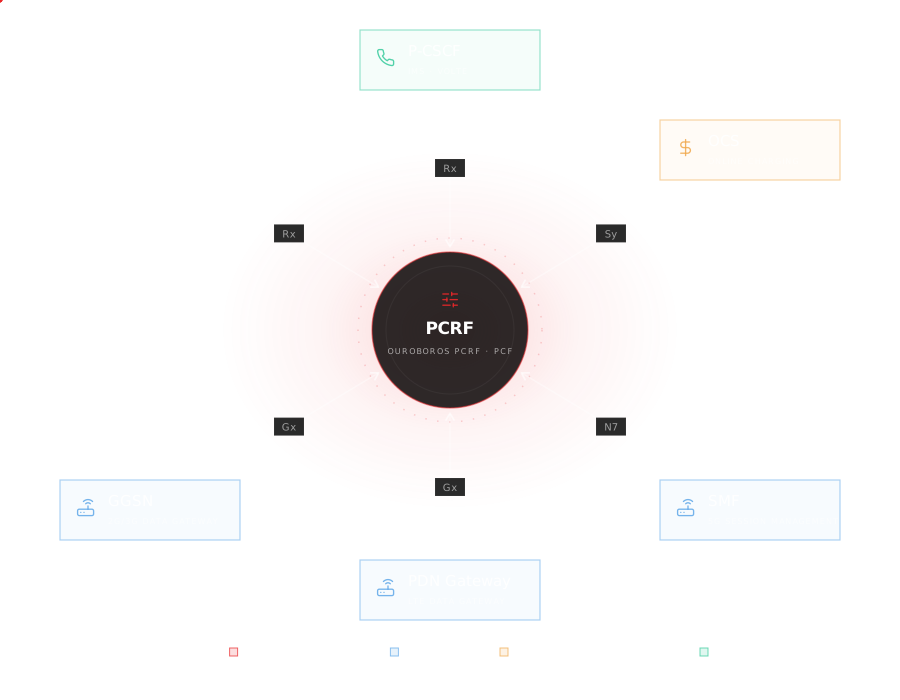
PCRF — policy control between the service layer and the gateways
Tiered plans, emergency priority, parental controls, zero-rating, congestion — one policy engine.
Tiered data plan enforcement
Operators offering basic, standard, and premium data plans enforce per-subscriber QoS at the bearer level. Plan changes take effect at next session creation without network downtime or manual intervention.
Emergency services prioritisation
Regulatory requirements in many markets mandate absolute priority for emergency bearers during congestion. The PCRF allocates dedicated bearer resources immediately on emergency session request, preempting lower-priority traffic if necessary.
Parental controls and content filtering
Operators with regulatory or commercial content obligations enforce category filters at the session level. Filtering policy triggers on subscriber attach based on age verification status held in the subscriber profile.
Zero-rating and commercial data offers
Zero-rated data for specific apps or social networks is configured as policy rules, not per-packet manual configuration. The PCRF identifies traffic by application and applies the rule without touching PDN-GW configuration.
Fair usage and congestion management
A bandwidth cap is set per billing cycle. Beyond it, the subscriber keeps browsing at a reduced rate, for example 64 or 128 kbit/s, until the next billing date. During peak load, background traffic is deprioritised and real-time services keep their QoS class.
Restricted business control
On the same principle as parental control, a company limits Internet access on its business phones outside working hours and at weekends, cutting hidden costs on the phone bill.
Roaming pass
A roaming subscriber buys a pass that caps data volume for a given period. The subscriber consumes at a flat rate instead of costly usage, and the operator keeps the customer.

Ouroboros is more agile and flexible than bigger ones. Its prices are competitive. The genuine expertise of the team enables a true dialogue with our partners.
Frédéric Maro
VP Network & Advanced Projects · Sierra Wireless
Per-subscriber QoS enforcement
Bearer class, guaranteed bitrate, and throttling rules apply at the individual subscriber session level. Tiered data plan commitments are met technically, not just commercially.
Integrated Application Server
Value-added service logic runs within the PCRF. No separate AS deployment required. Zero-rating, content subscriptions, and parental control deploy as policy rules, not network re-architecture.
Emergency bearer prioritisation
Emergency sessions receive absolute priority and dedicated bearer allocation immediately. Regulatory obligations for emergency service quality are met automatically during peak congestion.
PCRF and PCF in one element
The same element acts as PCF in 5G Standalone deployments over N7, N15 and N5, with URSP rules for the devices. 4G and 5G sessions share the same rules and subscriber data, and an IMS Rx session also applies to a 5G PDU session. Operators moving to 5G SA extend the PCRF rather than replace it.
Real-time congestion response
Congestion-triggered policies apply to active sessions within the current bearer lifetime. Network quality is protected during peak load without manual intervention.
Application detection and control
With the Ouroboros DPI option, the PCRF receives application start and stop events and applies rules per application: block, prioritise, or charge on a dedicated rating group. Zero-rating and application bundles deploy as policy rules.
Third-party OCS integration
Online Charging System interactions via the Sy interface allow external charging systems to influence policy decisions in real time. Operators running third-party OCS platforms keep their charging stack and gain Ouroboros policy control.
IPv4, IPv6 and dual-stack
Every interface runs over IPv4, IPv6 or both. The element fits an IPv6 core or a mixed network without a separate configuration.
Policy and bearer management are not optional in an LTE network that sells tiered plans. The Ouroboros PCRF delivers that capability per-subscriber, per-session, and in real time, with the PCF for 5G SA in the same element.
The integrated Application Server removes a standalone deployment for zero-rating and content services. Operators deploying commercial data offers configure them as policy rules, not separate systems. The platform has been in production since 2004, on networks including Sierra Wireless.
OPEX rental is available. For operators who cannot justify PCRF capital expenditure before subscriber-funded data revenue is established, cost scales with the network.

Walk us through your data plan structure, subscriber count, and 5G timeline. We'll map the PCRF deployment to your network and confirm what the 5G SA PCF extension covers.
 Product datasheet
4G / LTE · 4G/LTE
Policy and Charging Rules Function (PCRF)
Without policy enforcement, every subscriber on the network gets the same bearer treatment. You cannot honour tiered data plans, protect emergency traffic, or enforce parental controls. The PCRF is where those decisions are made, at the packet level, in real time.
In production since 2019 · 99.999% availability
An LTE network that treats all traffic the same
An LTE network without policy enforcement treats all data traffic identically. Video streaming, emergency services calls, messaging, and background app updates compete for the same bearer resources. Congestion hits indiscriminately. Premium subscribers experience the same degradation as basic-tier users.
Operators in this position cannot monetise higher-tier plans with confidence, cannot protect emergency traffic during peak load, and cannot comply with content filtering regulations at the session level. Every data plan commitment made commercially becomes difficult to honour technically.
Policy at the packet level, in real time.
Every session needs a decision
Every data session on an LTE network needs a decision: which bearer class does this subscriber get, how much bandwidth, what happens if the network is congested? In a network without a PCRF, those decisions are static — configured once per APN, applied uniformly. In a network with a PCRF, those decisions are dynamic, per-subscriber, and per-session.
Profile, session, network state
The Ouroboros PCRF sits at the intersection of the subscriber profile, the active session, and the current network state. It coordinates QoS between the Evolved Packet Core and external data networks, determining in real time how each packet flow is accounted, shaped, and prioritised.
Bearers managed per session
Bearer resources are managed per session. When a subscriber starts a video stream, the PCRF applies the correct QoS class for that subscriber's data plan — guaranteed bitrate for premium tiers, best-effort for basic. Emergency services traffic receives absolute priority regardless of congestion state. Parental control policies enforce at the session level, not at the network edge.
Rules, applications and 5G SA
Rules combine IP flow characteristics, URL signatures, ports, calendar, AVP content, quota usage, and applications detected by the Ouroboros DPI option (start and stop). Their actions set QoS (QoS class, maximum and guaranteed bitrate), gating (blocking, redirection), event reporting and charging control, so an application can be blocked or charged on its own rating group. The integrated Application Server extends this logic to value-added services: zero-rating for specific content, social network subscriptions, and TV-on-mobile packages. The same element is the PCF of the 5G Standalone core: N7 session policy, N15 access and mobility policy with URSP, and N5 application functions, with the same rules and the same subscriber data.
PCRF — policy control between the service layer and the gateways
How operators use it.
Tiered plans, emergency priority, parental controls, zero-rating, congestion — one policy engine.
Tiered data plan enforcement
Operators offering basic, standard, and premium data plans enforce per-subscriber QoS at the bearer level. Plan changes take effect at next session creation without network downtime or manual intervention.
Emergency services prioritisation
Regulatory requirements in many markets mandate absolute priority for emergency bearers during congestion. The PCRF allocates dedicated bearer resources immediately on emergency session request, preempting lower-priority traffic if necessary.
Parental controls and content filtering
Operators with regulatory or commercial content obligations enforce category filters at the session level. Filtering policy triggers on subscriber attach based on age verification status held in the subscriber profile.
Zero-rating and commercial data offers
Zero-rated data for specific apps or social networks is configured as policy rules, not per-packet manual configuration. The PCRF identifies traffic by application and applies the rule without touching PDN-GW configuration.
Fair usage and congestion management
A bandwidth cap is set per billing cycle. Beyond it, the subscriber keeps browsing at a reduced rate, for example 64 or 128 kbit/s, until the next billing date. During peak load, background traffic is deprioritised and real-time services keep their QoS class.
Restricted business control
On the same principle as parental control, a company limits Internet access on its business phones outside working hours and at weekends, cutting hidden costs on the phone bill.
Roaming pass
A roaming subscriber buys a pass that caps data volume for a given period. The subscriber consumes at a flat rate instead of costly usage, and the operator keeps the customer.
“Ouroboros is more agile and flexible than bigger ones. Its prices are competitive. The genuine expertise of the team enables a true dialogue with our partners.”
Frédéric Maro
VP Network & Advanced Projects · Sierra Wireless
Specifications.
Inside the platform.
Per-subscriber QoS enforcement
Bearer class, guaranteed bitrate, and throttling rules apply at the individual subscriber session level. Tiered data plan commitments are met technically, not just commercially.
Integrated Application Server
Value-added service logic runs within the PCRF. No separate AS deployment required. Zero-rating, content subscriptions, and parental control deploy as policy rules, not network re-architecture.
Emergency bearer prioritisation
Emergency sessions receive absolute priority and dedicated bearer allocation immediately. Regulatory obligations for emergency service quality are met automatically during peak congestion.
PCRF and PCF in one element
The same element acts as PCF in 5G Standalone deployments over N7, N15 and N5, with URSP rules for the devices. 4G and 5G sessions share the same rules and subscriber data, and an IMS Rx session also applies to a 5G PDU session. Operators moving to 5G SA extend the PCRF rather than replace it.
Real-time congestion response
Congestion-triggered policies apply to active sessions within the current bearer lifetime. Network quality is protected during peak load without manual intervention.
Application detection and control
With the Ouroboros DPI option, the PCRF receives application start and stop events and applies rules per application: block, prioritise, or charge on a dedicated rating group. Zero-rating and application bundles deploy as policy rules.
Third-party OCS integration
Online Charging System interactions via the Sy interface allow external charging systems to influence policy decisions in real time. Operators running third-party OCS platforms keep their charging stack and gain Ouroboros policy control.
IPv4, IPv6 and dual-stack
Every interface runs over IPv4, IPv6 or both. The element fits an IPv6 core or a mixed network without a separate configuration.
Policy and bearer management are not optional in an LTE network that sells tiered plans. The Ouroboros PCRF delivers that capability per-subscriber, per-session, and in real time, with the PCF for 5G SA in the same element.
The integrated Application Server removes a standalone deployment for zero-rating and content services. Operators deploying commercial data offers configure them as policy rules, not separate systems. The platform has been in production since 2004, on networks including Sierra Wireless.
OPEX rental is available. For operators who cannot justify PCRF capital expenditure before subscriber-funded data revenue is established, cost scales with the network.
vEPC (MME/SGW/PGW)
The PGW enforces PCRF-issued charging rules via the Gx interface. The two are designed to deploy together.
PDN-GW
The PDN-GW acts as the Policy and Charging Enforcement Function (PCEF). PCRF rules apply at the packet level through the PDN-GW.
HSS
Subscriber profile data in the HSS informs PCRF policy decisions: plan tier, parental control status, and roaming restrictions.
Policy Control Function (PCF)
The 5G SA side of the same element: N7, N15, N5 and URSP.
Next step
Selling tiered data plans without per-subscriber QoS enforcement?
Walk us through your data plan structure, subscriber count, and 5G timeline. We'll map the PCRF deployment to your network and confirm what the 5G SA PCF extension covers.