- 01Access and Mobility Management FunctionAMF
- 02Unified Data ManagementUDM
- 03Policy Control FunctionPCF
- 04Network Repository FunctionNRF
- 05Non-3GPP Interworking FunctionN3IWF
- 06Security Edge Protection ProxySEPP
- 07Network Slice Selection FunctionNSSF
- 08Service Communication ProxySCP
- 09Application FunctionAF
- 10Location Management FunctionLMF
- 11Cell Broadcast CentreCBCF
- 12Gateway Mobile Location CentreGMLC
- 13Session Management FunctionSMF
- 14User Plane FunctionUPF
- 15SMS FunctionSMSF
- 16Equipment Identity RegisterEIR
Every 5G data packet a subscriber sends or receives passes through the UPF. It forwards traffic, enforces QoS, and connects the network to external data networks. Place it centrally and latency suffers. Place it at the edge and latency-sensitive applications work. The UPF is where that decision is made.
In 5G Standalone, the data plane is a separate network function: the UPF. It forwards every packet, applies QoS, and provides the connection to external data networks. Where it sits determines the round-trip latency a subscriber experiences.
A centralised data plane works for general internet traffic. It does not work for the applications operators want 5G to enable: industrial automation, AR, low-latency edge compute. Those need the UPF distributed to the edge, close to the radio. A data-plane function that cannot be placed and scaled independently of the control plane forces a trade-off between architecture and deployment cost.

gNB sends traffic — UPF anchors the data path
The UPF is the anchor point for the data path in a 5G SA network. It receives traffic from the gNB over N3 (GTP-U with the PDU session container), forwards it to the internet or to private LANs over N6, and applies the rules programmed by the SMF over N4 using PFCP: QoS flows identified by their QFI, maximum bit rates, gating decided by the PCF. It buffers downlink data while an idle device is paged, and measures the volume per session and per rating group for converged charging.
Distributed P-Gateway: place the UPF at the edge
The Ouroboros UPF is the data-plane half of the gateway that runs as GGSN for 2G/3G and PDN-GW for LTE, and it still serves the 4G network as PGW-U and SGW-U. It runs on the same host as the SMF or on separate hosts, close to the antennas or centralised. Operators deploy UPF instances at the edge for low-latency traffic and centrally for general data, all controlled by one SMF, with up to 40 Gbps per instance.
QoS, charging, and application control — enforced in the data plane
IPv4, IPv6 and dual-stack PDU sessions are supported natively. With the DPI option, the UPF recognises applications — by traffic analysis, TLS and QUIC server names, and DNS — to block them or charge them on their own rating group. With the Lawful Interception option, it duplicates the content of the targets' sessions toward the mediation.
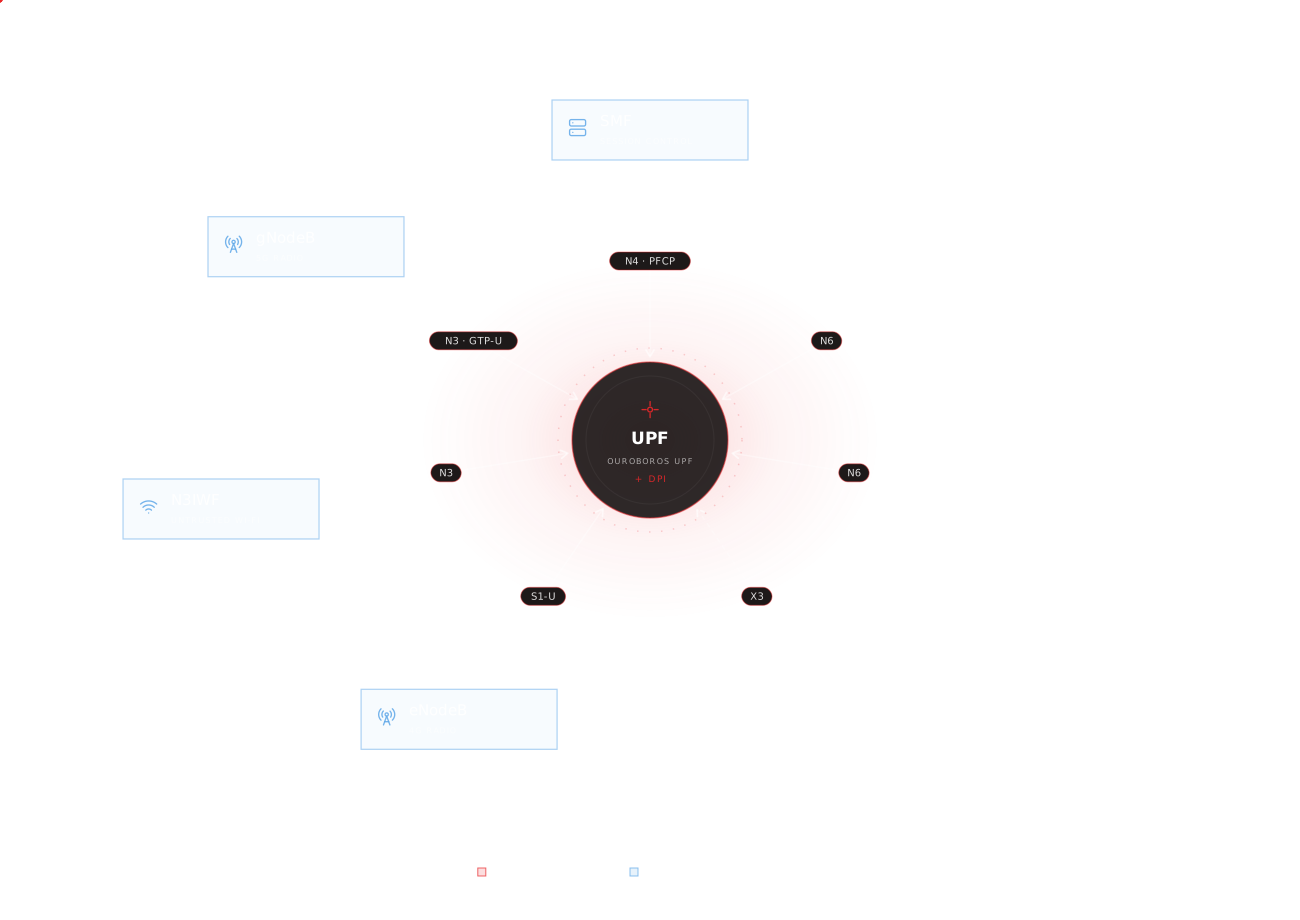
UPF — 5G and 4G user plane, edge or central
Edge compute, national data, private 5G, network slicing — the data plane that moves with the traffic.
Edge compute and low-latency applications
The UPF deploys at the network edge, close to the gNB, so traffic for latency-sensitive applications breaks out locally instead of routing to a central site. Round-trip latency drops without changing the control plane.
National 5G data access
Centrally deployed UPF instances carry general subscriber data traffic to the internet and external networks, with per-session QoS applied from SMF policy.
Private 5G with local breakout
A campus, port, or industrial private 5G network runs the UPF on-site so operational traffic stays local. Production data does not leave the facility, and latency is controlled locally.
Network slicing
Dedicated UPF instances carry the traffic for specific slices, isolating an enterprise or IoT slice's data path from consumer traffic.
Application-based offers
With the DPI option, the operator blocks applications or charges them separately — a zero-rated messaging app, a video pass — directly in the data path.

We've selected Ouroboros because it was the best company capable of fulfilling our need for a scalable and virtualised full MVNO platform. Moreover, the Ouroboros team is pragmatic, flexible and responsive.
Pascal Prot
CEO-CTO · Legos
Distributed edge deployment
UPF instances place the data plane close to the gNB, with the SMF controlling each over N4. Latency-sensitive traffic breaks out at the edge while general traffic routes centrally. One control plane manages both.
Data-plane continuity from PGW to UPF
The same platform that runs GGSN and PDN-GW provides the UPF data plane in 5G SA. The move to 5G extends the existing gateway rather than introducing a separate data core.
N4 control by the SMF
Forwarding, QoS, and charging rules are programmed by the SMF over PFCP. Data-plane capacity scales independently. Add UPF nodes without reconfiguring the control plane.
Local breakout
Selected traffic routes to a local data network without backhaul to a central site. Private and edge deployments keep operational traffic local, cutting latency and backhaul load.
Per-session QoS enforcement
QoS rules apply at the packet level per PDU session. Slice and plan commitments are honoured in the data path, not just in policy.
Native IPv4 and IPv6
IPv4, IPv6 and dual-stack PDU sessions. Operators running IPv6 or mixed addressing require no separate data-plane configuration.
Usage reporting per rating group
Volume is measured per session and per rating group and reported to the SMF for converged charging.
Shared with the 4G core
The same UPF acts as SGW-U and PGW-U for the Ouroboros MME, so 4G and 5G sessions share one data plane.
The UPF only earns its place if it can sit where the traffic needs it. The Ouroboros UPF inherits the distributed P-Gateway architecture already proven in the platform's LTE data gateway, so edge placement is a deployment choice rather than a re-architecture. The control plane and the data plane scale separately, which is the entire point of the 5G split.
It is the data-plane half of the gateway that runs as GGSN and PDN-GW, so operators reaching 5G SA extend a known platform. Carrier-grade, in production since 2004, deployable on COTS, virtualised, or cloud.
OPEX rental is available, so edge UPF capacity grows with the traffic it carries.

Where are your edge sites, and what latency are you targeting? We'll map a UPF deployment, central and edge, controlled from one SMF.
 Product datasheet
5G Standalone · 5G Standalone
User Plane Function (UPF)
Every 5G data packet a subscriber sends or receives passes through the UPF. It forwards traffic, enforces QoS, and connects the network to external data networks. Place it centrally and latency suffers. Place it at the edge and latency-sensitive applications work. The UPF is where that decision is made.
In production since 2019 · 99.999% availability
The data plane that has to move closer to the subscriber
In 5G Standalone, the data plane is a separate network function: the UPF. It forwards every packet, applies QoS, and provides the connection to external data networks. Where it sits determines the round-trip latency a subscriber experiences.
A centralised data plane works for general internet traffic. It does not work for the applications operators want 5G to enable: industrial automation, AR, low-latency edge compute. Those need the UPF distributed to the edge, close to the radio. A data-plane function that cannot be placed and scaled independently of the control plane forces a trade-off between architecture and deployment cost.
Data where it needs to be. Edge or core, one control plane.
gNB sends traffic — UPF anchors the data path
The UPF is the anchor point for the data path in a 5G SA network. It receives traffic from the gNB over N3 (GTP-U with the PDU session container), forwards it to the internet or to private LANs over N6, and applies the rules programmed by the SMF over N4 using PFCP: QoS flows identified by their QFI, maximum bit rates, gating decided by the PCF. It buffers downlink data while an idle device is paged, and measures the volume per session and per rating group for converged charging.
Distributed P-Gateway: place the UPF at the edge
The Ouroboros UPF is the data-plane half of the gateway that runs as GGSN for 2G/3G and PDN-GW for LTE, and it still serves the 4G network as PGW-U and SGW-U. It runs on the same host as the SMF or on separate hosts, close to the antennas or centralised. Operators deploy UPF instances at the edge for low-latency traffic and centrally for general data, all controlled by one SMF, with up to 40 Gbps per instance.
QoS, charging, and application control — enforced in the data plane
IPv4, IPv6 and dual-stack PDU sessions are supported natively. With the DPI option, the UPF recognises applications — by traffic analysis, TLS and QUIC server names, and DNS — to block them or charge them on their own rating group. With the Lawful Interception option, it duplicates the content of the targets' sessions toward the mediation.
UPF — 5G and 4G user plane, edge or central
How operators use it.
Edge compute, national data, private 5G, network slicing — the data plane that moves with the traffic.
Edge compute and low-latency applications
The UPF deploys at the network edge, close to the gNB, so traffic for latency-sensitive applications breaks out locally instead of routing to a central site. Round-trip latency drops without changing the control plane.
National 5G data access
Centrally deployed UPF instances carry general subscriber data traffic to the internet and external networks, with per-session QoS applied from SMF policy.
Private 5G with local breakout
A campus, port, or industrial private 5G network runs the UPF on-site so operational traffic stays local. Production data does not leave the facility, and latency is controlled locally.
Network slicing
Dedicated UPF instances carry the traffic for specific slices, isolating an enterprise or IoT slice's data path from consumer traffic.
Application-based offers
With the DPI option, the operator blocks applications or charges them separately — a zero-rated messaging app, a video pass — directly in the data path.
Specifications.
Inside the platform.
Distributed edge deployment
UPF instances place the data plane close to the gNB, with the SMF controlling each over N4. Latency-sensitive traffic breaks out at the edge while general traffic routes centrally. One control plane manages both.
Data-plane continuity from PGW to UPF
The same platform that runs GGSN and PDN-GW provides the UPF data plane in 5G SA. The move to 5G extends the existing gateway rather than introducing a separate data core.
N4 control by the SMF
Forwarding, QoS, and charging rules are programmed by the SMF over PFCP. Data-plane capacity scales independently. Add UPF nodes without reconfiguring the control plane.
Local breakout
Selected traffic routes to a local data network without backhaul to a central site. Private and edge deployments keep operational traffic local, cutting latency and backhaul load.
Per-session QoS enforcement
QoS rules apply at the packet level per PDU session. Slice and plan commitments are honoured in the data path, not just in policy.
Native IPv4 and IPv6
IPv4, IPv6 and dual-stack PDU sessions. Operators running IPv6 or mixed addressing require no separate data-plane configuration.
Usage reporting per rating group
Volume is measured per session and per rating group and reported to the SMF for converged charging.
Shared with the 4G core
The same UPF acts as SGW-U and PGW-U for the Ouroboros MME, so 4G and 5G sessions share one data plane.
The UPF only earns its place if it can sit where the traffic needs it. The Ouroboros UPF inherits the distributed P-Gateway architecture already proven in the platform's LTE data gateway, so edge placement is a deployment choice rather than a re-architecture. The control plane and the data plane scale separately, which is the entire point of the 5G split.
It is the data-plane half of the gateway that runs as GGSN and PDN-GW, so operators reaching 5G SA extend a known platform. Carrier-grade, in production since 2004, deployable on COTS, virtualised, or cloud.
OPEX rental is available, so edge UPF capacity grows with the traffic it carries.
Session Management Function (SMF)
The SMF controls the UPF over N4. Together they are the 5G SA data core: control plane in the SMF, data plane in the UPF.
PDN-GW
The LTE PGW is the predecessor of the SMF/UPF split. The distributed P-Gateway architecture carries forward into the UPF.
PCF
Issues the policy and the application rules the SMF programs onto the UPF.
CHF
Charges the usage reported by the UPF per rating group.
Next step
Need the 5G data plane at the edge, not just in the core?
Where are your edge sites, and what latency are you targeting? We'll map a UPF deployment, central and edge, controlled from one SMF.