Smishing campaigns adapt faster than static blocklists. A spoofed bank sender, a shortened URL, a burst of identical messages from one source — each is a signal your SMSC was never built to inspect. The Ouroboros SMS Firewall sits inline on the messaging path, scores every message, and blocks phishing before it reaches the subscriber.
Phishing over SMS — smishing — now drives a large share of mobile fraud: fake delivery notices, spoofed bank alerts, fraudulent prize claims, each carrying a link or a callback number designed to harvest credentials or money. The attack surface is the message itself, and it changes constantly. Sender IDs are spoofed, URLs are shortened and rotated, message text is reworded to dodge fixed-string filters, and high-volume bursts are timed to slip through before anyone notices.
A traditional SMSC routes and delivers. It does not inspect. And a filter built on static keyword lists alone ages out the moment attackers paraphrase their message.
What is needed is a dedicated firewall on the messaging path: one that combines deterministic rules an operator can audit — keywords, senders, URLs, rate limits — with an AI model that catches the variants the rules have not seen yet.

The SMSC asks the firewall before delivering
Every message — peer-to-peer (P2P) from the MSC or the IMS, application-to-person (A2P) from the ESMEs, SMS-MT from foreign SMSCs — reaches the SMSC, which submits it to the Ouroboros AI Anti-Smishing Firewall over HTTP and waits for the verdict before delivering it to the subscriber. The firewall is a dedicated product beside the SMSC — the Ouroboros Messaging Center or any SMSC able to call an HTTP service — so messaging and security run and scale as separate systems.
Layered detection runs: keyword, URL, sender, rate, and AI scoring
Each message is evaluated against layered detection:
- Keyword and pattern filtering — configurable rules match on words, phrases, regular expressions, and language-specific lexicons. Operators maintain their own lists; rules update live without platform downtime.
- URL and link analysis — links are extracted and checked, including shortened and obfuscated URLs, against reputation lists and structural heuristics typical of phishing pages.
- Sender and source reputation — spoofed or mismatched sender IDs, grey-route origins, and known-bad source addresses are flagged or blocked. White and black lists of up to 150 000 numbers each, with wildcards and longest match, cover calling and called parties, for anti-fraud or closed user groups.
- Message attributes — MSC of origin, data coding scheme, user data header, number of parts and protocol kind feed the same rules, so binary or concatenated abuse is caught as well as plain text.
- Rate and volume control (throttling) — per-sender, per-source, and per-destination rate limits catch burst campaigns and A2P abuse. Thresholds trigger throttle, quarantine, or block.
- AI smishing scoring — a model scores each message on intent and structure, catching reworded and novel campaigns that static rules miss. The score feeds the same decision engine as the deterministic rules.
Decision engine acts — allow, throttle, quarantine, or block
A single decision engine combines these signals into an action: allow, throttle, quarantine, or block. Because deterministic rules and the AI score share one engine, operators keep auditable control — a regulator can be shown exactly which rule blocked a message — while the model handles the variants no list anticipated.
Verdict logged for regulatory evidence and campaign analytics
Verdicts, blocked-message counts, and campaign patterns are logged for reporting and regulatory evidence. Filtering rules and model thresholds update without taking the messaging path down.
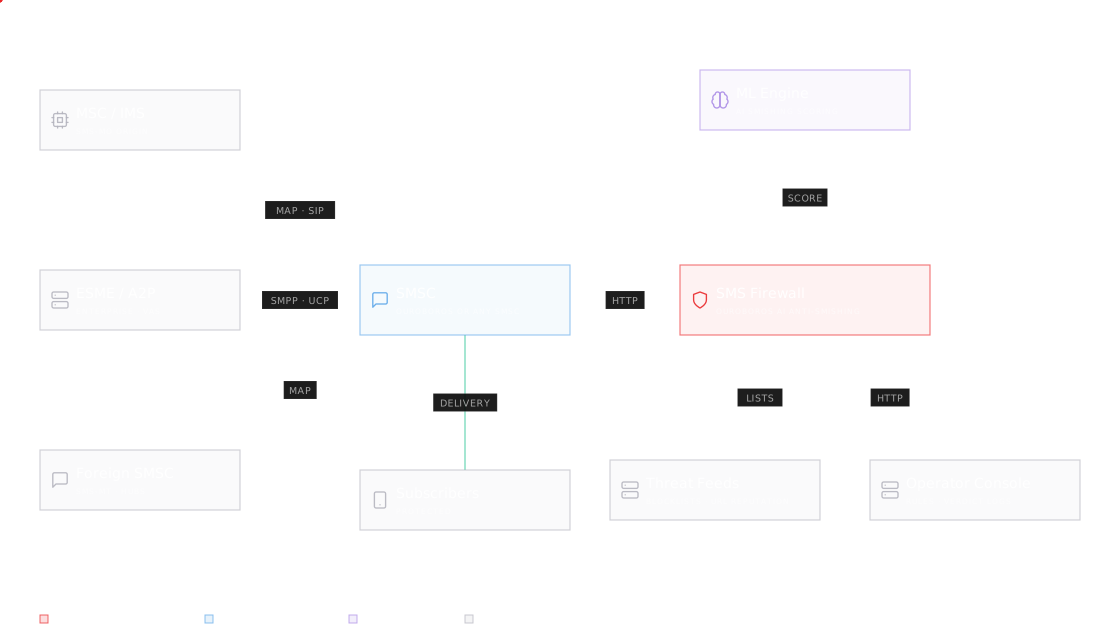
AI Anti-Smishing Firewall — consulted by the SMSC over HTTP for every message
Real-time smishing blocking, keyword enforcement, rate-based control, A2P protection, and regulatory compliance — one inline firewall for all messaging traffic.
Real-time smishing blocking
Phishing SMS carrying spoofed bank alerts, fake delivery links, or fraudulent prize claims are scored and blocked inline before delivery. The AI model catches reworded variants of an active campaign without waiting for a new keyword rule.
Keyword and pattern enforcement
Operators and regulators define keyword, phrase, and regex rules — for prohibited content, scam lexicons, or brand-impersonation terms. Rules are auditable and update live, so a new campaign can be countered in minutes without downtime.
Rate-based campaign control
A burst of near-identical messages from a single source is throttled or blocked by rate limits. Per-sender and per-destination thresholds contain A2P abuse and grey-route flooding before subscribers are hit.
A2P and bulk traffic protection
Enterprise and VAS traffic arriving over SMPP is inspected before delivery. Legitimate campaigns pass; spoofed sender IDs, malicious links, and volume anomalies are stopped at the firewall, protecting both subscribers and the operator's sender-ID reputation.
Regulatory anti-fraud compliance
Operators under national mandates to filter fraudulent or unsolicited SMS deploy the firewall to inspect, block, and log. Verdict logs provide the evidence trail regulators require, and rules adapt as mandates change — without platform downtime.

We've selected Ouroboros because it was the best company capable of fulfilling our need for a scalable and virtualised full MVNO platform. Moreover, the Ouroboros team is pragmatic, flexible and responsive.
Pascal Prot
CEO-CTO · Legos
Inline filtering on the messaging path
Every message is inspected in real time before delivery — not sampled, not mirrored after the fact. Phishing SMS are stopped before the subscriber ever sees them.
Keyword, phrase, and regex rules
Operators maintain auditable lists and patterns for scam lexicons, brand impersonation, and prohibited content. A new campaign can be countered in minutes, and a regulator can be shown exactly why a message was blocked.
URL and link analysis
Links — including shortened and obfuscated URLs — are extracted and checked against reputation and structural heuristics. The most common smishing payload, the malicious link, is caught even when the surrounding text changes.
Rate and volume control
Per-sender, per-source, and per-destination thresholds detect burst campaigns and A2P abuse. Flooding and grey-route campaigns are throttled or blocked before they reach scale.
AI smishing scoring
A model scores message intent and structure, catching reworded and previously unseen variants. Detection does not depend on a human writing a new rule for every paraphrase.
Standalone — deploys with any SMSC
A dedicated firewall that the messaging core consults over HTTP for every message, whether that is the Ouroboros Messaging Center or a third-party SMSC. Operators add smishing protection without replacing their SMSC, and messaging and security scale independently.
IPv4, IPv6 and dual-stack
Every interface runs over IPv4, IPv6 or both. The element fits an IPv6 core or a mixed network without a separate configuration.
The Ouroboros AI Anti-Smishing Firewall runs inline on the messaging path and scores every message in real time, adapting to new campaigns automatically — no rule-writing and no operator watching it. It is a dedicated firewall product, deployed alongside the Messaging Center rather than bolted into it, so messaging and security each scale on their own.
The combination of auditable deterministic rules — keyword, sender, URL, and rate — with an AI scoring layer is deliberate. Regulators and fraud teams need to see *why* a message was blocked; security teams need to catch the variant no rule anticipated. One decision engine gives both. Optional grey-zone handling can warn the subscriber about a suspicious message rather than blocking it outright. The OPEX rental model is available for operators who cannot justify a separate capital line item for messaging security.

Tell us your SMSC, your protocol mix, and your A2P and P2P volumes. We'll show you how the AI Anti-Smishing Firewall deploys in front of your SMSC and what it would catch on your traffic.
 Product datasheet
2G / 3G · 2G/3G Core
AI Anti-Smishing SMS Firewall
Smishing campaigns adapt faster than static blocklists. A spoofed bank sender, a shortened URL, a burst of identical messages from one source — each is a signal your SMSC was never built to inspect. The Ouroboros SMS Firewall sits inline on the messaging path, scores every message, and blocks phishing before it reaches the subscriber.
A standalone SMS firewall · In production since 2024 · 148M+ subscribers
Smishing moves faster than your blocklist
Phishing over SMS — smishing — now drives a large share of mobile fraud: fake delivery notices, spoofed bank alerts, fraudulent prize claims, each carrying a link or a callback number designed to harvest credentials or money. The attack surface is the message itself, and it changes constantly. Sender IDs are spoofed, URLs are shortened and rotated, message text is reworded to dodge fixed-string filters, and high-volume bursts are timed to slip through before anyone notices.
A traditional SMSC routes and delivers. It does not inspect. And a filter built on static keyword lists alone ages out the moment attackers paraphrase their message.
What is needed is a dedicated firewall on the messaging path: one that combines deterministic rules an operator can audit — keywords, senders, URLs, rate limits — with an AI model that catches the variants the rules have not seen yet.
Every message scored. Phishing blocked before delivery.
The SMSC asks the firewall before delivering
Every message — peer-to-peer (P2P) from the MSC or the IMS, application-to-person (A2P) from the ESMEs, SMS-MT from foreign SMSCs — reaches the SMSC, which submits it to the Ouroboros AI Anti-Smishing Firewall over HTTP and waits for the verdict before delivering it to the subscriber. The firewall is a dedicated product beside the SMSC — the Ouroboros Messaging Center or any SMSC able to call an HTTP service — so messaging and security run and scale as separate systems.
Layered detection runs: keyword, URL, sender, rate, and AI scoring
Each message is evaluated against layered detection: - Keyword and pattern filtering — configurable rules match on words, phrases, regular expressions, and language-specific lexicons. Operators maintain their own lists; rules update live without platform downtime. - URL and link analysis — links are extracted and checked, including shortened and obfuscated URLs, against reputation lists and structural heuristics typical of phishing pages. - Sender and source reputation — spoofed or mismatched sender IDs, grey-route origins, and known-bad source addresses are flagged or blocked. White and black lists of up to 150 000 numbers each, with wildcards and longest match, cover calling and called parties, for anti-fraud or closed user groups. - Message attributes — MSC of origin, data coding scheme, user data header, number of parts and protocol kind feed the same rules, so binary or concatenated abuse is caught as well as plain text. - Rate and volume control (throttling) — per-sender, per-source, and per-destination rate limits catch burst campaigns and A2P abuse. Thresholds trigger throttle, quarantine, or block. - AI smishing scoring — a model scores each message on intent and structure, catching reworded and novel campaigns that static rules miss. The score feeds the same decision engine as the deterministic rules.
Decision engine acts — allow, throttle, quarantine, or block
A single decision engine combines these signals into an action: allow, throttle, quarantine, or block. Because deterministic rules and the AI score share one engine, operators keep auditable control — a regulator can be shown exactly which rule blocked a message — while the model handles the variants no list anticipated.
Verdict logged for regulatory evidence and campaign analytics
Verdicts, blocked-message counts, and campaign patterns are logged for reporting and regulatory evidence. Filtering rules and model thresholds update without taking the messaging path down.
AI Anti-Smishing Firewall — consulted by the SMSC over HTTP for every message
How operators use it.
Real-time smishing blocking, keyword enforcement, rate-based control, A2P protection, and regulatory compliance — one inline firewall for all messaging traffic.
Real-time smishing blocking
Phishing SMS carrying spoofed bank alerts, fake delivery links, or fraudulent prize claims are scored and blocked inline before delivery. The AI model catches reworded variants of an active campaign without waiting for a new keyword rule.
Keyword and pattern enforcement
Operators and regulators define keyword, phrase, and regex rules — for prohibited content, scam lexicons, or brand-impersonation terms. Rules are auditable and update live, so a new campaign can be countered in minutes without downtime.
Rate-based campaign control
A burst of near-identical messages from a single source is throttled or blocked by rate limits. Per-sender and per-destination thresholds contain A2P abuse and grey-route flooding before subscribers are hit.
A2P and bulk traffic protection
Enterprise and VAS traffic arriving over SMPP is inspected before delivery. Legitimate campaigns pass; spoofed sender IDs, malicious links, and volume anomalies are stopped at the firewall, protecting both subscribers and the operator's sender-ID reputation.
Regulatory anti-fraud compliance
Operators under national mandates to filter fraudulent or unsolicited SMS deploy the firewall to inspect, block, and log. Verdict logs provide the evidence trail regulators require, and rules adapt as mandates change — without platform downtime.
Specifications.
Inside the platform.
Inline filtering on the messaging path
Every message is inspected in real time before delivery — not sampled, not mirrored after the fact. Phishing SMS are stopped before the subscriber ever sees them.
Keyword, phrase, and regex rules
Operators maintain auditable lists and patterns for scam lexicons, brand impersonation, and prohibited content. A new campaign can be countered in minutes, and a regulator can be shown exactly why a message was blocked.
URL and link analysis
Links — including shortened and obfuscated URLs — are extracted and checked against reputation and structural heuristics. The most common smishing payload, the malicious link, is caught even when the surrounding text changes.
Rate and volume control
Per-sender, per-source, and per-destination thresholds detect burst campaigns and A2P abuse. Flooding and grey-route campaigns are throttled or blocked before they reach scale.
AI smishing scoring
A model scores message intent and structure, catching reworded and previously unseen variants. Detection does not depend on a human writing a new rule for every paraphrase.
Standalone — deploys with any SMSC
A dedicated firewall that the messaging core consults over HTTP for every message, whether that is the Ouroboros Messaging Center or a third-party SMSC. Operators add smishing protection without replacing their SMSC, and messaging and security scale independently.
IPv4, IPv6 and dual-stack
Every interface runs over IPv4, IPv6 or both. The element fits an IPv6 core or a mixed network without a separate configuration.
The Ouroboros AI Anti-Smishing Firewall runs inline on the messaging path and scores every message in real time, adapting to new campaigns automatically — no rule-writing and no operator watching it. It is a dedicated firewall product, deployed alongside the Messaging Center rather than bolted into it, so messaging and security each scale on their own.
The combination of auditable deterministic rules — keyword, sender, URL, and rate — with an AI scoring layer is deliberate. Regulators and fraud teams need to see *why* a message was blocked; security teams need to catch the variant no rule anticipated. One decision engine gives both. Optional grey-zone handling can warn the subscriber about a suspicious message rather than blocking it outright. The OPEX rental model is available for operators who cannot justify a separate capital line item for messaging security.
Messaging Center (SMSC)
The messaging core that consults the firewall over HTTP. Handles SMS-MO/MT, IM-SIP, USSD, and SMPP across 2G to 5G; the firewall inspects every message it carries.
Next-Gen SMSC & AI Anti-Spam
The same AI anti-spam integrated in the messaging platform, for operators who prefer one system.
Next step
How much smishing is reaching your subscribers right now?
Tell us your SMSC, your protocol mix, and your A2P and P2P volumes. We'll show you how the AI Anti-Smishing Firewall deploys in front of your SMSC and what it would catch on your traffic.