Subscribers rely on USSD for balance checks, top-ups, and mobile money. When they move to VoLTE, the circuit-switched channel that carried those menus is gone. USSI keeps the same dialogs working over the IMS core, so the service does not disappear when the subscriber moves to 4G.
USSD needs no app and no data session and works on every handset, which is why operators built self-care, top-up, and mobile money on it. The transaction runs over the circuit-switched signalling path through the MSC/VLR.
A VoLTE subscriber has no circuit-switched channel. Once a subscriber is on LTE or 5G, the path that carried those dialogs is gone, and every USSD service built on it goes dark for that subscriber unless it is carried another way.

CSCF receives USSD in SIP and passes it to the USSI function
In IMS, USSD travels as a SIP packet (USSD over IMS, defined in 3GPP TS 24.390). The CSCF delivers the textual message to the USSI function in SIP. The USSI selects the right HLR, resolves the subscriber's IMSI, and routes the transaction on to the HLR, which forwards it to the legacy USSD Gateway that hosts the service.
USSD Push (network originated) from the HLR to the right CSCF
The same path runs in reverse for USSD Push. A network-originated dialog leaves the HLR and the USSI routes it to the CSCF currently serving the subscriber, which delivers it to the handset over SIP.
USSI as the USSD gateway, calling VAS over HTTP
The USSI can also act as the USSD Gateway itself, calling the right VAS directly over HTTP or SMPP rather than relaying the dialog to a separate gateway.
Three deployment architectures
The USSI fits the network the operator already has: collocated with the USSD Gateway in one platform, for greenfield IMS and simplified architectures; between the IMS and an existing USSD Gateway, to keep the gateway investment and scale each part independently; or between the IMS and the HLR, for networks with several USSD Gateways or specific HLR routing. The S-CSCF triggers the USSI through the subscriber's initial filter criteria.
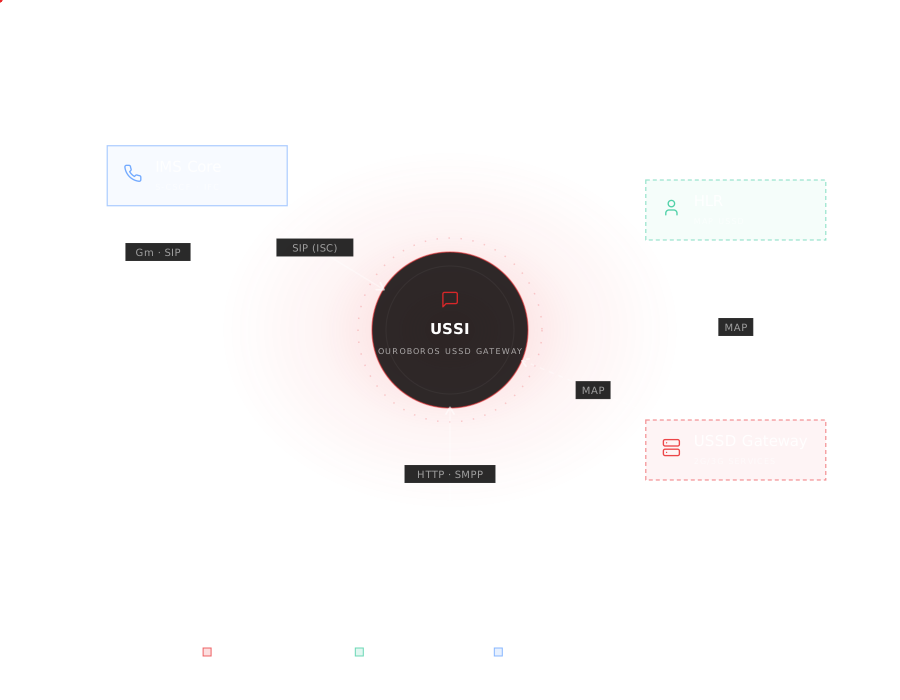
USSI — USSD over IMS between the CSCF and the USSD services
Self-care, mobile money, VAS — every USSD dialog reachable for VoLTE subscribers without a second USSD platform.
Operator self-service and account management
Prepaid balance checks, voucher top-up and recharge, data bundle purchase, tariff changes, and last-recharge or expiry queries run as menu-driven sessions. They work on any handset with no app and no data session, now including VoLTE-only subscribers.
Mobile money and financial services
Mobile money wallets — balance, send money, cash-in and cash-out, bill payment, airtime purchase — are delivered through USSD menus because they reach every handset and work without internet. USSI carries the same wallet menus to VoLTE subscribers, with no parallel implementation.
Value-added and information services
News, weather, sports scores, promotional opt-ins, contest entries, and VAS subscription management run as lightweight pull or network-initiated sessions over the same gateway.
Continuity through VoLTE migration
As subscribers move from 2G and 3G to VoLTE, their USSD services keep working, without a circuit-switched fallback kept alive only for USSD.

We've selected Ouroboros because it was the best company capable of fulfilling our need for a scalable and virtualised full MVNO platform. Moreover, the Ouroboros team is pragmatic, flexible and responsive.
Pascal Prot
CEO-CTO · Legos
SIP to MAP translation
USSD over IMS and MAP USSD map onto each other: SIP INFO carries the mid-session exchanges, and processUnstructuredSS-Request, unstructuredSS-Request and unstructuredSS-Notify run on the MAP side. Existing USSD applications work unchanged.
Stateful sessions
Each dialog keeps its context across the IMS and MAP domains, for interactive menus as well as single requests, at up to 500 000 concurrent sessions.
Network-initiated and user-initiated USSD
Pull dialogs start from the handset's short code; push dialogs from the network find the CSCF that serves the subscriber.
Flexible placement
Collocated with the USSD Gateway, between the IMS and the USSD Gateway, or between the IMS and the HLR — the architecture follows the existing network.
Multi-language menus
Menus are served in the subscriber's language, as on the 2G/3G gateway.
Carrier-grade operation
Active/standby clustering with a switch-over under 1 ms, geographic redundancy by database replication, REST, SNMP and CLI management, and CSV CDRs per session.
IPv4, IPv6 and dual-stack
Every interface runs over IPv4, IPv6 or both. The element fits an IPv6 core or a mixed network without a separate configuration.
USSD does not go away when subscribers move to 4G. Self-care, top-up, and mobile money still run through USSD dialogs, and for many subscribers they are the primary way to interact with the operator. USSI is what keeps those services reachable once the circuit-switched channel is gone.
Ouroboros handles USSI on the same USSD Gateway that already serves 2G and 3G, so operators add VoLTE and VoWiFi coverage without standing up a second USSD platform. The gateway was the first offered as a rental service, and the OPEX model lets the IMS path be added as subscribers migrate rather than ahead of them.

Tell us your IMS core, the USSD services you run, and where VoLTE migration stands. We'll confirm how USSI carries your USSD dialogs over IMS on the same gateway, on OPEX or CAPEX.
 Product datasheet
4G / LTE · 4G/LTE
USSI Gateway
Subscribers rely on USSD for balance checks, top-ups, and mobile money. When they move to VoLTE, the circuit-switched channel that carried those menus is gone. USSI keeps the same dialogs working over the IMS core, so the service does not disappear when the subscriber moves to 4G.
In production since 2024 · Deployed across 30+ countries · First USSD Gateway offered as a rental service
USSD that stops working when the subscriber moves to VoLTE
USSD needs no app and no data session and works on every handset, which is why operators built self-care, top-up, and mobile money on it. The transaction runs over the circuit-switched signalling path through the MSC/VLR.
A VoLTE subscriber has no circuit-switched channel. Once a subscriber is on LTE or 5G, the path that carried those dialogs is gone, and every USSD service built on it goes dark for that subscriber unless it is carried another way.
USSD delivered over IMS — same shortcode services, no circuit-switched channel needed.
CSCF receives USSD in SIP and passes it to the USSI function
In IMS, USSD travels as a SIP packet (USSD over IMS, defined in 3GPP TS 24.390). The CSCF delivers the textual message to the USSI function in SIP. The USSI selects the right HLR, resolves the subscriber's IMSI, and routes the transaction on to the HLR, which forwards it to the legacy USSD Gateway that hosts the service.
USSD Push (network originated) from the HLR to the right CSCF
The same path runs in reverse for USSD Push. A network-originated dialog leaves the HLR and the USSI routes it to the CSCF currently serving the subscriber, which delivers it to the handset over SIP.
USSI as the USSD gateway, calling VAS over HTTP
The USSI can also act as the USSD Gateway itself, calling the right VAS directly over HTTP or SMPP rather than relaying the dialog to a separate gateway.
Three deployment architectures
The USSI fits the network the operator already has: collocated with the USSD Gateway in one platform, for greenfield IMS and simplified architectures; between the IMS and an existing USSD Gateway, to keep the gateway investment and scale each part independently; or between the IMS and the HLR, for networks with several USSD Gateways or specific HLR routing. The S-CSCF triggers the USSI through the subscriber's initial filter criteria.
USSI — USSD over IMS between the CSCF and the USSD services
How operators use it.
Self-care, mobile money, VAS — every USSD dialog reachable for VoLTE subscribers without a second USSD platform.
Operator self-service and account management
Prepaid balance checks, voucher top-up and recharge, data bundle purchase, tariff changes, and last-recharge or expiry queries run as menu-driven sessions. They work on any handset with no app and no data session, now including VoLTE-only subscribers.
Mobile money and financial services
Mobile money wallets — balance, send money, cash-in and cash-out, bill payment, airtime purchase — are delivered through USSD menus because they reach every handset and work without internet. USSI carries the same wallet menus to VoLTE subscribers, with no parallel implementation.
Value-added and information services
News, weather, sports scores, promotional opt-ins, contest entries, and VAS subscription management run as lightweight pull or network-initiated sessions over the same gateway.
Continuity through VoLTE migration
As subscribers move from 2G and 3G to VoLTE, their USSD services keep working, without a circuit-switched fallback kept alive only for USSD.
Specifications.
Inside the platform.
SIP to MAP translation
USSD over IMS and MAP USSD map onto each other: SIP INFO carries the mid-session exchanges, and processUnstructuredSS-Request, unstructuredSS-Request and unstructuredSS-Notify run on the MAP side. Existing USSD applications work unchanged.
Stateful sessions
Each dialog keeps its context across the IMS and MAP domains, for interactive menus as well as single requests, at up to 500 000 concurrent sessions.
Network-initiated and user-initiated USSD
Pull dialogs start from the handset's short code; push dialogs from the network find the CSCF that serves the subscriber.
Flexible placement
Collocated with the USSD Gateway, between the IMS and the USSD Gateway, or between the IMS and the HLR — the architecture follows the existing network.
Multi-language menus
Menus are served in the subscriber's language, as on the 2G/3G gateway.
Carrier-grade operation
Active/standby clustering with a switch-over under 1 ms, geographic redundancy by database replication, REST, SNMP and CLI management, and CSV CDRs per session.
IPv4, IPv6 and dual-stack
Every interface runs over IPv4, IPv6 or both. The element fits an IPv6 core or a mixed network without a separate configuration.
USSD does not go away when subscribers move to 4G. Self-care, top-up, and mobile money still run through USSD dialogs, and for many subscribers they are the primary way to interact with the operator. USSI is what keeps those services reachable once the circuit-switched channel is gone.
Ouroboros handles USSI on the same USSD Gateway that already serves 2G and 3G, so operators add VoLTE and VoWiFi coverage without standing up a second USSD platform. The gateway was the first offered as a rental service, and the OPEX model lets the IMS path be added as subscribers migrate rather than ahead of them.
USSD Gateway
The same gateway serves legacy USSD over SS7 and SIGTRAN; USSI adds the IMS path for VoLTE and VoWiFi subscribers.
HLR
USSI resolves the subscriber's IMSI and routing against the HLR before delivering the session.
IMS Core
The S-CSCF triggers the USSI through the subscriber's initial filter criteria.
Next step
Moving subscribers to VoLTE and need USSD to keep working?
Tell us your IMS core, the USSD services you run, and where VoLTE migration stands. We'll confirm how USSI carries your USSD dialogs over IMS on the same gateway, on OPEX or CAPEX.